1. Why Carbon Fiber Furniture Is Not a Typical Furniture Project
Traditional furniture projects are mainly driven by form, surface finish, and assembly efficiency.
Carbon fiber furniture is fundamentally different.
A carbon fiber chair, table, or structural furniture frame is a composite structure. It must simultaneously satisfy:
- load-bearing requirements
- long-term stiffness and fatigue resistance
- connection integrity
- surface quality and cosmetic stability
- repeatable manufacturing capability
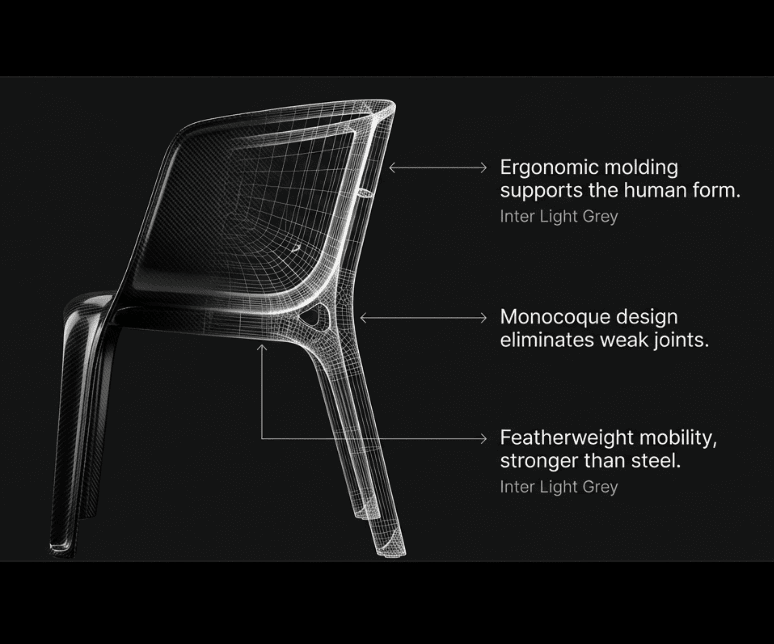
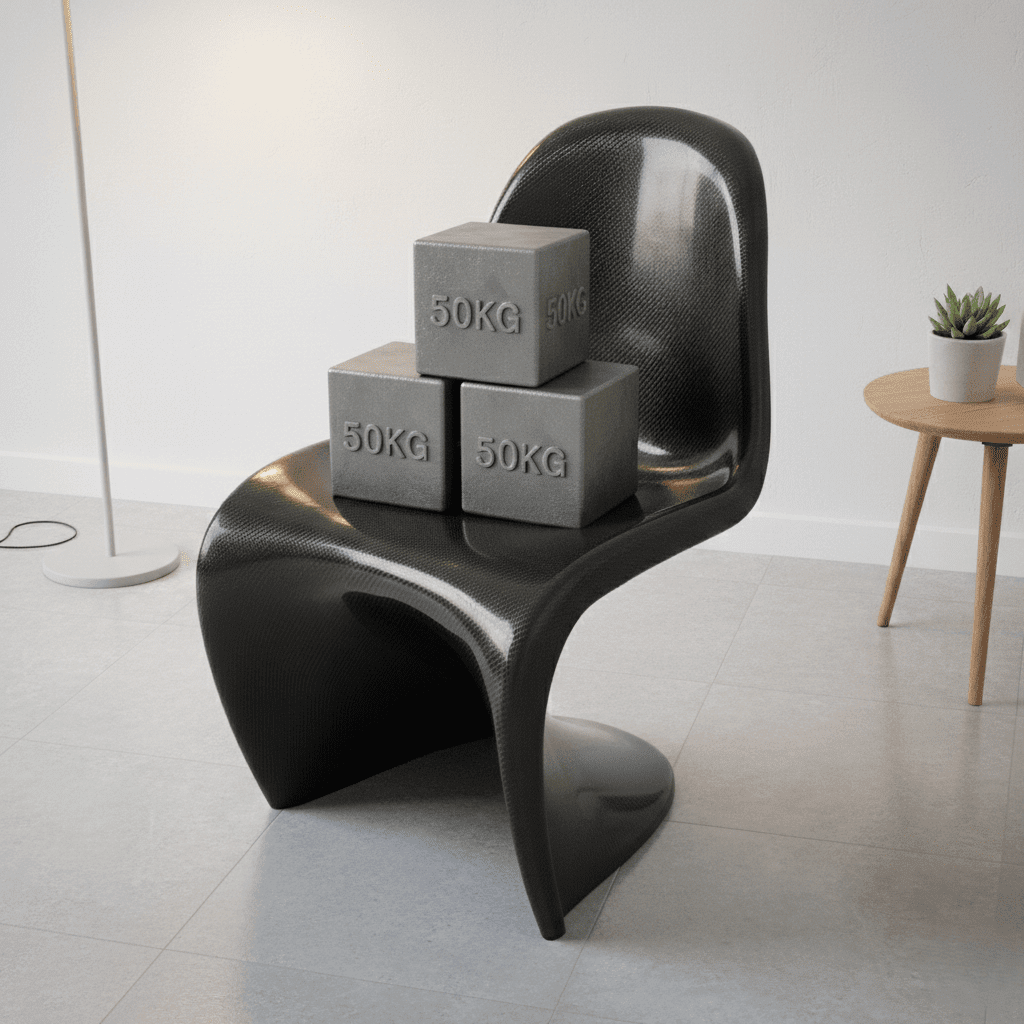
Unlike wood or metal furniture, carbon fiber parts are not shaped after the material exists.
The material system and the structure are created together.
Fiber orientation, stacking sequence, local reinforcements, and bonding strategy define:
- where the structure carries load
- how it resists deformation
- how it behaves under repeated use
- how stable its surface remains over time
If a supplier approaches carbon fiber furniture as “just a new material skin on a normal furniture frame”, the project risk increases dramatically.
Carbon fiber furniture is not decorative furniture.
It is composite structural engineering in a consumer product form.
2. Design Capability Comes Before Manufacturing
One of the most common mistakes when sourcing carbon fiber furniture is evaluating factories only by equipment and workshop size.
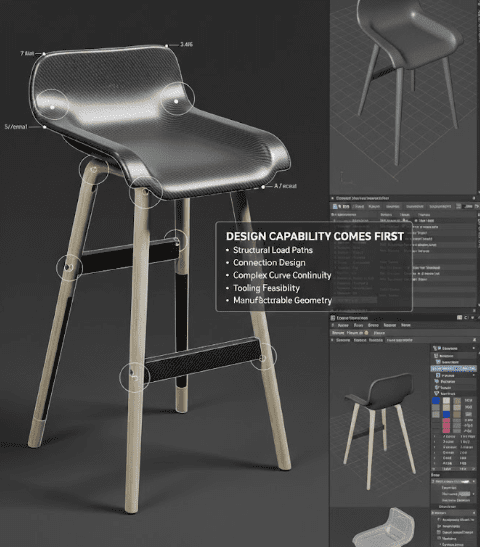
In composite manufacturing, design capability is more critical than machine count.
A qualified carbon fiber furniture manufacturer should be able to support:
- structural design of load paths
- connection design between composite parts and metal or polymer inserts
- surface continuity across complex curves
- tooling feasibility assessment
- manufacturable geometry optimization
In practical terms, your manufacturing partner should clearly explain:
- where reinforcement layers are placed
- why certain sections are locally thickened
- how sharp corners or thin edges are controlled
- how demolding and trimming are managed
If a supplier cannot explain how structural and cosmetic requirements are balanced during design, the project will rely on trial-and-error instead of engineering planning.
Carbon fiber furniture development is not a styling exercise.
It is an integrated design-for-manufacturing process.
3. What Engineering Validation Should Be Done Before Mass Production
Attractive samples are easy to produce.
Reliable carbon fiber furniture for real use is much harder.
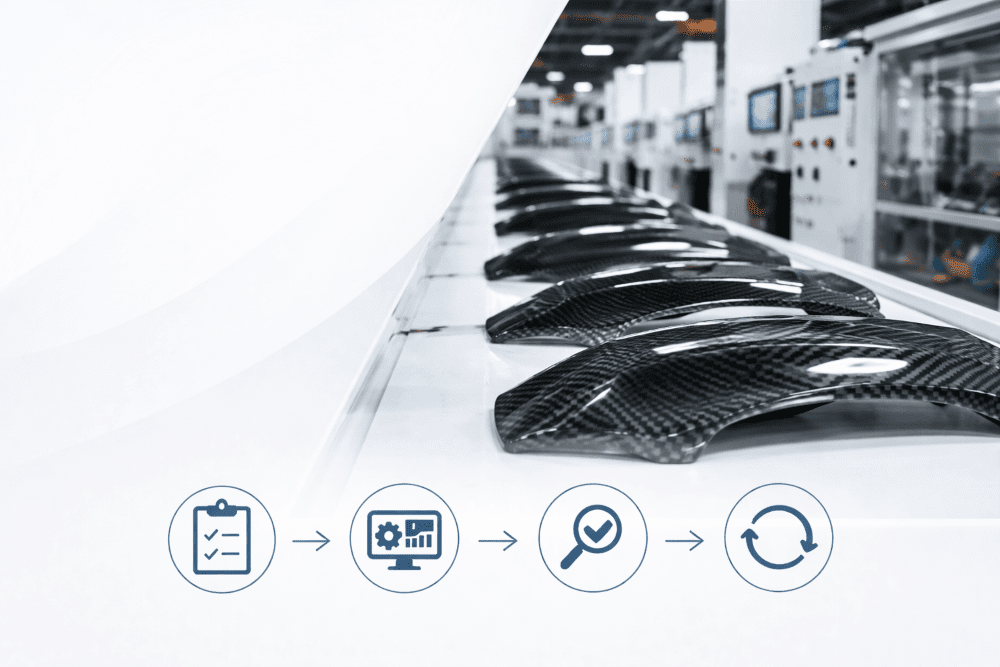
Before any production release, a structured validation loop should exist.
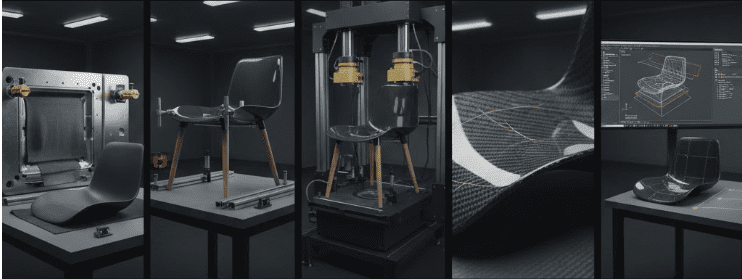
A typical engineering validation process includes:
Prototype build
Initial prototypes confirm whether the layup strategy, tooling design, and assembly sequence are feasible.
Fitment verification
Interfaces between parts, inserts, mounting features, and external components must be verified under real assembly conditions.
Load or fatigue evaluation
Structural areas must be reviewed under simulated or physical loading scenarios relevant to furniture use, such as seating loads, leaning loads, or localized stress concentrations.
Surface quality evaluation
Carbon fiber furniture often targets premium surface appearance. Clear coat stability, fiber print-through risk, and edge finish consistency must be reviewed.
Design refinement
Based on testing and inspection feedback, reinforcement layouts, geometry transitions, and bonding structures are adjusted.
Skipping this validation loop creates two major risks:
- early structural failures after market launch
- unstable cosmetic quality during batch production
Engineering validation is not optional for carbon fiber furniture projects.
It is the only way to balance weight reduction, durability, and visual quality.
4. Tooling and Process Route Define Final Cost and Lead Time
In carbon fiber furniture projects, tooling strategy and manufacturing route determine far more than the part price.
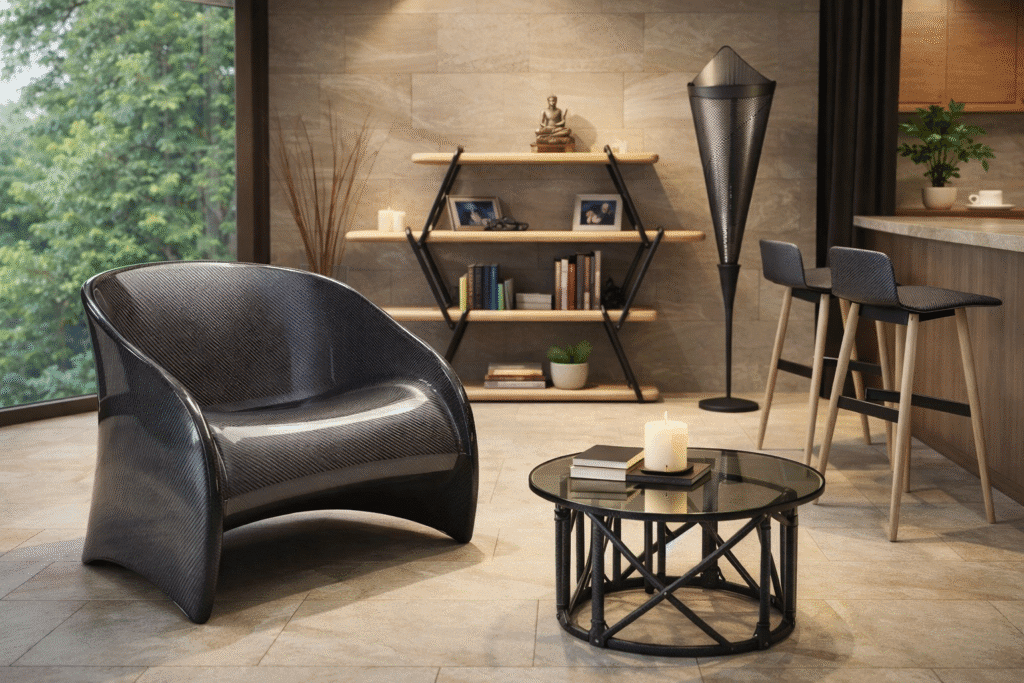
They define:
- achievable surface grade
- dimensional consistency
- production efficiency
- scrap rate
- scalability
For example, different tooling and process routes may be selected based on:
- part size and curvature complexity
- surface appearance requirements
- expected production volume
- cycle time constraints
Manufacturing routes commonly vary between:
- open mold processes for early development
- matched tooling for dimensional control
- vacuum-assisted processes for quality stability
- autoclave curing for high cosmetic and structural consistency
A professional carbon fiber furniture manufacturer should be able to explain:
- why a specific process route is recommended for your product
- how tooling investment affects per-unit cost
- what production risks exist at different volume levels
- how the process can scale as demand increases
If a supplier only provides a unit price without discussing tooling and manufacturing route, the quotation lacks essential engineering foundation.
5. How to Evaluate a Real Carbon Fiber Furniture Manufacturer (Engineering Checklist)
Use the following checklist when reviewing potential partners.
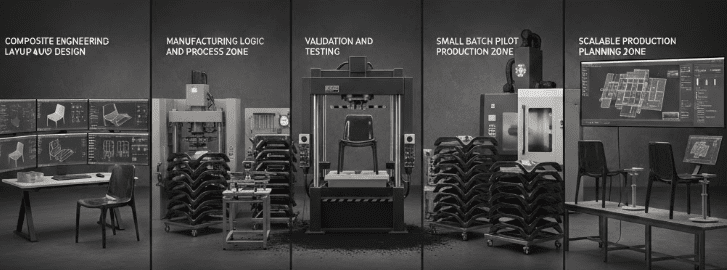
Composite engineering capability
Can the team support structural design and layup strategy, not only CAD surface modeling?
Clear explanation of manufacturing logic
Can they explain how the part will be produced, cured, trimmed, assembled, and inspected?
Validation and testing workflow
Is there a structured prototype and validation process before mass production?
Tooling development experience
Can they demonstrate past tooling programs for composite structural parts?
Small-batch pilot production experience
Can they support controlled pilot runs before full-scale production?
Scalable production planning
Can they explain how production capacity increases without compromising quality?
Cross-functional collaboration
Is there coordination between design, tooling, production, and quality teams?
A qualified carbon fiber furniture manufacturer should be able to answer these questions clearly and consistently.
6. Typical Mistakes Brands Make When Sourcing Carbon Fiber Furniture
Many brands face difficulties not because carbon fiber is unsuitable, but because supplier selection focuses on the wrong criteria.
The most frequent mistakes include:
Judging only by sample appearance
Cosmetic samples do not reveal structural robustness or production repeatability.
Ignoring process route discussions
Without understanding how the part is produced, long-term quality cannot be predicted.
Not requesting validation plans
Without defined testing and verification, production risk is transferred to the market stage.
Underestimating tooling impact
Tooling quality and design strongly influence surface consistency and dimensional control.
Treating the project as standard furniture sourcing
Carbon fiber furniture requires composite engineering management, not only furniture assembly management.
Avoiding these mistakes significantly improves project stability and supplier cooperation efficiency.
7. How JCSPORTLINE Supports Carbon Fiber Furniture Projects
At JCSPORTLINE, carbon fiber furniture programs are managed as engineering projects rather than catalog product orders.
Our development framework integrates:
- composite structural design and surface modeling
- process route planning based on production targets
- tooling feasibility evaluation at early design stages
- prototype validation and controlled iteration loops
- scalable production planning aligned with OEM and ODM programs
Instead of focusing on isolated parts, we support complete project lifecycles:
- concept feasibility review
- design and engineering collaboration
- prototype and validation development
- tooling and process optimization
- pilot production and scalable manufacturing
This approach allows carbon fiber furniture brands to move from concept to stable production without sacrificing structural reliability or cosmetic consistency.
Most carbon fiber furniture programs are developed through project-based cooperation, where engineering alignment, tooling planning, and validation execution are essential from the very beginning.
Conclusion
Carbon fiber furniture is not a styling upgrade to traditional furniture.
It is a composite engineering project with consumer-facing expectations.
The right manufacturing partner should not only produce visually attractive samples, but should demonstrate:
- engineering design capability
- validation and testing discipline
- process and tooling planning expertise
- scalable production management
By using an engineering-driven evaluation checklist, brands can significantly reduce development risk, improve time-to-market reliability, and establish long-term manufacturing partnerships that support future product programs.
Selecting the right carbon fiber furniture manufacturing partner is ultimately about one question:
Can this supplier engineer your product — not just manufacture it?