Introduction
Here is a situation that more brand owners recognize than will admit it publicly.
You launched a carbon fiber product line six months ago. The supplier looked solid — a professional website, responsive sales team, reasonable pricing, photos of what appeared to be a real production facility. But since the first order shipped, you have spent a significant portion of every week doing things that have nothing to do with building your brand: chasing delivery updates, reviewing quality photos of defective parts, coordinating a re-run after the mounting positions came out wrong, explaining to your customers why the product they ordered is delayed.
This is not a supplier communication problem. It is a supplier selection problem. And it is far more common in the carbon fiber parts manufacturer landscape than the industry acknowledges — because the visual difference between a genuine carbon fiber factory in China, a trading company reselling someone else’s production, and an assembler outsourcing the critical steps is almost impossible to detect from a product listing, a catalog, or an introductory video call.
How to find a reliable carbon fiber manufacturer in China is the right question. But the answer is not about finding the lowest price or the fastest sample turnaround. It is about identifying the supplier whose operational structure means they can actually be accountable for your outcome — quality, delivery, consistency, and the technical support your product development requires — without you having to become an expert in composite manufacturing to keep things on track.
The right carbon fiber manufacturer in China does not just make your parts. They absorb your supply chain risk, handle the engineering complexity, and give you back the time and attention your brand actually needs.
This article gives you a concrete framework to identify who that is — including how to conduct a structured remote audit if you cannot visit China in person — and the specific operational signals that separate a manufacturer capable of being your long-term partner from one that will keep pulling you back into production-floor problems.
Factory or Middleman? The First Question Every Buyer Gets Wrong
The carbon fiber factory in China vs trading company question sounds simple. In practice, it is one of the most consistently misread distinctions in B2B sourcing — because both parties have learned to present themselves in nearly identical ways.
A trading company operating in the carbon fiber space will typically have a professional website with factory imagery, polished product photography, ISO certification documents, and an English-speaking sales team that can discuss technical specifications fluently enough to pass an initial qualification call. An assembler — a company with a production floor that outsources mold design, fabric sourcing, and critical process steps — looks nearly identical from the outside. The difference only becomes visible when something goes wrong: a delivery slips and nobody can tell you which production step caused it; a quality defect appears and the root cause analysis is “we’ll replace it”; you ask to see the layup specification for your part and the answer is silence.
How to identify a real carbon fiber factory requires looking past the presentation layer into the operational structure. Four signals matter most.
Mold ownership and design capability. A genuine real carbon fiber factory designs and manufactures its own tooling in-house. Ask directly: where is your mold shop, and can we see it on a live video call? A trading company will redirect the question or describe a mold partner they work with. An assembler may have a mold shop but rely on external design — which means when a design decision causes a production problem, no single party is accountable for both.
Raw material traceability. Ask who supplies the carbon fiber fabric, and ask to see the material certification. A manufacturer with in-house fabric production or a direct relationship with a primary fiber producer — Toray, Hexcel, Teijin — can answer this in one step. A trading company typically cannot provide the full material chain.
Production process documentation. Request a sample SOP or layup specification for a comparable part they have manufactured. A real manufacturer has these documents. A trading company does not produce them because they exist in a factory the trading company does not control.
Price behavior after order confirmation. Suppliers who quote without doing internal engineering assessment — trading companies and assemblers frequently do this because they are re-quoting from a sub-supplier’s estimate — often discover post-order that the price needs to adjust. A manufacturer with in-house engineering quotes from their own cost structure, which does not change after the order is placed.
The reason this distinction matters is not simply about authenticity. It is about accountability. The difference between a carbon fiber trading company vs manufacturer is structural: a trading company’s leverage over its sub-factory is limited, and when you escalate a quality issue, they relay the message to someone whose job is to manage the trading company relationship — not fix your product. A manufacturer controls the production line, the process parameters, and the personnel. When you escalate to a real factory, there is someone whose job it is to resolve the root cause.
Carbon fiber supplier evaluation starts here. Everything else is secondary.
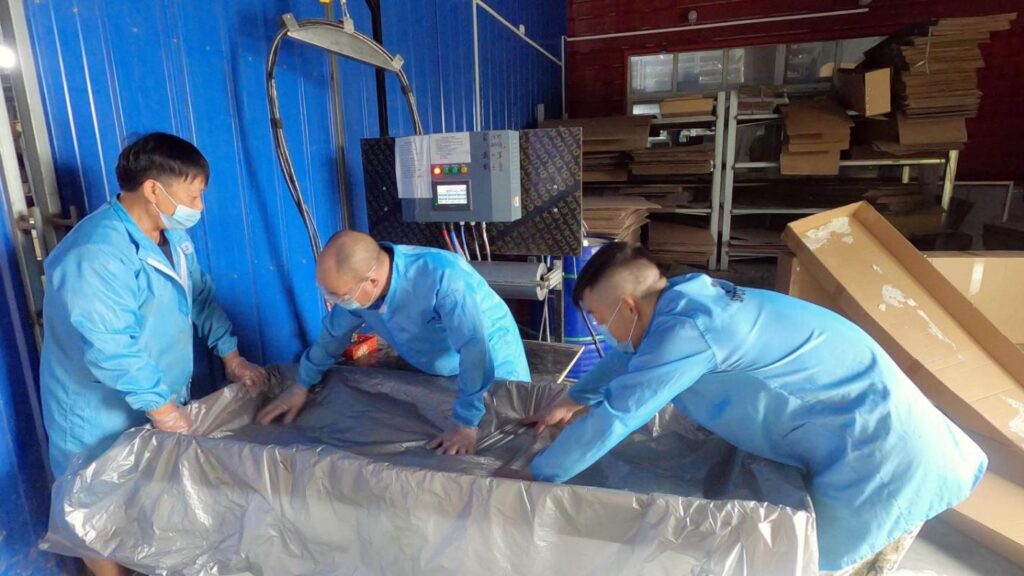
How to Audit a Carbon Fiber Factory Remotely: A 4-Dimension Video Audit Framework
Most sourcing managers and procurement officers evaluating a carbon fiber manufacturer in China cannot realistically schedule a factory visit for every supplier under consideration. A structured remote audit — done correctly — covers the same ground that matters for the initial qualification decision.
If you cannot visit the factory in person, a structured video audit is the next best option. The four dimensions below separate a real manufacturer from a capable-looking middleman — because a real manufacturer can answer all four on camera, and a middleman cannot.
Dimension 1: Production Capacity — Is the Production Line Standardized?
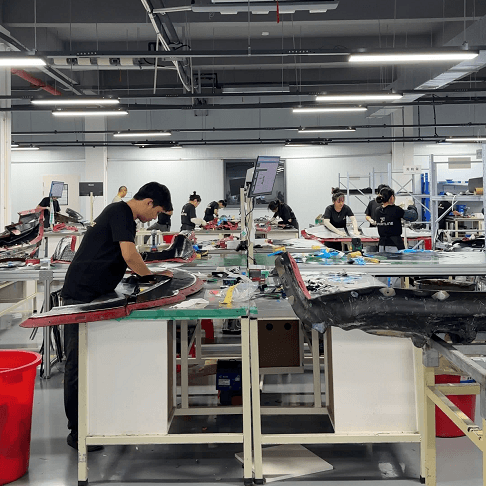
Ask the supplier to walk the camera through an active production line during a live call — not a pre-recorded factory tour. Request to see hot press or compression molding equipment in operation, the number of molds currently loaded, and the workstation layout.
Key question: How many molds can you run simultaneously, and what happens to my order priority during your peak season?
A standardized production line has consistent workstation layouts, visible SOP postings at each station, and equipment clearly in regular use. How to verify carbon fiber factory production capacity is not about counting machines — it is about whether the operational rhythm you observe looks like a real production environment or a demonstration floor. A trading company will offer a pre-recorded video or redirect this request. An assembler may show you a floor but cannot answer the peak-season question with specific numbers, because the answer depends on a subcontractor’s schedule they do not control.
Dimension 2: Delivery Management — Does a Real Production Management System Exist?
Ask the supplier to demonstrate — live, on screen — the system they use to track production orders. Ask them to show you an active order with its current production stage visible.
Key question: If I place an order today for 100 parts, what production milestones will I be able to see, and how will I be notified at each stage without asking?
A manufacturer with real production management infrastructure can answer this with a live screen demonstration — showing order entry, production stage assignment, and completion tracking. A trading company cannot demonstrate this because the production data lives in a factory they do not operate. They will describe a process — weekly updates, messaging notifications — but cannot show you the underlying system. This is the single most reliable signal in a remote audit. JCSportline’s AI-assisted production scheduling system generates delivery commitments based on real-time production data, not sales estimates, and gives clients milestone visibility for every active order.
Dimension 3: R&D Capability — Is Design and Tooling Genuinely In-House?
Ask to see the mold design and CNC machining area on camera. Ask the engineer who would handle your project to join the call.
Key question: If I send you a 3D file tomorrow, who specifically will conduct the feasibility assessment — is that person your employee, and where do they sit?
A genuine **OEM carbon fiber manufacturer with in-house production** has its engineering team, mold shop, and production floor on the same campus. The engineer who joins the call should describe, without hesitation, the layup approach they would recommend for your part geometry and why. An **original carbon fiber manufacturer with mold and production capability** means the same organization that designs your mold also manufactures it, specifies the layup, and runs the production. When those functions are split across different companies, accountability for the outcome is split too. JCSportline’s carbon fiber project management process keeps every development step — from feasibility to first article — under one engineering roof.
Dimension 4: After-Sales Infrastructure — Where Is the Service When You Need It?
Ask the supplier to describe specifically their after-sales support structure — who handles warranty claims, where that person is located, and their average response time for a quality issue raised in your region.
Key question: If I have an installation problem with a customer in Europe next Tuesday at 10 AM local time, who do I contact, and how long before I have a technical response?
A **carbon fiber manufacturer with overseas service team** gives you a specific name, a time zone, and a communication channel — describing local subsidiaries with technical competence, not just sales support. A supplier without this infrastructure routes everything through China headquarters, which means your European customer’s Tuesday morning problem gets addressed at the earliest the following day. JCSportline’s local teams in the Netherlands, Japan, and the United States provide technical support in your time zone — detailed on the team page.
4-Dimension Video Audit Framework Summary:
| Dimension | What to Request | Key Question | Strong Signal | Weak Signal |
| Production Capacity | Live production floor walkthrough | How many molds running simultaneously? | Active floor, specific numbers | Pre-recorded video, vague answers |
| Delivery Management | Live system demonstration | What milestones can I see without asking? | Screen demo with real order data | Description of process, no system shown |
| R&D Capability | Engineer joins call, mold shop tour | Who does the feasibility — employee or outsourced? | In-house engineer, same campus | “Our partner handles design” |
| After-Sales Infrastructure | Specific regional support description | Who answers in my time zone, how fast? | Named contact, local presence | Routes through China HQ only |
What “Full In-House Control” Actually Means in Carbon Fiber Manufacturing
For product developers and OEM program managers who have been through a difficult carbon fiber project, the phrase “we control the full process” is one they have heard before — usually from a supplier who turned out to control rather less than advertised. Here is what full in-house control means when it is real, and why each element directly affects your project outcome.
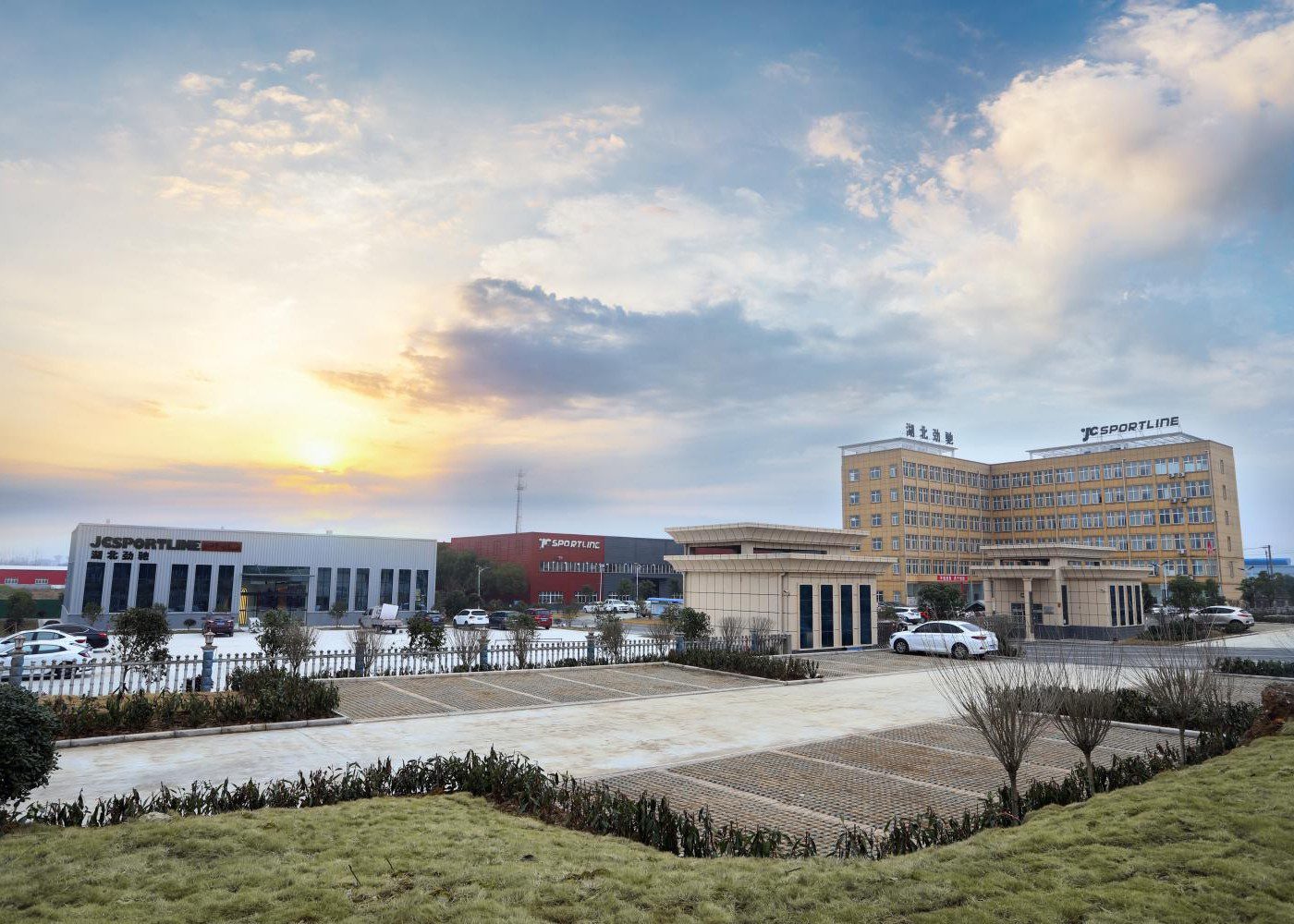
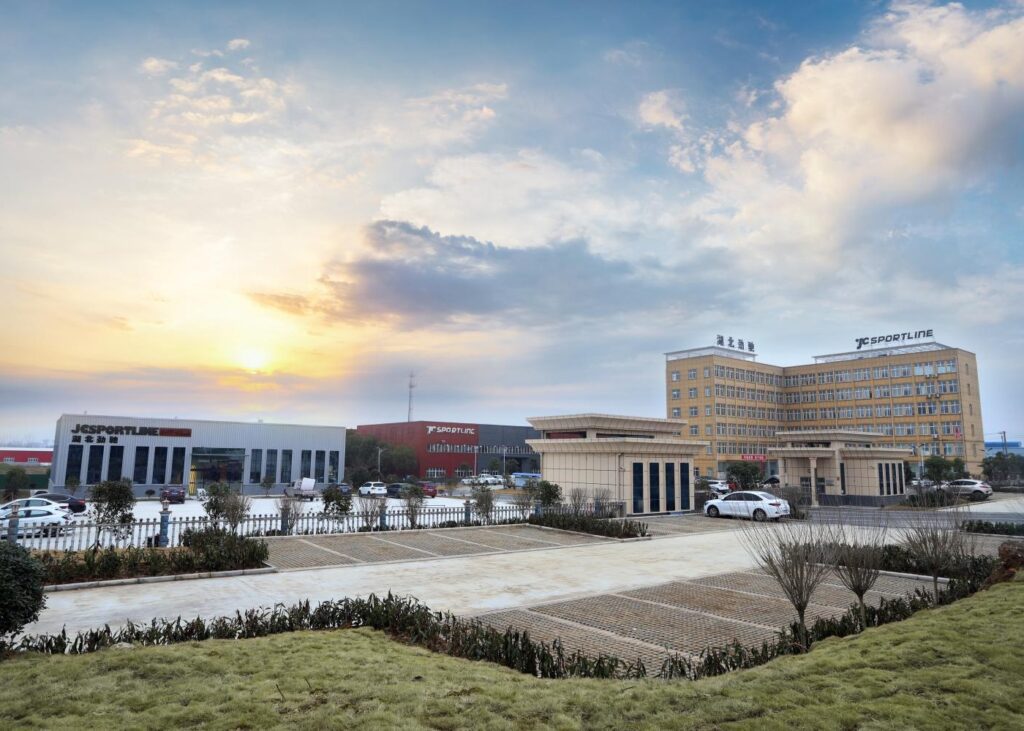
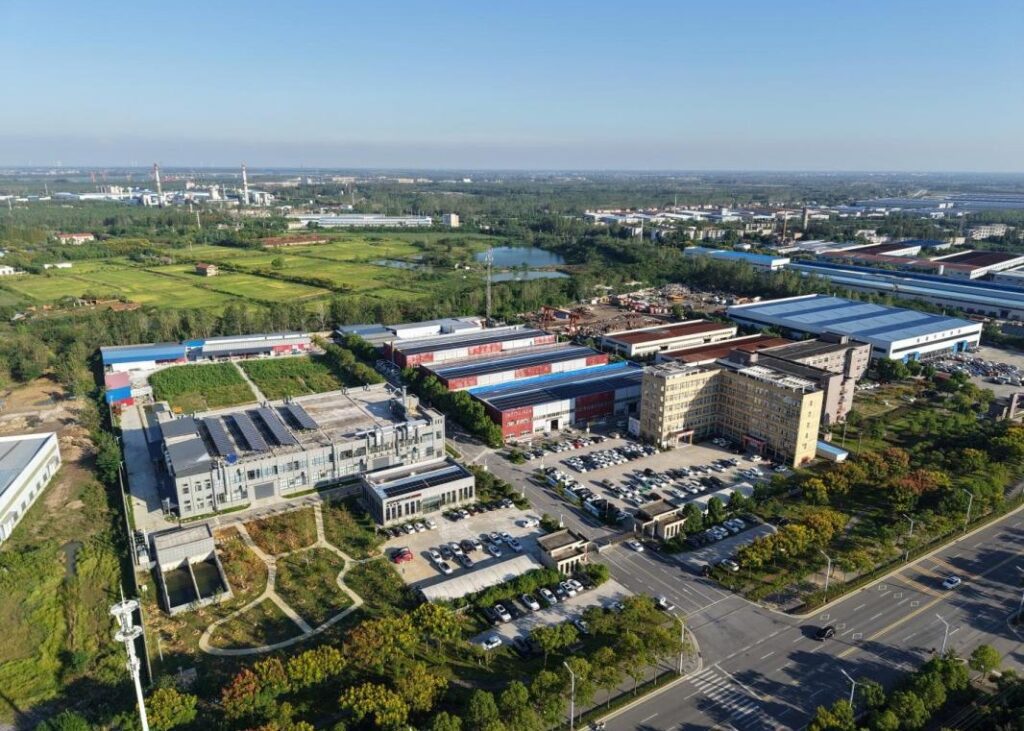
Facility scale: 150,000 m² in-house manufacturing base. Scale at this level means hot pressing, compression molding, CNC machining, surface finishing, and assembly happen within the same facility complex. When every production step is under the same roof, material transfer time shrinks, quality handoffs are internal and auditable, and the person responsible for step four cannot blame step three on a subcontractor. For a direct manufacturer for custom carbon fiber parts in China, the physical co-location of every process step is the structural basis for delivery predictability and quality accountability.
You can see the full scope of this infrastructure on the JCSportline about page.
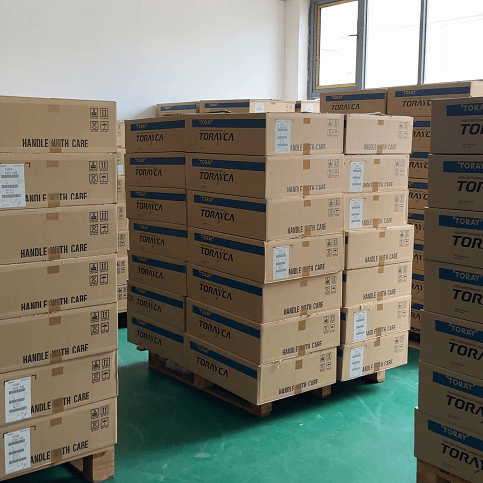
In-house fabric mill and Toray carbon fiber yarn. This is the carbon fiber supply chain China element that most buyers overlook — and the one that most directly affects batch-to-batch quality consistency. Fabric produced in-house from Toray carbon fiber yarn means the material going into your production order is not purchased on the open market from whichever distributor has stock that week. It is woven in-house, from a primary fiber source with internationally recognized property specifications: tensile strength, modulus, dimensional tolerances. When you approve a first-article sample, the material going into your production order is the same material, from the same source, woven to the same specification. Batch variation — one of the most common causes of quality inconsistency in carbon fiber production — is controlled at the source. A trading company sourcing from multiple subcontractors cannot offer this.
Hot press and compression molding on independent production lines. Different carbon fiber applications require different manufacturing processes. Structural parts with complex geometry require hot press with precisely controlled cure cycles. High-volume appearance parts in simpler geometry suit compression molding. An OEM carbon fiber manufacturer with in-house production across both process types means your project is matched to the process that suits it — not constrained to fit the factory’s single process capability. For custom carbon fiber manufacturer programs where the product design is still evolving, this process flexibility is a genuine advantage.
**Mold design and fabrication in-house.** **In-house carbon fiber production** of tooling — not just the parts — is what makes pre-production feasibility assessment meaningful. When the team that manufactures your mold is the same team that reviewed your design for manufacturability, there is direct accountability between the design decision and the production outcome. When mold design is outsourced, that accountability is split across a contractual boundary. The full scope of JCSportline’s mass production capabilities is built on this integrated tooling-to-production model.
A manufacturer who controls their own fiber, fabric, tooling, and production lines is not just a factory. They are the only party in your supply chain who can actually be held accountable for your outcome — end to end.
R&D Depth and Quality Consistency: The Two Things a Trading Company Can Never Fake
For engineers, composite specialists, and mechanical engineers evaluating suppliers at the technical level, two capabilities distinguish a genuine carbon fiber manufacturer with R&D capability from a production facility that can execute a specification but cannot originate one.
R&D Depth: 100 Engineers, 15% of the Total Organization. JCSportline’s R&D center comprises 100 engineers — 15% of total group headcount. That ratio is a structural choice. For every six people in production, quality, logistics, and administration combined, one person is working in engineering development. The team covers every major composite manufacturing process — hot press, compression molding, RTM, hand layup — which means when a product developer brings a new application requirement, the engineering response is not limited by the factory’s process capability.
From project receipt to first sample delivery: 58 days for standard custom development programs. This is the output of a standardized engineering development process that has been run enough times to be predictable. For **automotive professionals** and brand programs where development timing directly affects market window, a supplier whose internal engineering process is a throughput engine rather than a bottleneck is a structural program advantage. The full scope of what JCSportline’s engineering team can take on — from concept feasibility to production specification — is available through the carbon fiber consultant service.
Quality Consistency: A Four-Stage Closed Loop.
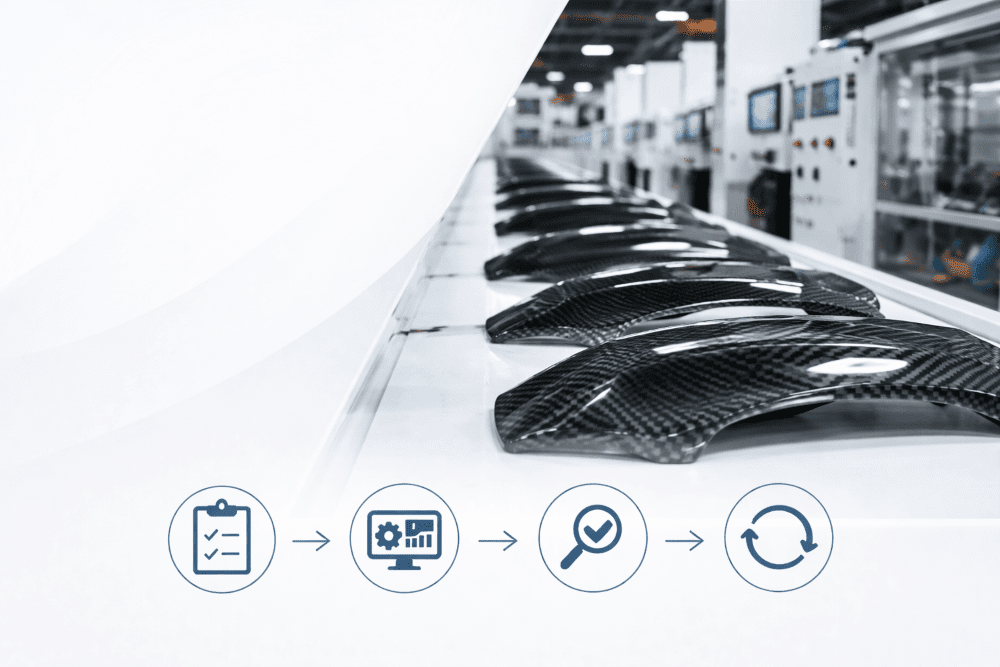
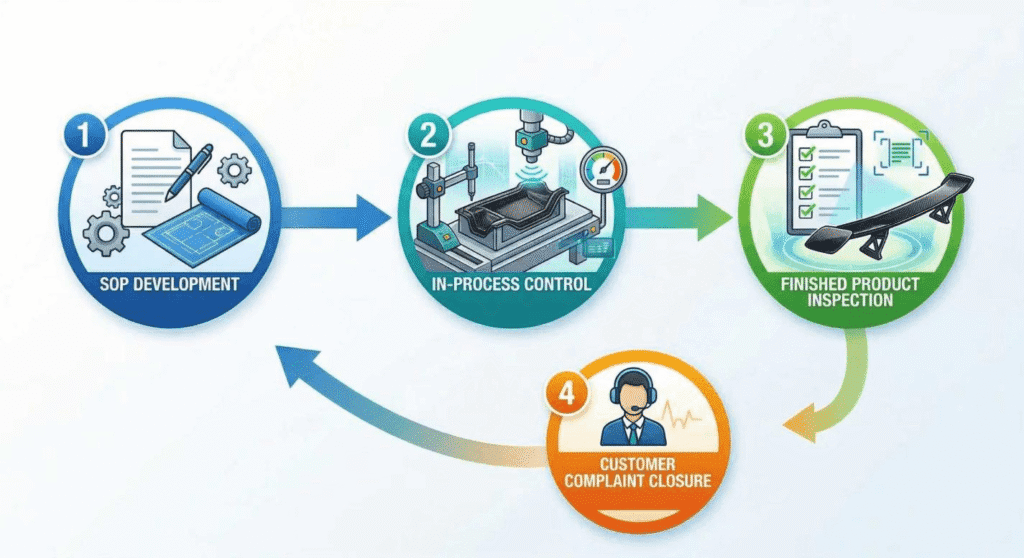
Carbon fiber quality control at JCSportline operates as a four-stage closed loop — not a post-production inspection step, but a system that runs from design through to customer feedback resolution.
Stage 1 — SOP Development: Every production part has a written standard operating procedure developed during the engineering phase, before the first production run. Layup sequence, cure cycle parameters, inspection criteria, and packaging specification are documented before production begins.
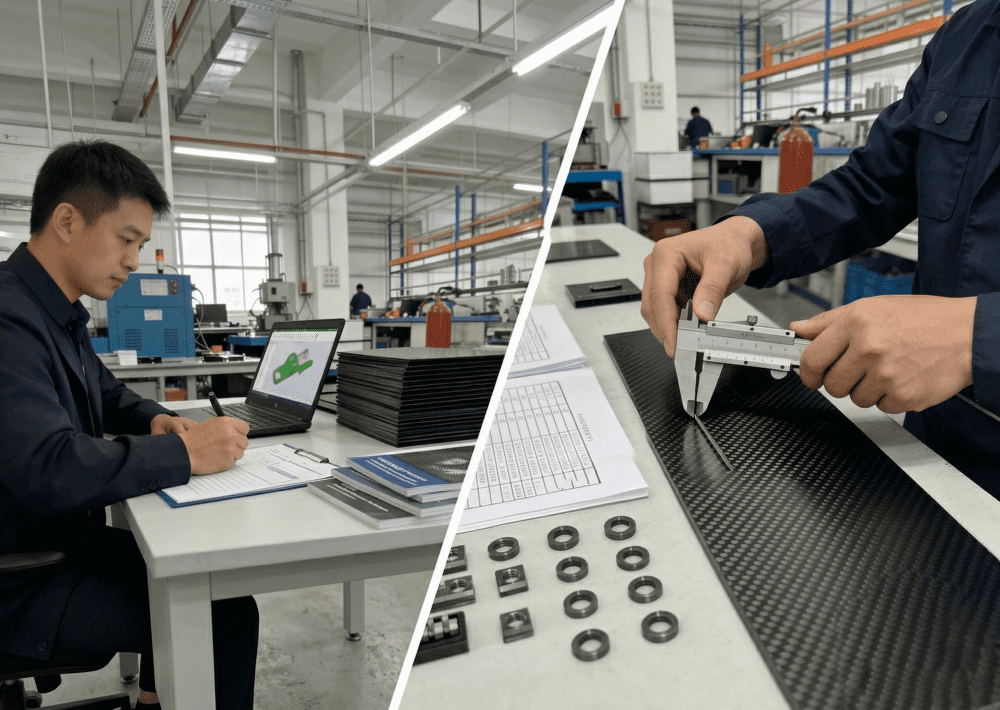
Stage 2 — In-Process Control: Production-floor quality verification uses equipment-based measurement at each stage, not visual inspection by a technician applying judgment.
Stage 3 — Finished Product Inspection: Every outgoing batch is inspected against the documented acceptance criteria from Stage 1 — a systematic comparison against a defined standard, not a sampling exercise.
Stage 4 — Customer Complaint Closure: When a quality issue is raised, the root cause investigation traces back through all three prior stages to the specific decision or parameter that caused the problem. The resolution is a documented process change, not a replacement shipment.
Most quality failures in carbon fiber factory in China operations trace to three structural absences: no written SOP, no purpose-built inspection tooling, and no complaint-to-root-cause traceability. The four-stage loop addresses all three. A brand customer who moved to JCSportline from a previous supplier described their response to receiving the SOP documentation and layup work instruction alongside the first production sample: they had not previously seen this level of process documentation from a carbon fiber manufacturer, and it clarified precisely why JCSportline could make a consistency commitment their previous supplier could not.
The Service Layer: Why the Right Manufacturer Lets You Focus on Your Brand
The case for service as the defining competitive dimension in carbon fiber manufacturing has a specific arithmetic.
If a brand owner managing a carbon fiber product line spends 30% of their working time on supplier-related issues — delivery follow-up, quality escalation, technical clarification, re-run coordination — that is 15 weeks per year not spent on product development, marketing, customer acquisition, or brand building. The cost is not the time spent on supplier calls. The cost is the brand growth that did not happen.
The goal of finding the right custom carbon fiber manufacturer is not to minimize the cost per part. It is to reduce the operational burden of supply chain management to a level where it no longer competes with your core business for attention.
Overseas Service Teams: Local Presence, Not Remote Support. JCSportline operates local subsidiaries in the Netherlands, Japan, and the United States, each providing both technical support and sales capability in the local time zone. The distinction between a local subsidiary and a remote support arrangement matters for two practical reasons. First, time zone alignment: a technical question raised by a European customer at 9 AM CET is addressed by a team already at their desk — not relayed to China and answered the following morning. Second, technical competence at the local level: a carbon fiber manufacturer with overseas service team whose local offices can handle installation support, technical troubleshooting, and initial quality assessment means the resolution cycle for field issues is measured in hours, not days.

AI-Driven Delivery Management: Predictable Lead Times, Not Estimates. Delivery unpredictability is one of the two most consistently cited failure modes when brand owners and sourcing managers describe why they changed carbon fiber suppliers. JCSportline’s carbon fiber supply chain China operations use an AI-assisted scheduling system that forecasts production capacity, assigns order priority against the live schedule, and generates delivery commitments based on current production data — not the sales team’s optimistic estimate. Clients have real-time milestone visibility for every order without requiring follow-up calls.
The Enablement Model: What You Delegate, What You Keep. The operational model that the right carbon fiber parts manufacturer partnership enables has a specific structure. You delegate: engineering assessment, process specification, production execution, quality verification, and logistics management. You keep: product strategy, brand development, customer relationships, and market growth. When a supplier cannot absorb the engineering and operational complexity on your behalf — when you are the one managing the process, troubleshooting the quality, and coordinating the production — the partnership is not functioning as it should. The right carbon fiber manufacturer in China does not sell you parts. They give you back the time to build something with them.
Conclusion: The Right Factory Is Not a Cost Center. It’s Your Brand’s Unfair Advantage.
When product developers, sourcing managers, and brand owners search for a carbon fiber manufacturer in China, the search almost always starts with product categories and price ranges. That is a reasonable starting point. It is not a sufficient one.
The supplier you are looking for is not the one with the lowest sample cost or the shortest initial lead time quote. It is the one whose operational structure means they can be accountable for your outcome — quality, delivery, development, and service — without requiring you to manage the process on their behalf.
The four-dimension remote audit framework in this article gives you a practical tool to make that determination without a factory visit. Capacity, delivery management, R&D capability, and after-sales infrastructure — these four questions, asked live during a video call with a real production environment as the backdrop, reveal more about a supplier’s actual capability than any certification document or capabilities presentation.
JCSportline’s answer to those four questions: a 150,000 m² in-house manufacturing base, an AI-assisted production scheduling system with milestone visibility for every order, a 100-person R&D center covering all major composite processes, and local subsidiaries across three continents providing technical support in your time zone. Everything behind those numbers is described on the JCSportline about page.
That is not a supplier profile. It is a supply chain infrastructure — designed to absorb your operational complexity so your brand can do what brands are built to do.
Tell us your project. We will take it from there.
Frequently Asked Questions
Q1: What is the difference between a carbon fiber factory and a carbon fiber trading company in China?
A carbon fiber factory in China designs tooling, specifies layup processes, runs production, and manages quality in-house. A trading company sources from one or more factories, adds a margin, and resells — with limited visibility into the production decisions that determine your part quality. The practical difference appears when something goes wrong: a factory traces a quality issue to a specific process step and corrects it at the source. A trading company replaces your parts but cannot change the production decision that caused the problem, because that decision belongs to a factory they do not control.
Q2: How do I verify that a supplier is a real carbon fiber manufacturer, not just an assembler?
Ask for a live video call with four specific stops: the mold design and CNC machining area, an active production line with parts in process, the engineer who would handle your feasibility assessment, and the quality inspection area with instruments used for production verification. An assembler will redirect some of these requests or will show you a floor where critical steps — mold fabrication, layup specification — are described as handled elsewhere. A real carbon fiber factory shows you all four stops in the same facility.
Q3: What should I ask during a video factory audit for carbon fiber parts?
The four highest-signal questions: How many molds are currently running, and what happens to my order during your peak period? Can you show me a current order in your production management system with its stage visible? Who specifically conducts feasibility assessments — is that person an employee, and can they join this call? If I have a technical problem with a customer in my region next week, who responds, where are they, and what is their typical response time? These questions reveal operational reality faster than any documentation. The carbon fiber consultant service at JCSportline is the starting point for exactly this kind of structured supplier engagement.
Q4: Can a carbon fiber manufacturer in China handle full OEM development — from design to production?
A genuine OEM carbon fiber manufacturer with in-house production — with in-house engineering, tooling, and production — can handle the complete development cycle: feasibility assessment from your 3D file, process specification, tooling design and fabrication, first article production, and series production. The signal that engineering is real and in-house: the manufacturer provides a written feasibility assessment document covering layup design, mold architecture, assembly method, and inspection plan before any tooling commitment is made.
Q5: How does in-house raw material control affect quality consistency in carbon fiber manufacturing?
When a manufacturer produces its own carbon fiber fabric from a primary yarn source rather than purchasing on the open market, batch-to-batch material variation is controlled at the source. For programs where first-article approval needs to translate reliably into production part quality, in-house carbon fiber production of the raw fabric is one of the most significant structural quality controls available — and one that no trading company or assembler can replicate.
Q6: What does after-sales service look like with a professional carbon fiber manufacturer?
Effective after-sales service from a carbon fiber manufacturer with overseas service team has three components: local presence in your time zone with technical competence, a defined response protocol with a named contact and committed response time, and root-cause accountability where quality issues result in documented process corrections rather than replacement shipments. The question to ask any supplier: If a customer in my region reports an installation problem next Tuesday, who specifically responds, and what is the process? A supplier with genuine service infrastructure answers with specifics.
Click to visit YouTube and follow us to learn more.