Why Fatigue Life Defines Carbon Wheelchair Value
The true cost of a wheelchair extends far beyond its sticker price. Over a 10-year ownership period, a high-fatigue-life carbon frame can eliminate multiple replacements, reduce downtime from repairs, and avoid costly insurance claims due to sudden failure. Aluminum chairs typically require replacement every 3–5 years under active use, while premium carbon frames designed for 1 million+ cycles often outlast their users’ mobility needs.
Regulatory standards reinforce this reality: ISO 7176-8 mandates a minimum of 200,000 fatigue cycles for manual wheelchairs—a baseline many manufacturers barely meet. But real-world demands exceed lab conditions. Curb drops, potholes, and aggressive propulsion create complex stress states that accelerate micro-crack growth. A sudden tube fracture isn’t just inconvenient; it risks serious injury and exposes providers to liability.
This is where market differentiation emerges. Frames validated beyond ISO requirements—especially those passing 1,000,000+ cycles—command premium pricing because they solve the buyer’s deepest fear: hidden damage leading to catastrophic failure. By quantifying and guaranteeing fatigue life, we transform uncertainty into trust.
JCSPORTLINE Fatigue Design Workflow
Durability begins long before the first mold is cut. Our fatigue-centric design process integrates real-world usage data, advanced materials science, and predictive simulation to build resilience into every ply.
2.1 Load-Path Mapping & Rider Personas
We don’t design for “average” users—we design for extremes. Using datalogger studies from urban commuters to Paralympic athletes, we model load cases spanning the 5th-percentile female (45 kg) to 95th-percentile male (120 kg). Scenarios include:
- Double-drum rolling over 8 mm oblique bumps
- 50 mm curb drops at speed
- 3-g impacts from uneven terrain
Critical stress concentrations—like the caster-head tube junction, rear-axle bridge, and back-rest hinge—are mapped using finite element analysis (FEA) to ensure load paths flow smoothly through the structure, avoiding dangerous stress risers.
2.2 Ply-By-Ply Lay-up for Fatigue Resistance
Carbon fiber doesn’t fail like metal. Instead of yielding, it develops micro-cracks that propagate under cyclic loads. Our lay-up strategy arrests this early:
- Hybrid orientation: 0° plies handle axial loads, ±45° resist torsion, and 90° layers manage side impacts.
- Toughened epoxy resin with a glass transition temperature (Tg) of 250°C prevents matrix softening during hot climates or friction heating.
- Interleaved veil layers between structural plies act as crack bridges, slowing delamination.
- 57% fiber volume ratio balances stiffness, weight, and fracture toughness—optimized via DOE (Design of Experiments).
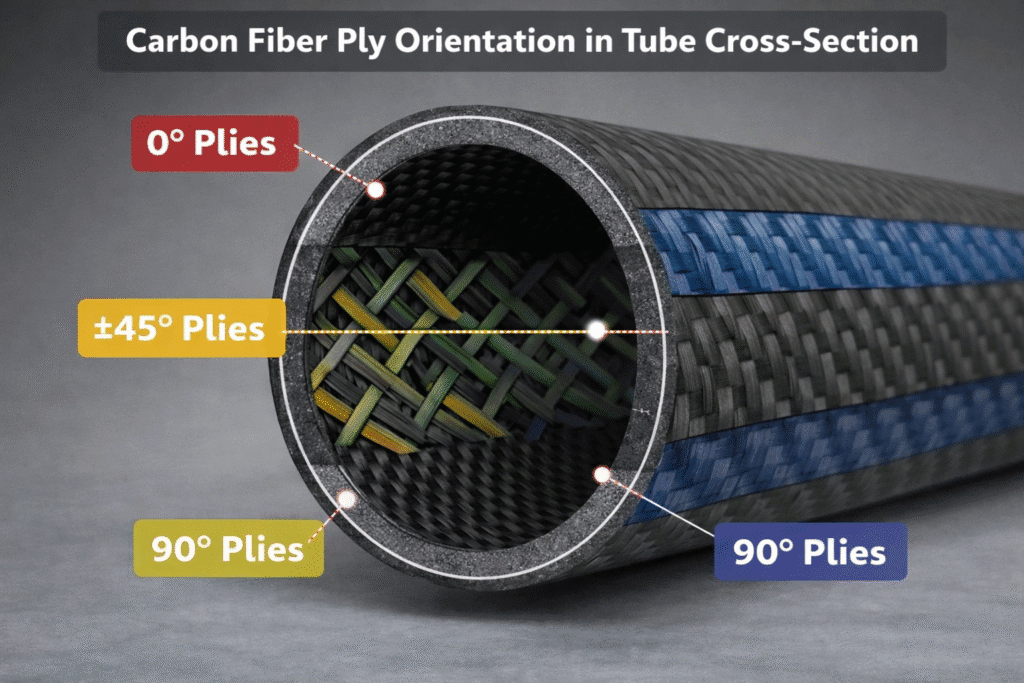
This approach eliminates the dreaded “snap” failure riders fear, replacing brittle behavior with graceful degradation.
2.3 Predictive FEA & Fatigue Simulation
Before investing in tooling, we run virtual fatigue trials using MSC Nastran with 1 mm shell elements at critical joints. Our workflow includes:
- S–N curves derived from coupon tests on our actual material system
- Miner’s rule to calculate cumulative damage from variable-amplitude loads
- Iterative refinement: adjust ply count/orientation → simulate 2,000,000 cycles → verify safety factor ≥ 3
Simulation results are later correlated with physical tests, ensuring digital predictions match reality.
2.4 Design Freeze Gate & Risk Matrix
No project advances to production without clearing our Fatigue Design Freeze Gate. Using a risk matrix (Probability × Severity × Detectability), we assess every potential failure mode. Crucially:
- Tooling purchase orders are blocked unless predicted fatigue life exceeds 5× ISO 7176-8 (i.e., ≥1,000,000 cycles)
- Cross-functional sign-off is required from Engineering, QA, Regulatory Affairs, and Aftermarket Service
This institutionalizes durability as non-negotiable—not optional.
Laboratory Fatigue Test Protocol & Validation Data
Validation transforms theory into proof. Every JCSPORTLINE frame undergoes four tiers of fatigue testing.
3.1 ISO 7176-8 Double-Drum Rig Explained
Our baseline test follows the international standard exactly:
- 200,000 cycles at 4 Hz
- 80 kg dummy on an 8 mm oblique castor bump
- 12 strain gauges log real-time deformation at 1 kHz
- Pass criteria: no crack >5 mm, stiffness loss <5%
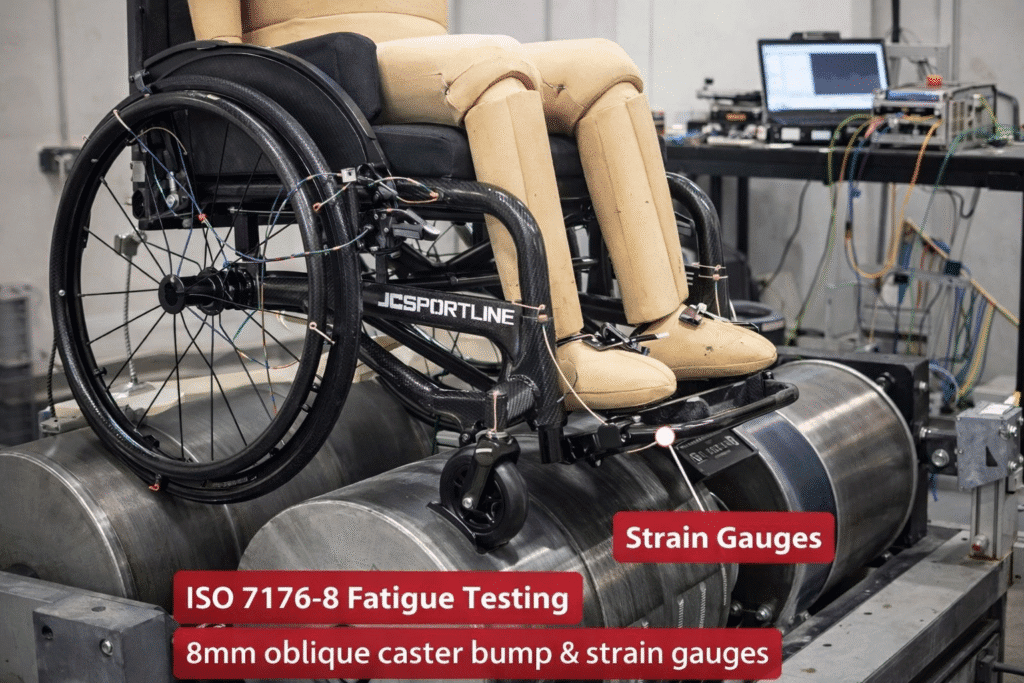
But we go further: all data is archived for traceability, so “ISO certified” means verifiable numbers—not just a logo.
3.2 Extended 1,000,000-Cycle Overkill Test
For sport and heavy-duty users, we run an internal “x5” protocol:
- Same rig, but 12 mm bump and 120 kg load
- Interrupted every 200k cycles for non-destructive testing (NDT): ultrasound scans detect subsurface delamination; thermography reveals heat signatures from internal friction
- Target: zero buckling, zero repairable damage, ≤3% stiffness drop
This proves the frame survives a lifetime of aggressive use.
3.3 Curb-Drop Impact-to-Fatigue Coupled Test
Real life isn’t pure rolling—it’s impacts followed by miles of vibration. Our coupled test replicates this:
- 10,000 curb drops from 50 mm height
- Immediately followed by 200,000 double-drum cycles
- Measures how impact-induced matrix damage accelerates fatigue crack growth
All frames must complete this sequence without functional impairment.
3.4 Statistical Weibull Analysis & Lifetime Prediction
Test data feeds statistical models to define warranty terms. Using Weibull analysis:
- A modulus β ≥ 18 indicates low scatter—high consistency in fatigue life
- B10 life (10% failure probability) = 3.2 million cycles, equivalent to ~15 years of daily use
- Our 5-year public warranty is based on the 95% confidence lower bound
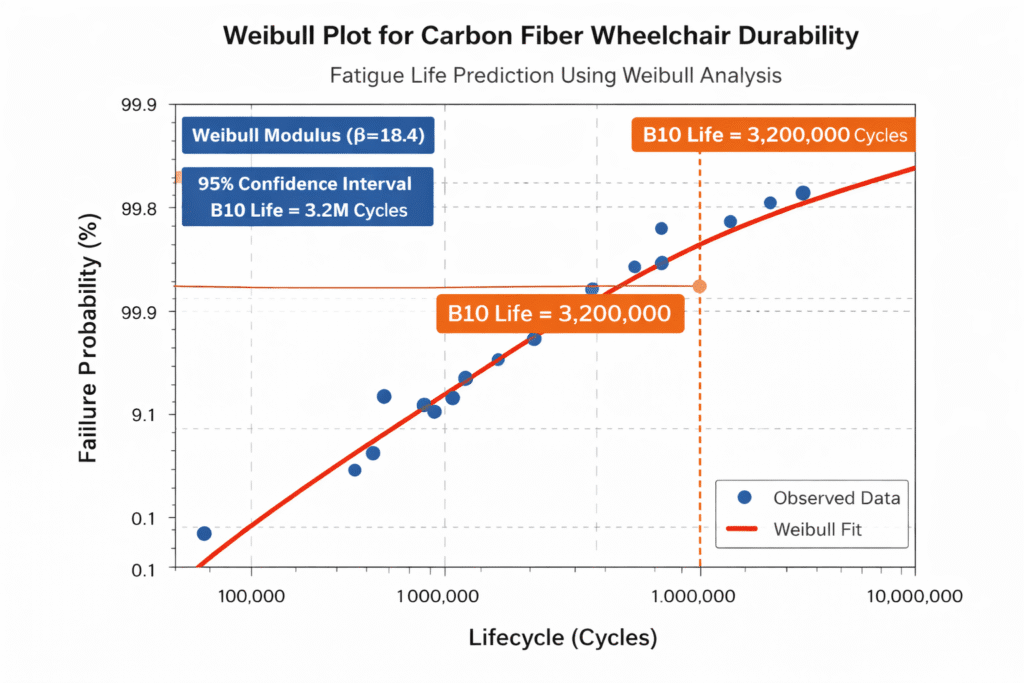
Buyers get a number they can trust—not a guess.
Field Feedback & Continuous Improvement
Lab tests simulate reality—but real users define it. We close the loop via:
- QR-coded frame registry: Owners upload usage hours and inspection photos
- Annual forensic teardowns of returned frames to compare actual vs. predicted failure modes
- Data-driven iterations: Gen 4 frames show 22% higher fatigue life than Gen 3 due to refined resin systems and ply stacking
Your purchase today benefits from yesterday’s field lessons.
FAQ – Common Questions About Carbon Wheelchair Fatigue Life
Q1: How many years can a carbon wheelchair frame last under daily use?
A: With a B10 life of 3.2 million cycles (~600 km/year), most users can expect 12–15 years of reliable service—far exceeding typical warranties.
Q2: What’s the difference between ISO 7176-8 and JCSPORTLINE’s internal test?
A: ISO requires 200k cycles at 80 kg; we test to 1 million+ cycles at 120 kg with larger bumps and impact pre-conditioning—a 5x safety margin.
Q3: Can visible scratches affect fatigue life?
A: Superficial scratches rarely matter. However, deep gouges near high-stress zones (e.g., axle mounts) should be inspected. Our frames include protective gel coats to minimize surface damage.
Q4: Does rider weight over 120 kg void the warranty?
A: Our standard frames are rated to 120 kg. For heavier users, we offer reinforced variants with validated fatigue life up to 150 kg—warranty remains intact when matched to the correct model.
By anchoring every decision in fatigue science—from persona-based load mapping to million-cycle validation—JCSPORTLINE ensures that durability isn’t promised; it’s proven. In a market flooded with “lightweight” claims, fatigue life is the ultimate differentiator between a chair that performs—and one that endures.