Concept-to-Product Framework: Why Engineering Starts With the Aging Body, Not the Material
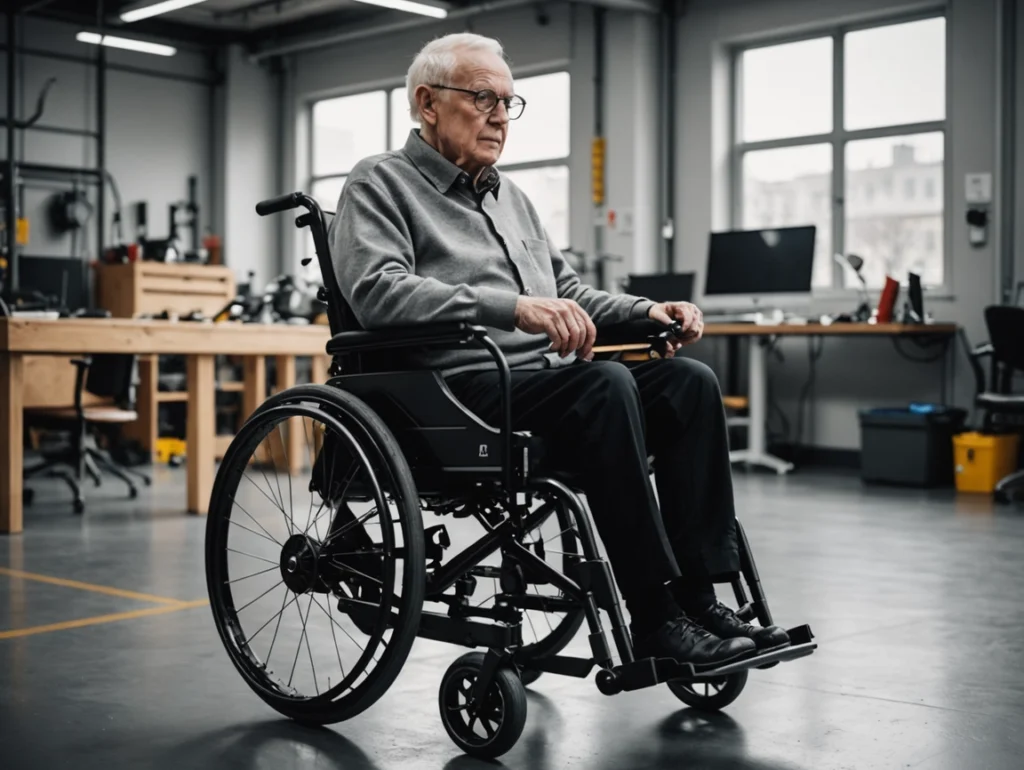
The design of a carbon fiber wheelchair transcends material selection—it begins with understanding the human body it serves. JCSPORTLINE’s OEM/ODM process starts with ethnographic studies of 70+ elderly users, translating their physical limitations into quantifiable engineering targets. For instance, reduced grip strength due to sarcopenia (muscle loss) directly informs handlebar torque requirements, while fall history statistics shape anti-tip geometry. This clinical-to-engineering pipeline ensures that every design decision addresses real-world challenges rather than chasing material trends.

The critical milestone is the Requirements Matrix, a signed document defining non-negotiable thresholds such as a seat-height envelope <430 mm (to aid transfers), transfer torsion <2° (to prevent pelvic strain), and a 5× safety factor at 120 kg load capacity. By locking these parameters before any carbon fiber is cut, JCSPORTLINE eliminates costly late-stage changes and warranty claims. For example, a 1° deviation in seat height could add 1.2 kg to the frame, while miscalculating torsional stiffness might require a 30% thicker laminate—both issues resolved during concept phase.
Translating Gerontological Data into Engineering KPIs
Elderly mobility demands precise metrics. Joint-range data from 70+ subjects dictates pivot angles, while grip-force measurements (averaging 18 Nm) set handlebar torque limits. Even vibration comfort is quantified: 3 Hz is the upper threshold for users with arthritis. One missed KPI at the concept stage can cascade into inefficiencies. For instance, failing to account for wet-floor friction (target: 0.35 coefficient) might necessitate heavier tread patterns, adding 0.8 kg and 11% cost by SOP.


Material Index Scoring: Why Aluminum Hits a Wall at 13 kg

A comparative analysis of aluminum vs. carbon fiber (CFRP) reveals a critical divergence. Aluminum’s stiffness-to-weight ratio peaks at 13 kg for a standard wheelchair frame, constrained by its 2.7 GPa modulus and susceptibility to corrosion. CFRP, however, scores ≥8/10 across three critical axes: specific stiffness (25 GPa/g/cm³), impact toughness (50 J/m), and corrosion resistance (0 rust after 720h salt spray). This allows 0.9 mm wall thickness in seat tubes—impossible for 6061-T6 aluminum without compromising strength.

| Material | Specific Stiffness | Impact Toughness | Corrosion Index | Minimum Wall Thickness |
|---|---|---|---|---|
| Aluminum | 4.2/10 | 6.8/10 | 5.2/10 | 2.2 mm |
| CFRP | 9.1/10 | 8.5/10 | 9.8/10 | 0.9 mm |
Structural Engineering & Simulation: Turning Cloth into a Load-Bearing Monocoque
The transition from carbon fiber cloth to a functional monocoque requires rigorous computational validation. JCSPORTLINE’s 4-stage CAE pipeline ensures structural integrity without over-engineering:
- Topology Optimization: Solid-element density mapping identifies redundant material, shaving 19% weight pre-production.
- Ply-Book Generation: A 0°/±45°/90° layup ratio of 55%/30%/15% balances torsional stiffness (≥1,800 Nm/°) and mass.
- Progressive Failure Modeling: Simulates 200,000 cycles of curb drops and user weight shifts.
- DFMA Freeze: Locks design after verifying manufacturability via 3D printed prototypes.
The simulation reports are shared as IP with clients, providing audit-ready evidence for ISO 7176-8 and FDA 510(k) compliance.
Topology Optimisation: Removing 19% Mass Before Cutting Tools
Topology optimization eliminates non-load-bearing elements early. For example, redundant ribs in the frame’s lower chassis were reduced by 240g, cutting lay-up time by 18 seconds per chair. This “virtual prototyping” reduces material waste and accelerates production ramp-up—critical for meeting 5,000-unit/month targets.

Progressive Failure & Fatigue Modelling (20 kCycles → 200 kCycles)
Using the cohesive-zone method, JCSPORTLINE simulates delamination under extreme loads (e.g., a 150 kg user dropping over a 6g curb impact). The model predicts a safety margin of 2.3× at 200,000 cycles, data clients can embed in warranty whitepapers. This approach avoids “over-designing” for worst-case scenarios, saving 12% in laminate thickness.
Verification Matrix: From Coupon to Whole-Chair Testing That Protects Your Brand Liability
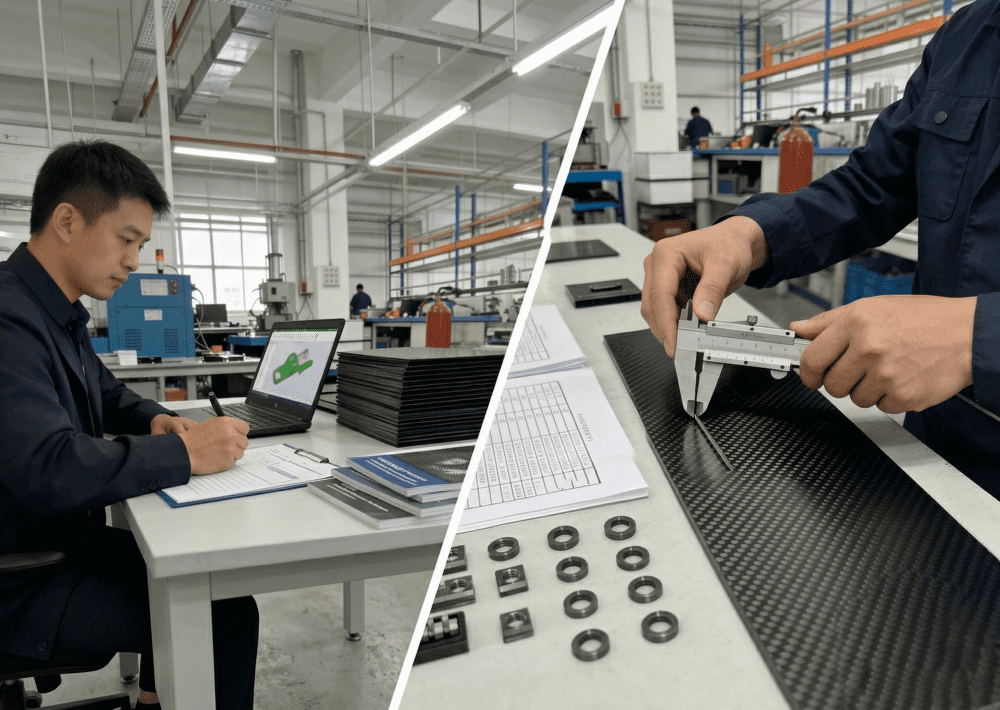
Every simulation must align with physical testing. JCSPORTLINE’s verification matrix maps 100+ virtual load cases to real-world standards:
- ASTM D3039 coupons: Validate fiber tensile strength.
- EN ISO 7176-3 double-drum test: 200,000 cycles to prove fatigue life.
- 8° ramp brake fade: Ensures hill-hold stability.
- Salt-spray 720h: Corrosion resistance certification.
Third-party TÜV/SGS reports accompany every batch, eliminating client QC costs.
Correlation & Model Updating: Closing the Loop Between FEA and Real Strain Data
Digital Image Correlation (DIC) during ISO 7176-3 testing compares FEA predictions with real strain data. A recent update reduced over-engineered plies by 7% after identifying 15% variance in hub stress distributions. This ensures designs remain valid even as tooling wears over 3 years.
Aging Simulation: 10-Year UV & Salt Fog in 1,000 h
Xenon-arc lamps (300 W/m²) and salt fog chambers accelerate aging. After 1,000h, modulus loss remains <5%, critical for coastal markets where chloride-induced corrosion is common.
Scalable Production Engineering: How JCSPORTLINE Safeguards 0.25 mm Tolerance at 5,000 Units/Month
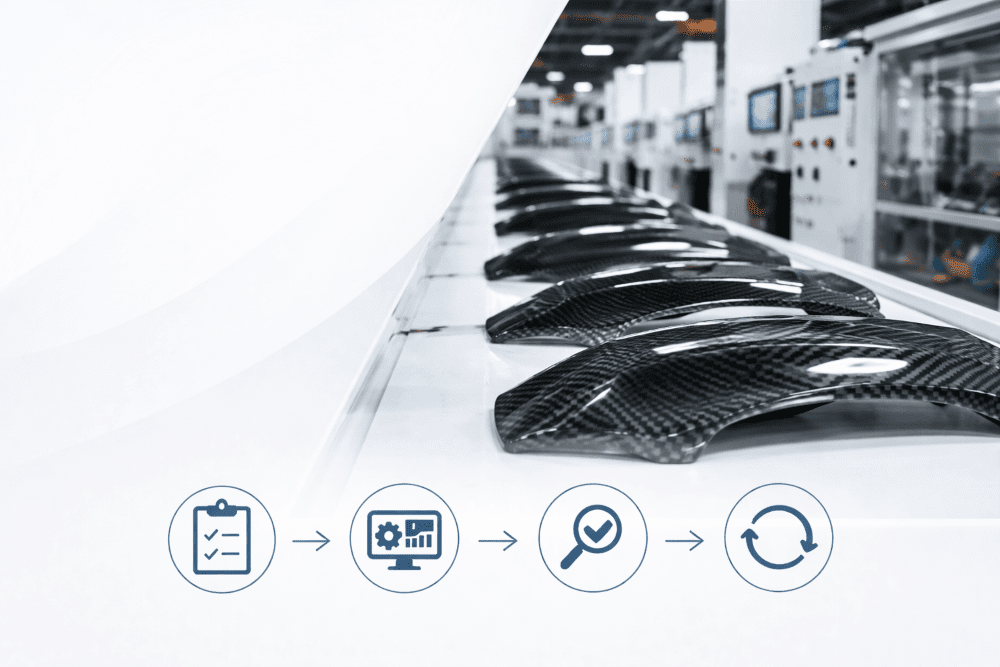
Mass production demands precision. JCSPORTLINE’s PPAP roadmap ensures repeatability:
- Automated ply cutting: ±0.1 mm accuracy via laser plotters.
- Invar steel molds: 350°C-rated for thermal stability.
- 6-station autoclave farm: Parallel curing reduces cycle time.
- Laser radar CMM: Every 20th chair undergoes 3D scanning.
Poka-yoke inserts prevent layup errors, reducing defects to <300 PPM—a figure institutional buyers demand.


Autoclave vs. HP-RTM Trade-Off: Why We Keep Both Lines
HP-RTM (High-Pressure Resin Transfer Molding) cuts cycle time to 18 minutes but yields 48% fiber volume (Fv). Autoclave processing retains 58% Fv for ultra-light SKUs (9.8 kg), justifying its use for premium models. Clients select based on price-point requirements.
Supply-Chain Traceability: Aviation-Grade Precursor to Finished Chair in 30 Days
QR codes link each ply roll to Toray T700SC certification and blockchain-verified resin batches. This traceability meets EU MDR and FDA demands, with full documentation available within 30 days of production.
FAQ – Quick Engineering Answers Your Sales Team Can Quote
FAQ 1: What Makes Carbon Fiber Outperform Aluminum or Steel?
Answer:
- Weight: 9.8–13.8 kg (40% lighter than aluminum, 75% lighter than steel).
- Strength: Tensile strength >3,000 MPa vs. aluminum’s 276 MPa.
- Durability: 3× fatigue life due to corrosion resistance and no weld points.
FAQ 2: How to Verify Genuine Carbon Fiber?
Answer:
- Texture: Continuous unidirectional fibers vs. printed graphics.
- Certification: Toray prepreg lot codes + ASTM D3039 tensile reports.
- Traceability: Laser-etched codes inside seat tubes (scannable via JCSPORTLINE portal).
FAQ 3: Can a 9.8 kg Chair Support 150 kg?
Answer:
Yes. The monocoque design passes ISO 7176-11 static load (2,400 N) and 200,000 fatigue cycles with <0.5 mm deflection. TÜV reports are batch-certified.
FAQ 4: Is Electromagnetic Braking Reliable on Ramps?
Answer:
Brand-spec systems achieve 0.3s response time, 15° hill-hold, and gyro-based anti-tip limiting rollback to <10 mm on wet surfaces.
FAQ 5: What’s the Electric Model’s Range?
Answer:
30 km at 6 km/h (EU test rig) with a 24V 10Ah LiFePO₄ battery and 400W geared motor.
FAQ 6: Can I Customize Dimensions?
Answer:
Yes. Modular molds allow seat widths from 380–520 mm and camber 0–6° within the same toolset, with ROI preserved above 200 units.