1. Performance Criteria That Justify Carbon Fiber
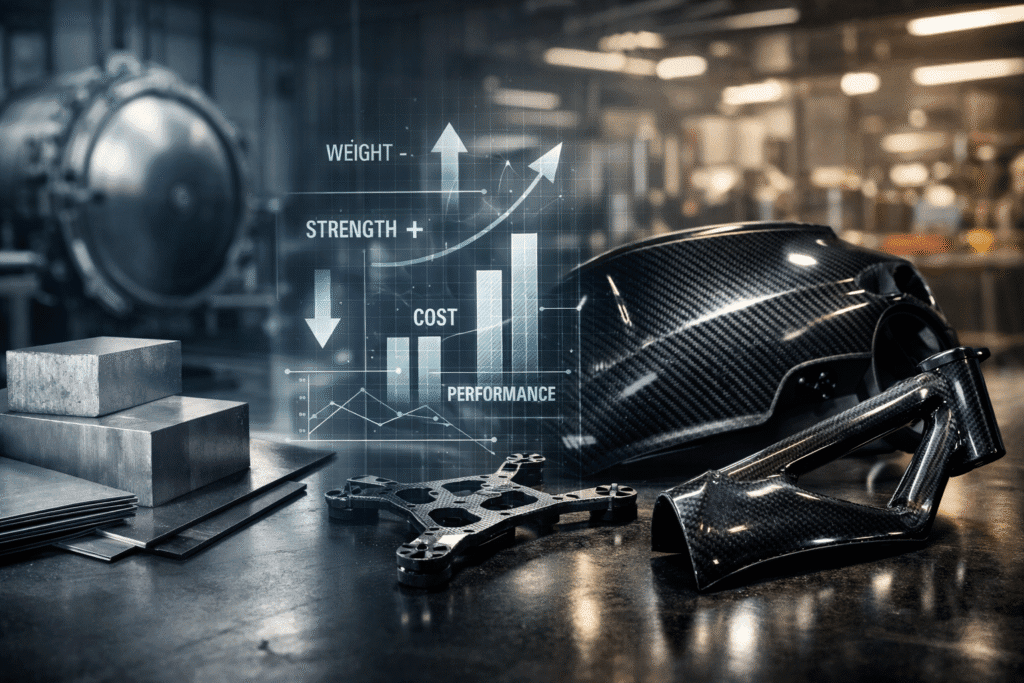
Not every application benefits from carbon fiber’s premium properties. To justify its higher cost, specific engineering thresholds must be met—typically where weight savings directly translate into measurable performance gains or operational durability.
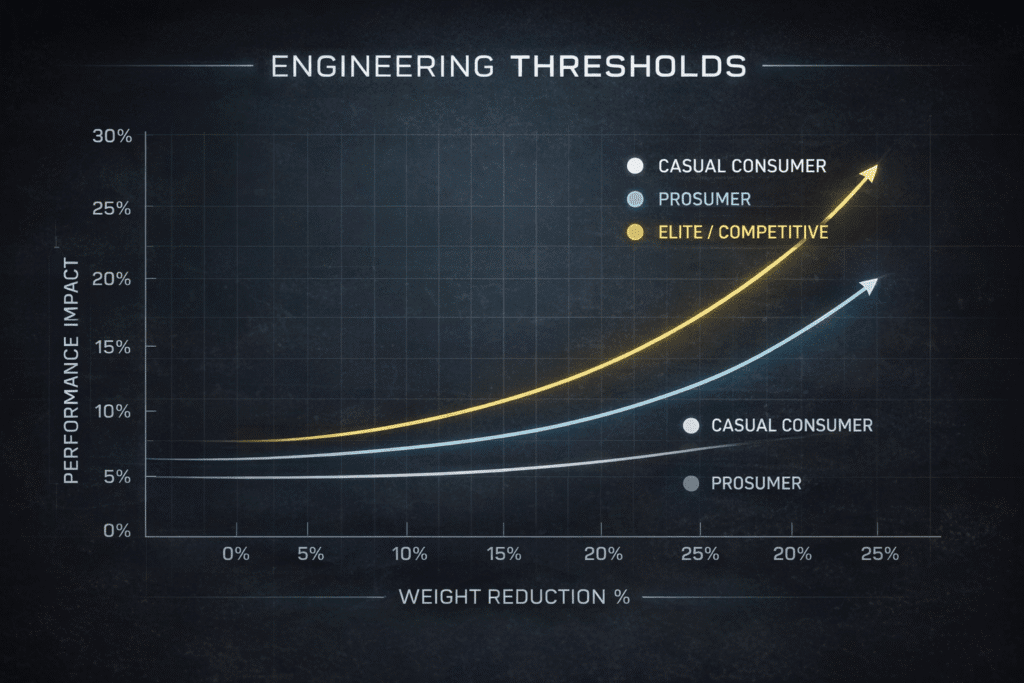
Strength-to-Weight Ratio Benchmarks vs. Aluminum & Steel
Carbon fiber reinforced polymer (CFRP) offers a specific strength (strength divided by density) roughly 5x that of steel and 2–3x that of aluminum alloys like 6061-T6. For example:
- CFRP tensile strength: ~500–1,500 MPa at 1.5–1.6 g/cm³
- Aluminum 6061-T6: ~310 MPa at 2.7 g/cm³
- Mild steel: ~400 MPa at 7.8 g/cm³
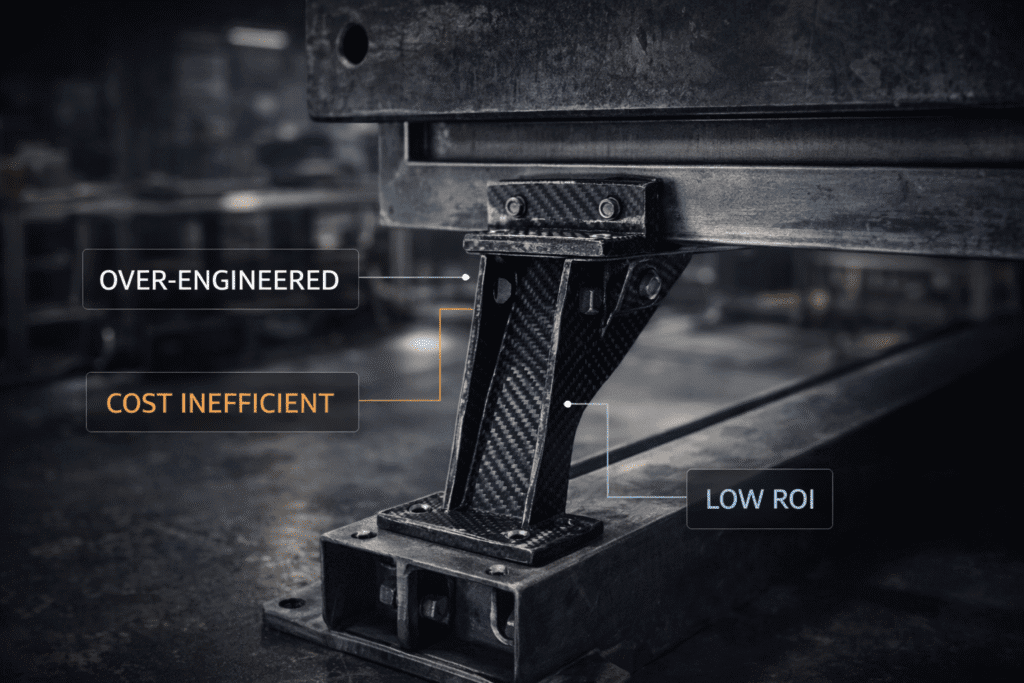
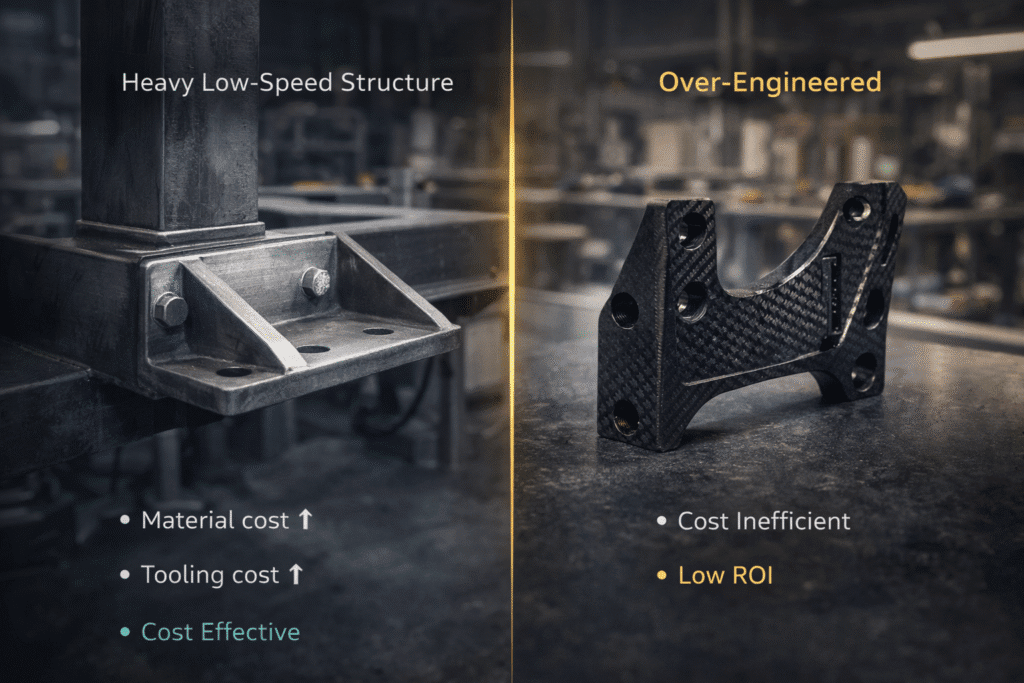
This means for the same load-bearing capacity, a carbon part can weigh less than half of an aluminum equivalent—and one-fifth of steel. But if your structure isn’t weight-constrained (e.g., a stationary bracket), this advantage vanishes.
Stiffness Requirements for Racing & Aero Applications
Stiffness (modulus of elasticity) matters more than strength in many dynamic systems. CFRP’s modulus ranges from 70–200 GPa, comparable to aluminum (~69 GPa) but far below steel (~200 GPa). However, because CFRP is so much lighter, specific stiffness (stiffness/density) is ~2x aluminum and ~4x steel.
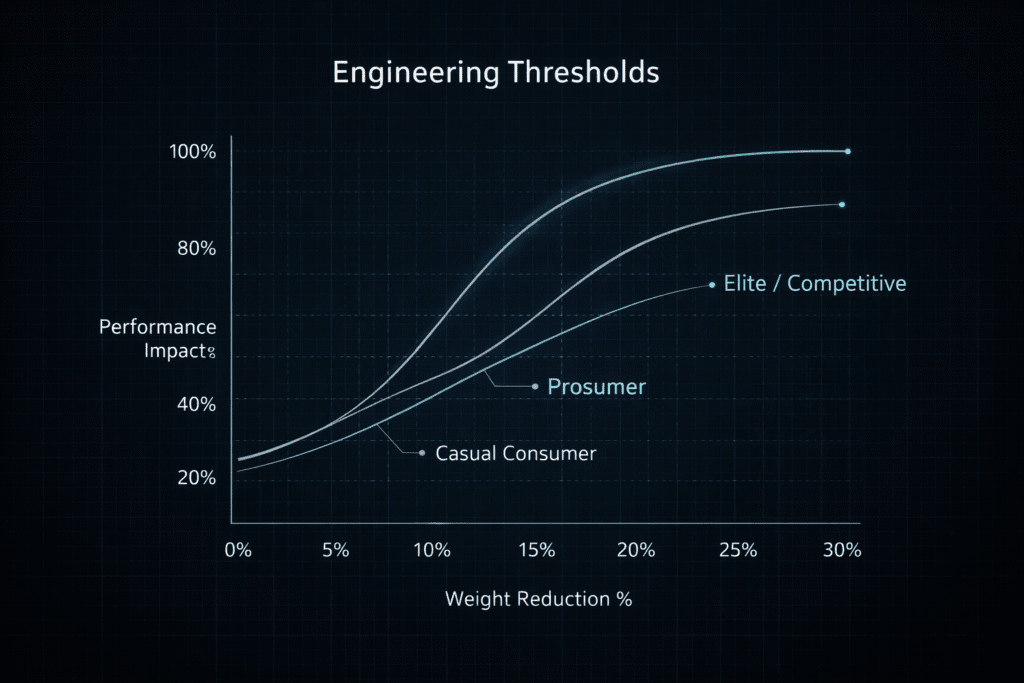
In aerodynamics or suspension geometry, even minor flex under load can degrade performance. Carbon fiber’s high specific stiffness ensures precise control—critical in wings, chassis components, or drone arms where deflection alters airflow or stability.
Fatigue Life & Corrosion Immunity in Harsh Environments
Unlike metals, carbon fiber doesn’t suffer from metal fatigue in the traditional sense—it fails via delamination or fiber breakage after millions of cycles, but with predictable degradation. More importantly, it’s immune to rust and galvanic corrosion, making it ideal for marine, off-road, or chemical-exposed applications where aluminum would require protective coatings or frequent replacement.
Thermal Limits and Expansion Coefficient Advantages
Carbon fiber has a near-zero coefficient of thermal expansion (CTE) along the fiber direction—often <1 ppm/°C, versus aluminum’s 23 ppm/°C. This dimensional stability is vital in precision instruments, satellite components, or brake ducts where temperature swings cause misalignment in metal parts.
However, standard epoxy-based CFRP softens above ~120°C. High-temperature resins (e.g., bismaleimide) extend this to 250°C+, but at significantly higher cost.
💡 Value Proposition: Carbon fiber shouldn’t be chosen because it’s “strong”—it should be chosen when every gram saved delivers measurable ROI in speed, efficiency, or longevity. If a steel or aluminum part meets your stiffness, durability, and weight targets at lower cost, stick with it.
2. Total Cost-of-Ownership Analysis
The upfront price of carbon fiber parts often shocks buyers—$500 for a hood, $3,000 for a bike frame. But lifetime value tells a different story.
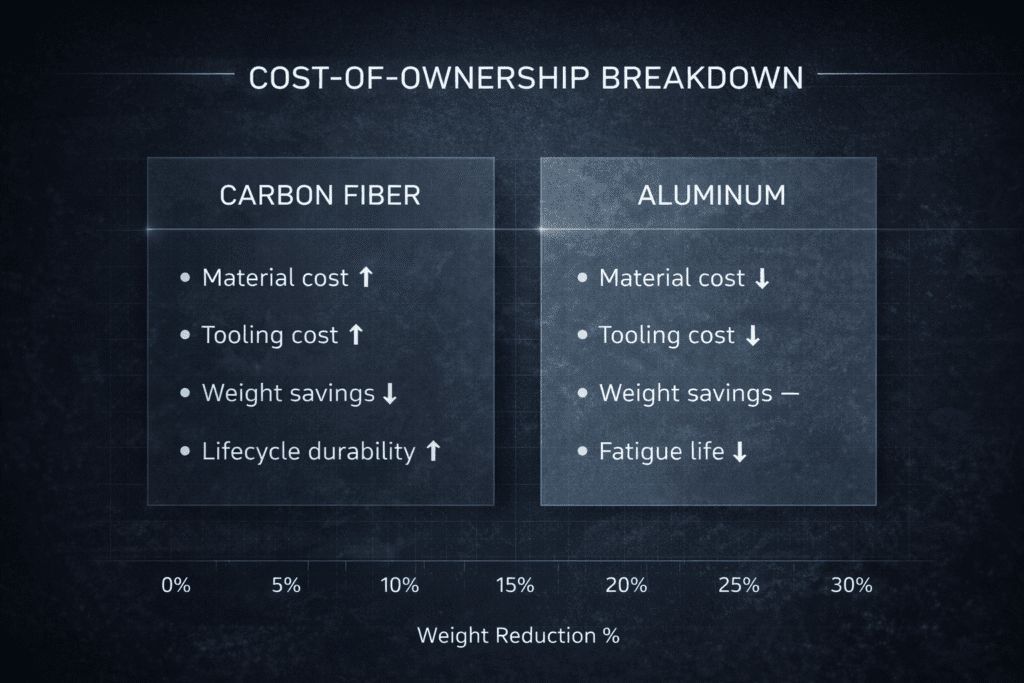
Up-Front Cost vs. Long-Term Fuel/Energy Savings
In weight-sensitive applications, reduced mass compounds over time:
- Automotive: Saving 100 kg can improve fuel economy by 3–5% (U.S. DOE). Over 150,000 miles, that’s hundreds of gallons saved.
- UAVs/Drones: Every 1 kg saved in airframe weight = +1 kg payload or +3 minutes flight time—directly increasing mission capability or revenue per flight.
- Cycling: A 200g frame saving reduces climbing power demand by ~1.5 watts on a 5% grade—enough to gain seconds per kilometer in races.
Repairability & Inspection Costs
Cosmetic cracks in clear-coated carbon are common and usually harmless. But structural damage (delamination, crushed fibers) requires specialized repair—often costing 50–100% of a new part. Unlike metal, which dents visibly, carbon damage can be hidden, necessitating ultrasound or thermography inspections.
Insurance & Crash-Replacement Realities
Many insurers treat carbon fiber components as “total loss” items after moderate impacts due to uncertain structural integrity. Replacement costs can inflate claims—especially on street cars not designed for composite crash structures.
Resale Value Premium
In performance markets (track cars, high-end bikes, racing drones), carbon fiber commands a 10–20% resale premium. Enthusiasts recognize its role in performance, making it a sound investment—if aligned with actual use.
💡 Value Proposition: Calculate dollars saved per kilogram over the product’s life. If fuel, time, or performance gains outweigh the initial markup within your ownership window, carbon fiber pays for itself.
3. Application Benchmarks: Where Carbon Fiber Excels
Let’s examine real-world cases where carbon fiber passes both performance and economic tests.
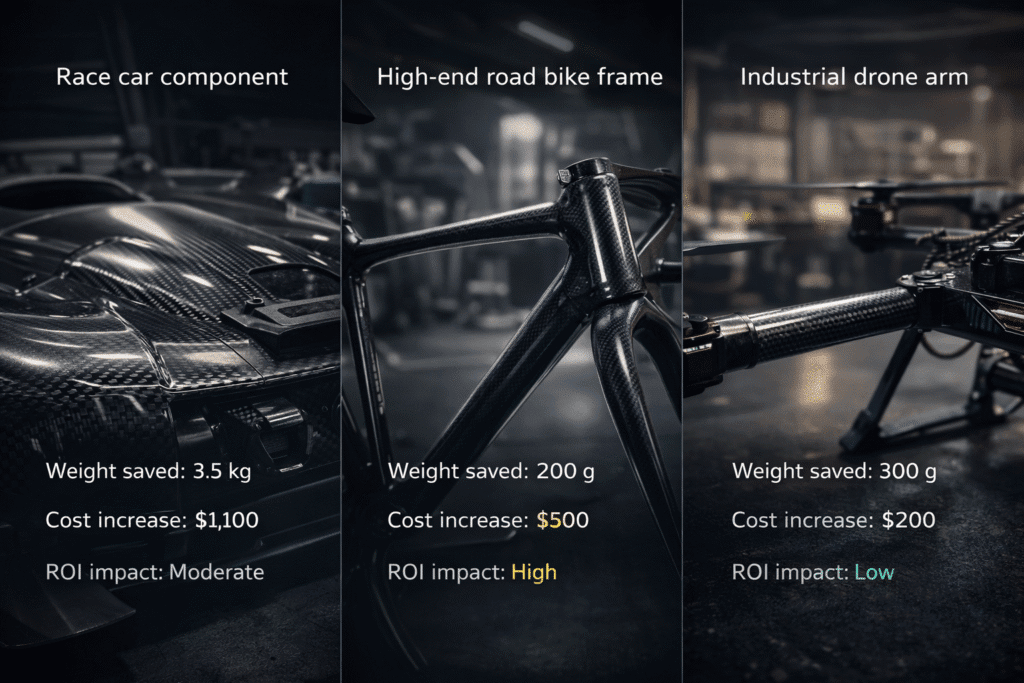
3.1 Motorsport & Track-Day Vehicles
In racing, weight location matters as much as total mass. FIA regulations set minimum vehicle weights, so teams use ultra-light carbon parts (roof, hood, seats) to reposition ballast lower and closer to the center, improving handling.
Case Study: Porsche 911 GT3 RS
- Carbon roof vs. glass: −3 kg
- Result: −0.3 seconds per lap at the Nürburgring
- ROI: For pro teams, 0.1s = podium position → justifies $10k+ part cost
✅ Use carbon fiber here: When lap time = revenue.
3.2 Aerospace & Drones
Payload efficiency is everything. In commercial UAVs:
- A 1.5 kg carbon frame vs. 2.5 kg aluminum = +1 kg camera/battery
- Extends flight time from 25 → 28+ minutes—critical for surveying or delivery
But certification (e.g., RTCA DO-160) adds cost and time. Only viable at scale or for high-margin operations.
✅ Use carbon fiber here: When every minute of flight = billable hour.
3.3 High-End Bicycle & Sporting Goods
Elite road bikes use carbon to balance stiffness (power transfer), compliance (comfort), and low weight.
- 200g saved ≈ 1.5W less effort climbing
- Over a 100km race with 2,000m elevation, that’s ~50 kJ saved—enough to stay with the peloton
But crash risk looms. Brands like Specialized and Trek now offer crash replacement programs (50% off new frame within 2 years), reducing buyer anxiety.
✅ Use carbon fiber here: If you race or ride aggressively—and accept the risk.
3.4 Luxury Automotive Trim & Aero
Here, carbon fiber often crosses into marketing territory. A carbon spoiler on a 1,800 kg SUV might save 0.8 kg—just 0.04% of total mass. Fuel impact? Negligible.
Yet the visual weave signals performance—even when none exists. Forged carbon (random chips in resin) offers similar looks at lower cost but less structural benefit.
⚠️ Caution: Cosmetic carbon rarely improves performance. Buy it for aesthetics, not engineering.
4. Red Flags: Situations to Avoid Carbon Fiber
Carbon fiber isn’t universally superior. These scenarios often lead to cost overruns, safety issues, or regulatory trouble.
| Red Flag | Why It Matters | Better Alternative |
|---|---|---|
| High-impact, low-energy zones (e.g., front bumper) | Carbon shatters; repair > replacement cost | Thermoplastics, aluminum |
| Operating temps > 120°C (brake ducts, exhaust) | Standard epoxy degrades; warps or delaminates | High-temp alloys, ceramic composites |
| Low-volume production (<100 units) | Tooling + labor amortization kills ROI | CNC aluminum, 3D-printed polymers |
| Strict end-of-life rules (EU, California) | CFRP isn’t recyclable via conventional means; landfill bans emerging | Bio-composites, recyclable metals |
💡 Key Insight: If your part lives in a high-abrasion, high-heat, or crash-prone zone, or you’re making fewer than 100 units, carbon fiber likely fails the cost-benefit test.
5. FAQ: Quick Answers to Common “Should I Use Carbon Fiber?” Questions
How much weight will carbon fiber actually save on my car hood?
Typical steel hood: 18–22 kg
Aluminum: 10–12 kg
Carbon fiber: 6–8 kg
→ Savings: 4–6 kg vs. aluminum, 12–14 kg vs. steel. Real-world fuel impact: minimal on daily drivers, noticeable on track.
Can carbon fiber be repaired after a crack?
Cosmetic cracks: Yes—fill, sand, clear coat.
Structural damage: Requires professional layup, autoclave curing. Often not cost-effective for consumer parts.
Does carbon fiber degrade in sunlight?
UV rays attack the epoxy resin, causing yellowing and surface microcracks. Always use UV-resistant clear coat. Fibers themselves are unaffected.
Is forged carbon stronger than woven carbon?
No. Forged carbon (compression-molded chips) has lower fiber alignment, reducing strength and stiffness vs. unidirectional or woven prepreg. It’s chosen for complex shapes and visual texture, not peak performance.
Final Thought: Choose Function Over Fashion
Carbon fiber is a tool, not a trophy. Use it when physics and economics align—when grams saved turn into seconds gained, miles extended, or lifespans lengthened. But don’t let the allure of black weave blind you to simpler, smarter solutions.
Ask: Does this part need to be lighter, stiffer, or more durable—and will those improvements pay back their cost? If yes, carbon fiber may be your answer. If not, save your budget for where it truly matters.