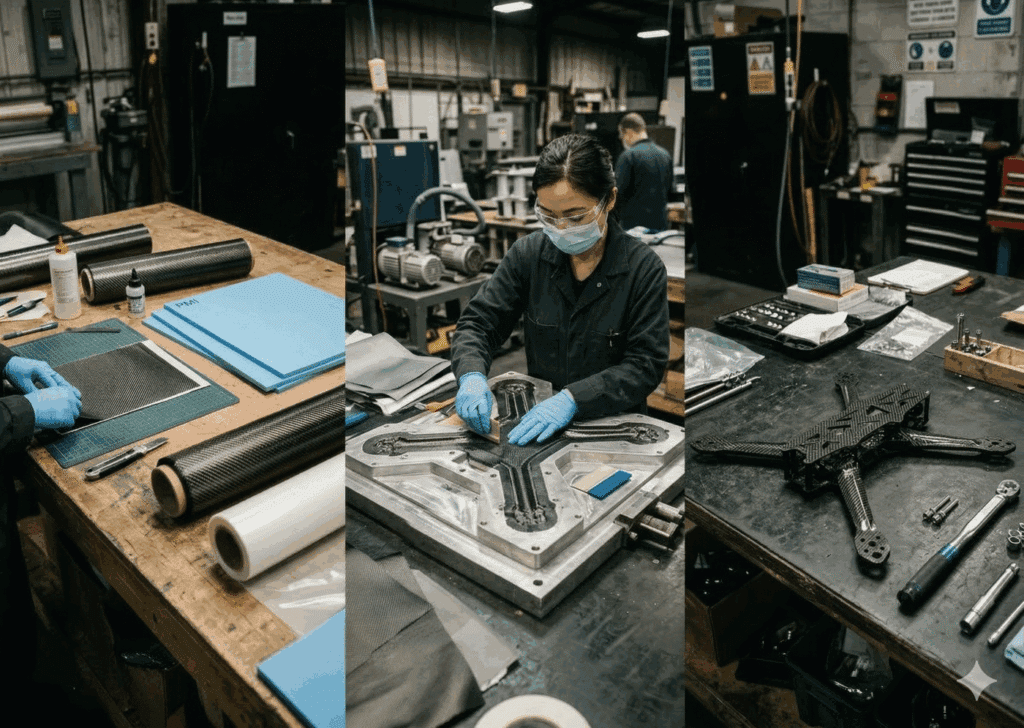
Why Carbon Fiber Is the Preferred Material for Drone Structures
Drone design is fundamentally constrained by weight. Every gram added to a UAV structure reduces payload capacity, shortens flight endurance, and increases power consumption. Because of this, engineers constantly search for materials that offer high structural strength without adding unnecessary mass.
Carbon fiber composites have emerged as the ideal solution. By combining carbon fiber reinforcement with advanced resin systems, manufacturers can produce structural components that are significantly lighter and stronger than conventional metals such as aluminum.
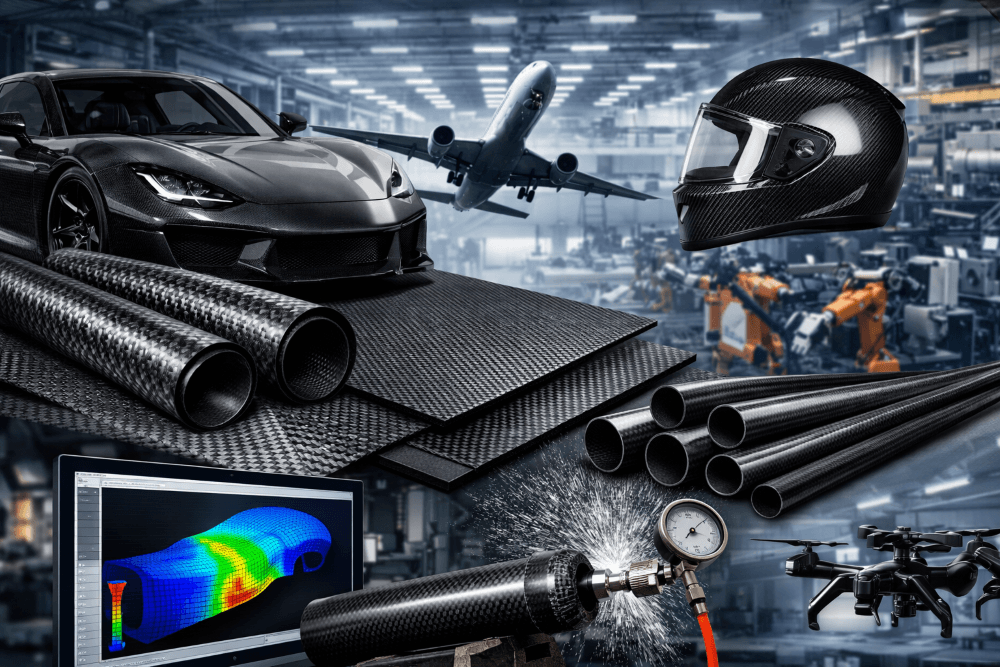
In modern UAV engineering, carbon fiber is widely used for frames, fuselage shells, wings, rotor arms, and structural panels. These components must withstand aerodynamic loads, vibration, and repeated stress cycles while maintaining dimensional stability.
Strength-to-Weight Advantages in UAV Design
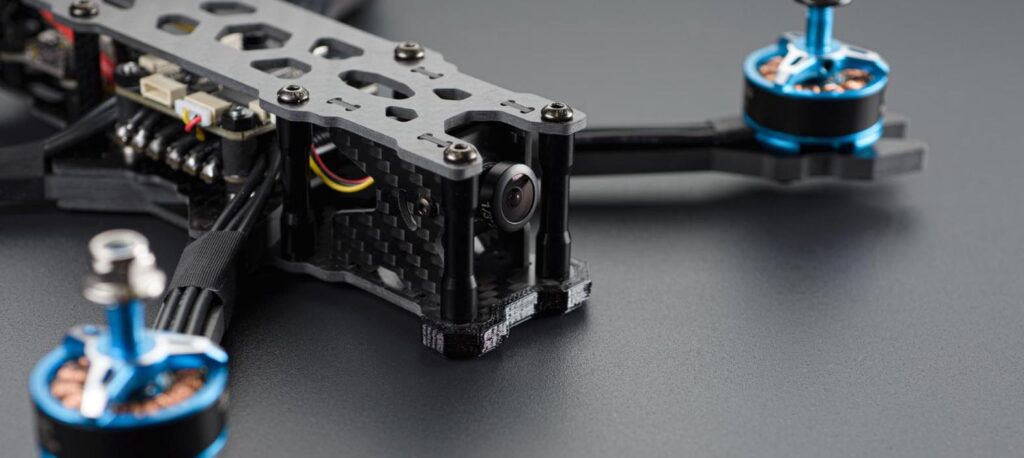
One of the most important reasons carbon fiber is used in drone construction is its exceptional strength-to-weight ratio.
Traditional metals offer predictable mechanical performance but come with a significant weight penalty. Carbon fiber composites, in contrast, provide high tensile strength while maintaining extremely low density.
| Material | Approximate Density | Strength-to-Weight Advantage |
|---|---|---|
| Carbon Fiber Composite | ~1.6 g/cm³ | Very High |
| Aluminum Alloy | ~2.7 g/cm³ | Moderate |
| Steel | ~7.8 g/cm³ | Low |
This difference allows engineers to design UAV structures that are lighter yet stronger than comparable metal components. The benefits include:
- Increased flight endurance due to reduced structural mass
- Higher payload capacity for sensors or equipment
- Improved maneuverability and aerodynamic performance
- Better resistance to vibration and fatigue
For high-performance drones, these advantages translate directly into longer flight times and more stable operation.
Why Sandwich Structures Improve Drone Structural Performance
While carbon fiber itself is strong and lightweight, additional structural efficiency can be achieved using sandwich composite construction.
A sandwich structure typically consists of:
- Two thin carbon fiber composite skins
- A lightweight structural core material placed between them
The core material separates the two carbon fiber skins, increasing the structural moment of inertia and dramatically improving bending stiffness without significantly increasing weight.
This concept is widely used in aerospace engineering and has become common in UAV components such as:
- Drone wings
- Fuselage panels
- Structural housings
- Aerodynamic covers
One of the most widely used core materials for these sandwich structures is PMI foam.
Materials Used in Carbon Fiber Drone Components
The performance of a composite UAV structure depends heavily on the materials used in its construction. Carbon fiber composites are not a single material but rather a system consisting of reinforcement fibers, resin matrices, and sometimes structural core materials.
Understanding these materials helps explain how modern drone components achieve their strength, stiffness, and lightweight characteristics.
Carbon Fiber Fabrics and Structural Reinforcement
Carbon fiber reinforcement is the primary load-bearing component of composite drone structures. These fibers are typically woven or arranged in specific orientations to provide strength along desired load paths.
The orientation of fibers plays a crucial role in determining the mechanical performance of the final component. Engineers often use multiple fiber directions within a laminate to ensure balanced strength in different loading conditions.
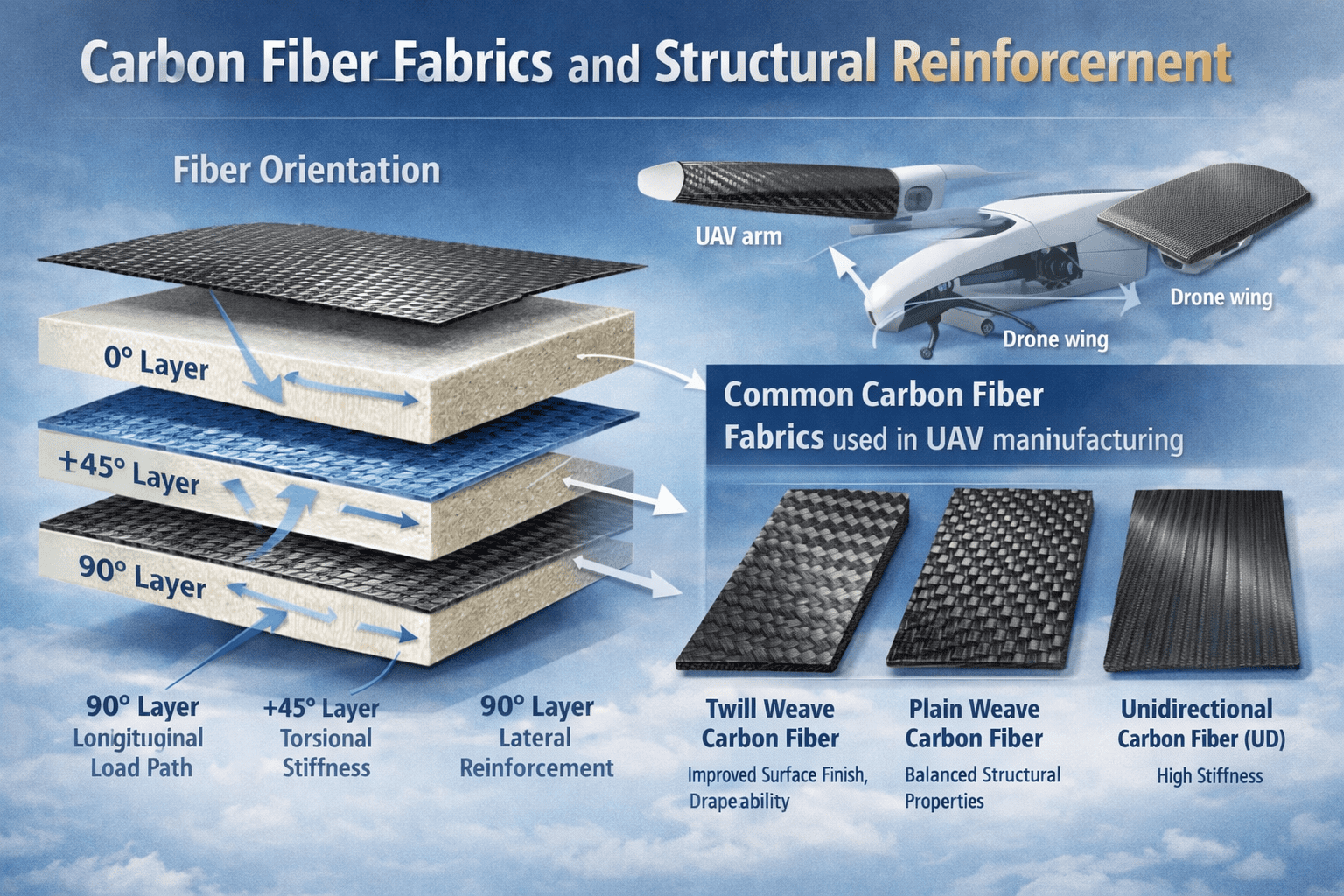
Typical fiber orientations include:
- 0° layers for longitudinal strength
- ±45° layers for torsional rigidity
- 90° layers for transverse stability
By stacking these layers strategically, engineers can create composite structures tailored to the load conditions experienced by drone components.
Common carbon fiber fabrics used in UAV manufacturing include:
- Twill weave fabrics for improved surface finish and drapability
- Plain weave fabrics for balanced structural properties
- Unidirectional carbon fiber for high stiffness in specific directions
The combination of these materials enables highly optimized structural performance.
The Role of Epoxy Resin Systems in Composite Parts
While carbon fibers provide strength, they cannot function as structural components without a binding matrix. This is where resin systems play a crucial role.
Epoxy resin is the most commonly used matrix material in aerospace composites. Its functions include:
- Binding fibers together into a solid laminate
- Transferring loads between fibers
- Protecting fibers from environmental damage
- Providing chemical and thermal resistance
Proper resin curing is essential for achieving the desired mechanical properties. During manufacturing, temperature and pressure are carefully controlled to ensure complete resin polymerization.
High-quality resin systems also improve fatigue resistance and long-term durability — both critical for UAV structures exposed to vibration and cyclic loading.
Why PMI Foam Is Used as a Lightweight Core Material
PMI (polymethacrylimide) foam is a high-performance structural foam widely used in aerospace composite sandwich structures.
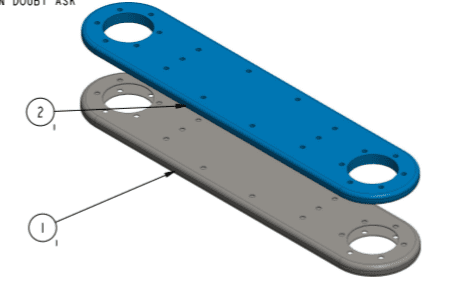
Unlike conventional foams, PMI foam offers:
- High compressive strength
- Excellent thermal resistance
- Low density
- Compatibility with composite curing processes
Because of these properties, PMI foam is frequently used as the core material in drone components that require high stiffness without increased weight.
Typical applications include:
- UAV wing structures
- Drone fuselage panels
- Aerodynamic fairings
- Structural reinforcement panels
By combining carbon fiber skins with PMI foam cores, engineers can create extremely stiff yet lightweight structures ideal for UAV applications.
The Carbon Fiber Drone Manufacturing Process
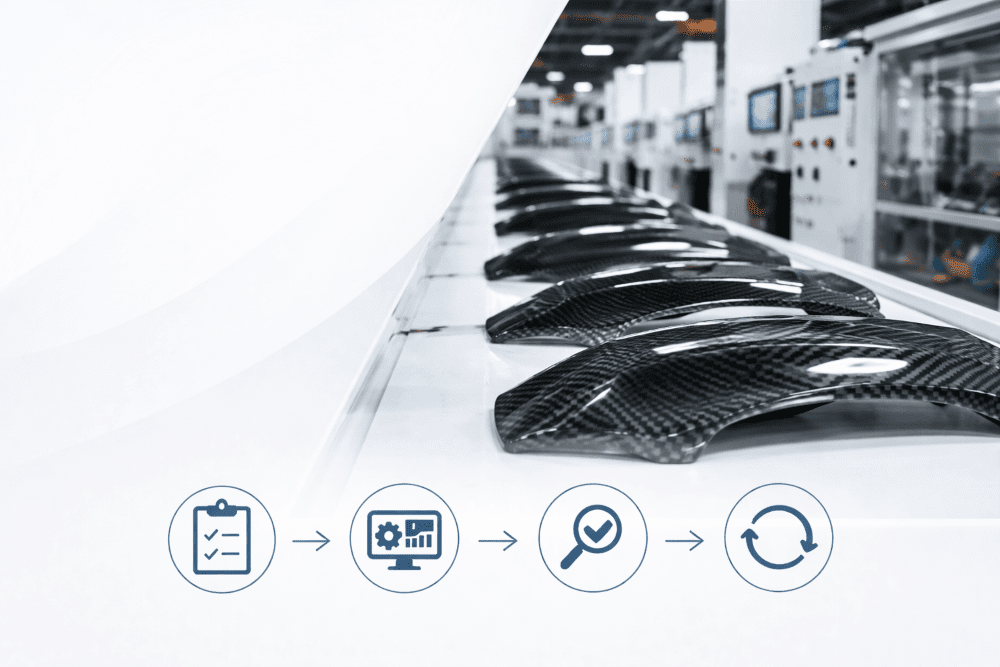
Producing carbon fiber drone components involves a multi-step manufacturing process that ensures both structural integrity and dimensional accuracy.
The process typically includes mold preparation, composite layup, precision molding, and post-processing operations.
Mold Preparation and Composite Layup
Manufacturing begins with the preparation of molds that define the final geometry of the drone component.
These molds are typically made from aluminum, steel, or composite tooling materials depending on production volume and complexity.
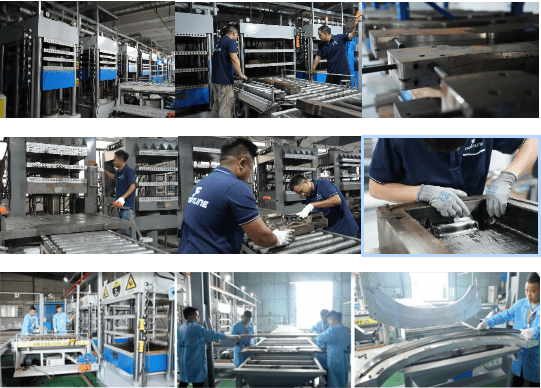
Before layup begins, several preparation steps are performed:
- Mold surface cleaning
- Application of release agents
- Inspection of mold geometry
Once the mold is prepared, carbon fiber fabrics are cut according to the required fiber orientation patterns. These layers are then carefully placed into the mold.
During layup, technicians ensure:
- Correct fiber orientation
- Uniform material distribution
- Accurate alignment of structural layers
This step is critical because errors during layup can lead to structural weaknesses or defects in the finished part.
Compression Molding for Carbon Fiber Drone Parts
After the composite layers and core materials are placed in the mold, the assembly undergoes compression molding.
Compression molding is widely used for carbon fiber drone components because it provides consistent pressure and temperature conditions during curing.
The typical process includes:
- Mold closing and pressure application
- Controlled heating to activate resin curing
- Sustained pressure during curing
- Controlled cooling before demolding
The advantages of compression molding include:
- Excellent dimensional consistency
- High production repeatability
- Smooth surface finish
- Efficient production for medium-volume parts
This method is particularly suitable for structural UAV components that require tight tolerances and repeatable mechanical performance.
Post-Processing: Machining, Bonding, and Surface Finishing
Once the molded part is removed from the mold, additional operations are often required to achieve the final product specifications.
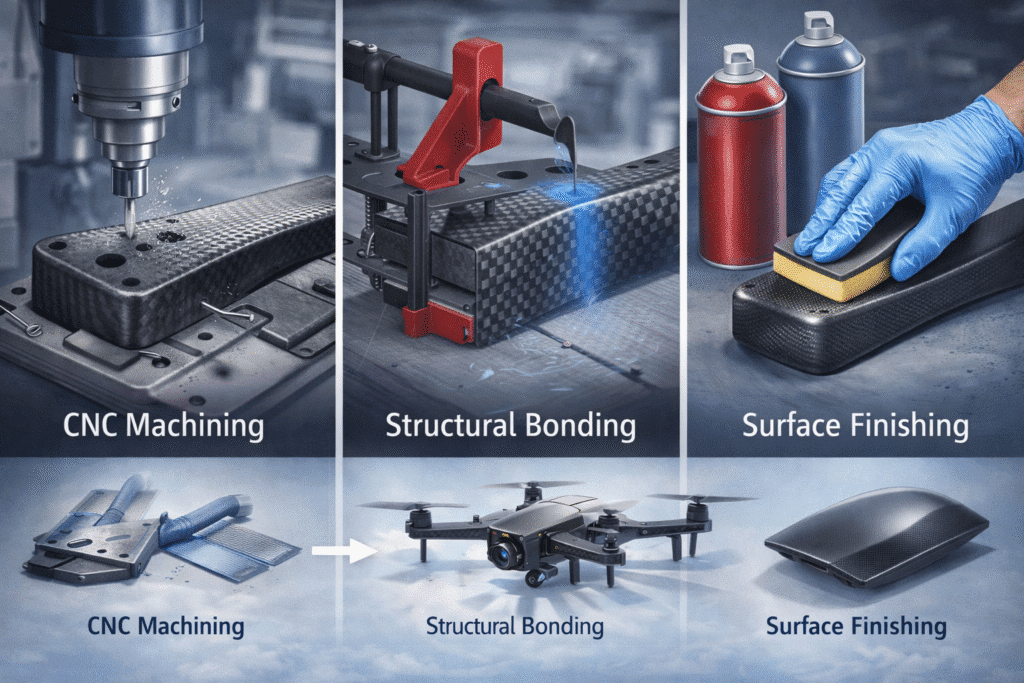
Common post-processing steps include:
CNC Machining
CNC machining is used to achieve precise tolerances and create features such as mounting holes, edges, and interface surfaces.
Typical tolerances for high-quality carbon fiber parts can reach approximately ±0.3 mm depending on the manufacturing process.
Structural Bonding
Some UAV components consist of multiple composite sections that must be bonded together using aerospace-grade adhesives.
Structural bonding ensures:
- Load transfer between parts
- Structural integrity
- Smooth aerodynamic surfaces
Surface Finishing
Final finishing operations improve both appearance and environmental protection. These may include:
- Sanding and polishing
- Protective coatings
- Matte or painted surface finishes
These steps ensure the component meets both functional and aesthetic requirements.
FAQ: Carbon Fiber Drone Manufacturing
What tolerance can carbon fiber drone parts achieve?
High-precision composite manufacturing processes can typically achieve tolerances around ±0.3 mm for molded parts. Additional CNC machining can further refine critical features and mounting interfaces.
Why are foam core structures used in UAV components?
Foam core structures increase stiffness without adding significant weight. By separating two carbon fiber skins with a lightweight core such as PMI foam, engineers can dramatically improve structural rigidity.
What manufacturing process is best for carbon fiber drone parts?
Several processes are used in composite manufacturing, but compression molding is widely preferred for UAV components because it provides consistent curing conditions, good surface quality, and repeatable structural properties.
How durable are carbon fiber UAV components compared with aluminum?
Carbon fiber composites often offer superior fatigue resistance and corrosion resistance compared with aluminum. When properly engineered, they can withstand repeated loading cycles while maintaining structural integrity.