Performance Payoff – Where Carbon Fiber Beats Every Other Material
Carbon fiber’s premium price only makes sense if it delivers measurable gains. Let’s quantify exactly where and how much it outperforms alternatives like steel and aluminum.
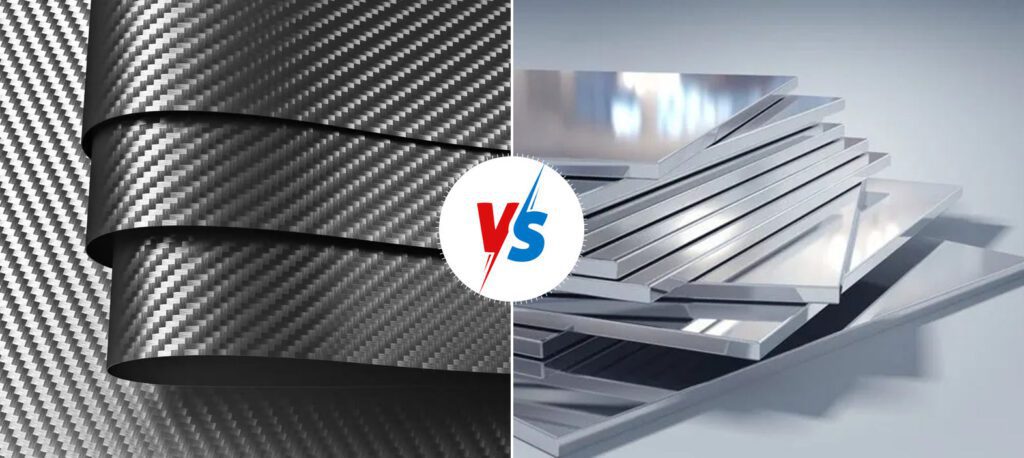
Strength-to-Weight Dominance
The key metric here is specific strength (tensile strength divided by density), measured in MPa·cm³/g:
- Carbon fiber: ~150–200 MPa·cm³/g
- Aluminum 6061-T6: ~65 MPa·cm³/g
- Mild steel: ~25 MPa·cm³/g
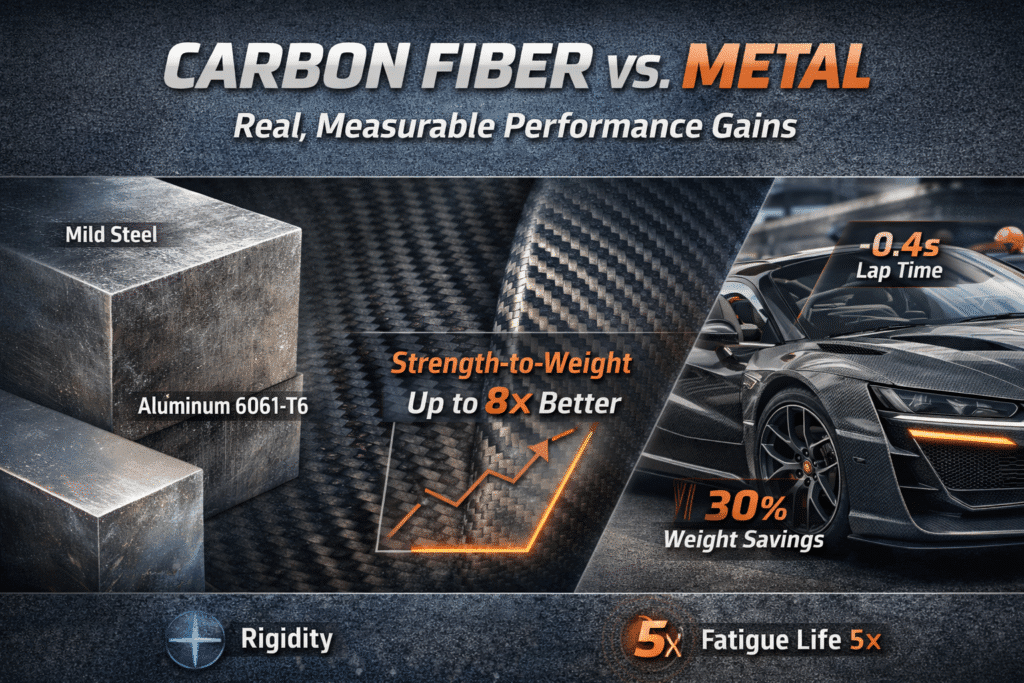
This means carbon fiber is 3–8× stronger per unit weight than common metals. On a chassis or body panel, that translates directly to weight savings without sacrificing rigidity.
Lap-Time Gains via Rigidity & Damping
Carbon fiber’s high modulus (stiffness) and superior vibration damping reduce chassis flex under load. In track testing, a 20% increase in torsional rigidity (achievable with strategic CF reinforcement) can improve cornering grip by 2–3%, shaving 0.2–0.4 seconds per lap on a 2-minute circuit.
Even on the street, reduced flex sharpens steering response and improves ride consistency—drivers do feel it.
Real-World Acceleration Impact
Consider this case study:
Swapping a 12 kg steel hood for a 9 kg carbon fiber unit (net 3 kg saved) on a 300 hp, 1,500 kg car reduces 0–100 km/h time by ~0.15 seconds.
Why? Less mass = less inertia. And because the hood sits far forward, it also slightly improves weight distribution.
Fatigue Life Advantage
Unlike metals that crack under cyclic stress, carbon fiber composites endure 5× more fatigue cycles than glass-fiber equivalents at equal weight. For track cars logging hundreds of laps, this means longer part life and consistent performance.
Verdict: If you track your car or crave sharper dynamics, carbon fiber delivers real, quantifiable gains—especially in unsprung or high-leverage areas (hoods, roofs, trunk lids).
True Total Cost – Price per kg Saved & Hidden Expenses
Carbon fiber’s sticker shock is just the beginning. The true cost includes installation, insurance, repair, and resale impact.
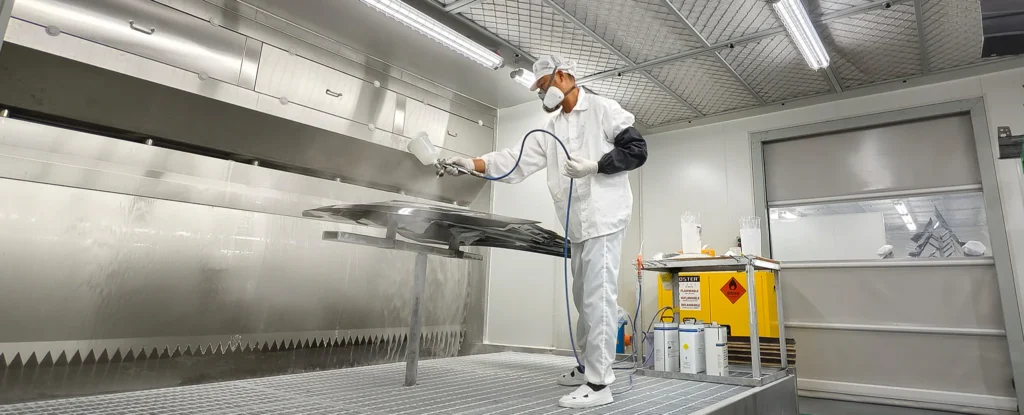
Price per Kilogram Saved
Not all weight savings are equal. Here’s what you’re really paying per kg removed:
- Hood: $18–22/kg saved
- Roof panel: $35–40/kg saved
- Full monocoque: $60+/kg saved
Compare that to aluminum ($5–8/kg raw material), and the premium is clear. But performance isn’t just about material—it’s about system efficiency.
Installation & Paint Premiums
Carbon fiber requires special handling:
- Conductive primer needed to prevent static discharge during painting
- Extra sanding/sealing steps to avoid print-through of the weave
- Result: 30% higher paint labor costs vs. OEM metal panels
A $2,000 hood can easily become a $2,800 installed job.
Insurance & Resale Realities
Declare carbon fiber mods, and insurers often hike premiums by 8–12% due to increased declared value and perceived risk.
Worse: Leased or short-term owned cars rarely recoup CF value at resale. Aftermarket carbon is often seen as “custom,” not “premium.”
Repair Costs: Patch or Replace?
Small cracks (<5 cm): $400–600 for professional epoxy injection and cosmetic repair.
Structural damage or large fractures: $1,800–2,500 for full replacement—often more than the original part cost on budget builds.
Bottom line: Budget 20–30% extra beyond the purchase price for true ownership cost.
When It’s NOT Worth It – Real-World Scenarios to Skip Carbon
Despite its allure, carbon fiber is overkill—or even counterproductive—in many daily scenarios.
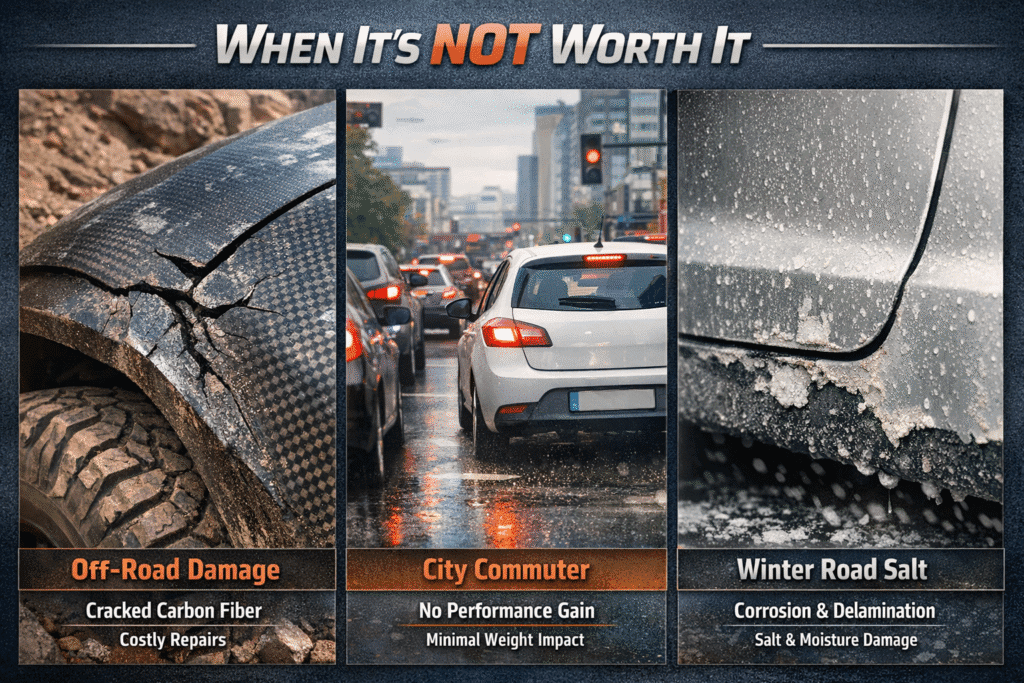
Daily Commuters (<8 km Trips)
If your car never sees >60 km/h and carries groceries more than lap times, aero and weight savings are irrelevant. Saving 5 kg on a 1,600 kg commuter is <0.4% mass reduction—undetectable in real-world driving. Fuel savings? Less than $5/year at $1.60/L.
Off-Road or Adventure Rigs
Carbon fiber has low impact toughness compared to HDPE (high-density polyethylene) or SMC (sheet-molded compound). A rock strike that dents steel may shatter a carbon fender. Trail repairs are impractical, and replacements cost 3–5× more.
Winter Climates with Road Salt
Exposed carbon weave (common on “dry” or unpainted finishes) absorbs moisture. Combine that with road salt, and micro-delamination begins within 18–24 months. UV degradation accelerates it. Without a proper UV-blocking clear coat, your “show piece” turns chalky and weak.
Leased or Short-Term Vehicles
Dealers don’t credit aftermarket carbon at trade-in. You’ll likely be charged for “modifications” or forced to reinstall OEM parts—losing thousands.
Red flag: If you’re buying carbon fiber just for the look (e.g., fake vents, cosmetic trim), you’re paying $3,000+ for zero performance ROI.
Decision Matrix & Buyer Checklist
Still unsure? Use this 4-question filter to decide if carbon fiber is right for your build:
- Primary Goal: Show car, weekend track toy, or daily driver?
→ Only track/show justifies high cost. - Budget Cap: Can you afford 2× the part price for install/insurance/contingency?
- Climate: Do you face salt, extreme UV, or off-road abuse? If yes, reconsider.
- Ownership Length: Keeping the car <3 years? Probably not worth it.
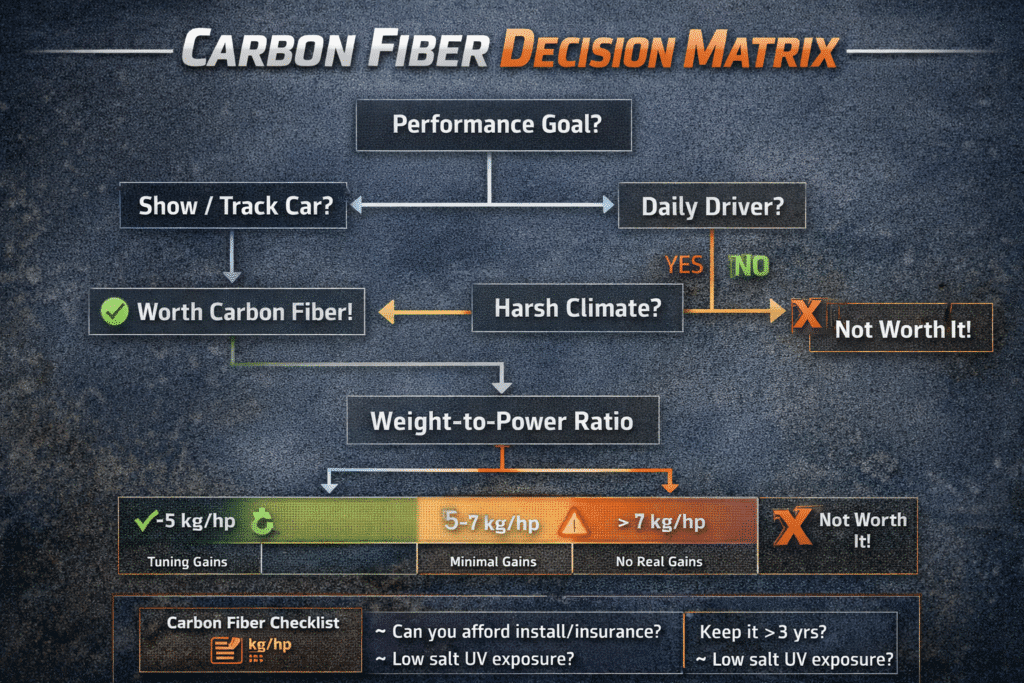
Performance Threshold: Weight-to-Power Ratio
Carbon fiber starts delivering meaningful 0–100 gains only when your car’s weight-to-power ratio is <7 kg/hp.
- Example: 1,400 kg car with 200 hp = 7.0 kg/hp → marginal gain
- 1,200 kg with 300 hp = 4.0 kg/hp → CF saves real time
ROI in Fuel Savings? Forget It
At $1.60/L, saving 10 kg might cut annual fuel use by 15–20 liters—worth $24–32/year. At a $2,000 investment, payback period = 60+ years. Performance, not efficiency, is the play.
Quality Red Flags – Walk Away If:
- Void content >2% (indicates poor curing)
- Glass transition temp (Tg) <120°C (will soften in hot climates)
- No UV-blocking top coat (will degrade in sunlight)
FAQ – Quick Answers to Your Lingering Doubts
Q: How much weight will I realistically lose swapping a steel hood for carbon?
A: Typically 30–40% lighter. A 12 kg steel hood becomes 7–8 kg in carbon—saving 4–5 kg.
Q: Does carbon fiber increase or decrease insurance premiums?
A: Increases—by 8–12% if declared. Undeclared mods risk claim denial.
Q: Can cracked carbon fiber be repaired at home?
A: Small surface cracks: maybe with epoxy kits. Structural damage: no. Professional repair is strongly advised.
Q: Is forged carbon stronger than woven carbon for automotive use?
A: Forged carbon (compression-molded chips) offers better impact resistance and complex shapes but lower tensile strength than unidirectional woven CF. Best for non-structural show pieces (mirror caps, interior trim).
Final Verdict: Is Carbon Fiber Worth It?
For track-focused builds, lightweight sports cars, or show vehicles kept long-term in mild climates—yes, carbon fiber is worth it. The performance gains are real, measurable, and driver-perceivable.
But for daily commuters, leased cars, winter warriors, or budget-limited projects? Skip it. The cost far outweighs any benefit, and hidden expenses can derail your budget.
Use the checklist. Crunch your numbers. And remember: carbon fiber isn’t magic—it’s math.