
Moving a CAD design straight to mold production without a detailed engineering review is one of the most expensive mistakes a procurement or engineering team can make. In advanced composite manufacturing, transferring a digital model into a physical, scalable product requires navigating a minefield of material behaviors, thermal dynamics, and structural constraints. If a part cannot be reliably demolded, or if thermal expansion warps the final dimensions, the resulting delays and tooling modifications can derail an entire project.
Bridging the gap between conceptual design and mass production requires a rigorous upfront assessment. This is exactly where a feasibility study for carbon fiber composite parts becomes your most valuable asset. Unlike traditional metalworking, where material properties are uniform, carbon fiber manufacturing involves creating the material and the part simultaneously. By conducting a deep-dive engineering analysis before any metal is cut for molds, B2B buyers can ensure their designs are not only mechanically sound but also viable for consistent, cost-effective manufacturing.Drawing from real-world engineering practices at JCSPORTLINE, this guide will break down what these evaluations entail, explore the logic behind them, and explain why this step is critical to your supply chain success.
What Is a Feasibility Study in Carbon Fiber Composite Manufacturing?
To understand what is a feasibility study, we must look beyond simple cost estimates. In the composites sector, a feasibility study is a comprehensive, multidisciplinary evaluation conducted by tooling specialists, composite engineers, and quality control experts. Its primary objective is to determine if a specific CAD design can be reliably and economically manufactured at scale, meeting all required structural and aesthetic tolerances.
A professional composite feasibility analysis breaks down the entire lifecycle of the proposed product. It dictates the lay-up strategy, the choice of matrix and fiber, the necessary mold structure (including split lines and sliders), the curing environment, and the final assembly methodology.
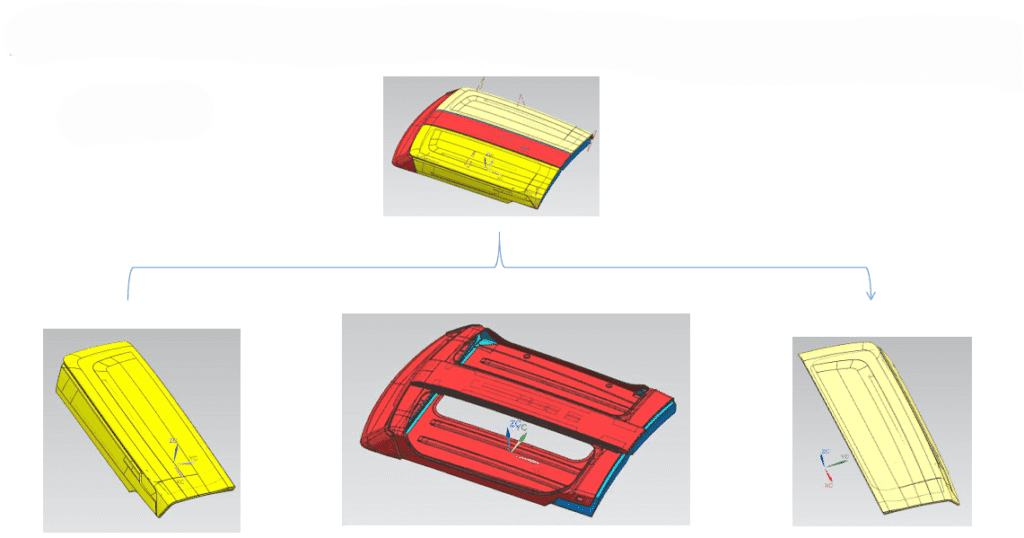
For example, when evaluating a highly complex multi-component project like a high-performance car roof assembly, engineers cannot simply look at the outer shell. They must assess the left and right door assemblies, the main body, inner and outer panels, and structural metal brackets. The feasibility study acts as the master blueprint that proves whether these disparate pieces can be manufactured and assembled within strict dimensional tolerances.
Why Do Carbon Fiber Composite Parts Need a Feasibility Study?
Many procurement managers transitioning from isotropic materials (like steel or aluminum) to anisotropic composites underestimate the unique variables of composite manufacturing. Understanding why do carbon fiber composite parts need a feasibility study comes down to mitigating several severe risks.
Mitigating Severe Tooling Risks
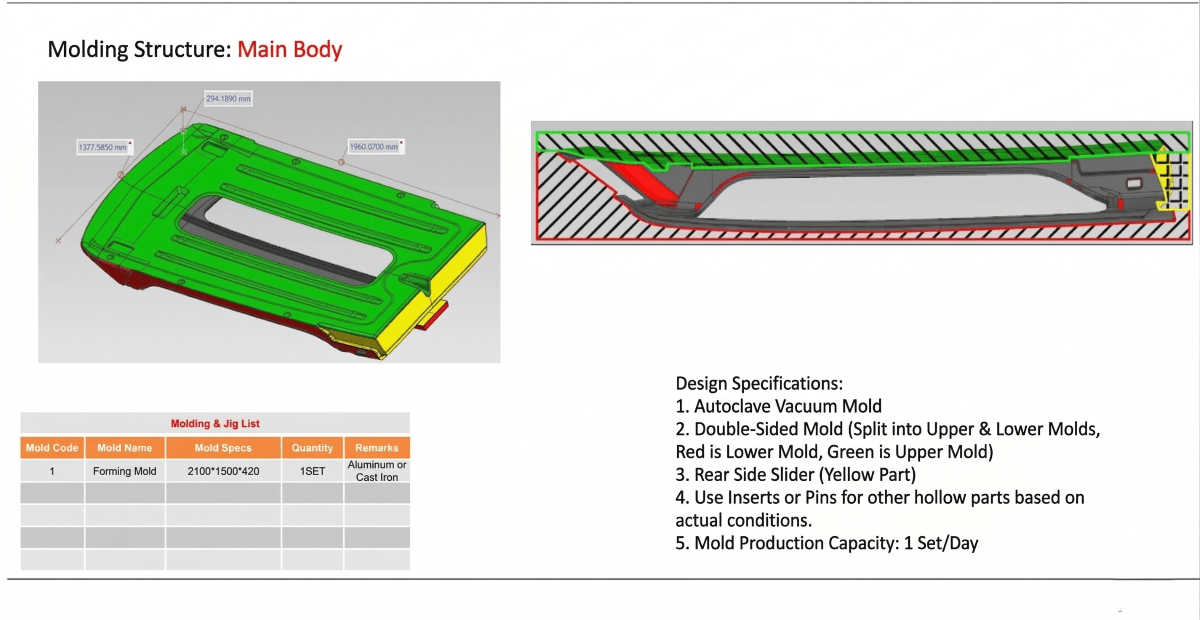
Carbon fiber tooling—whether constructed from aluminum, steel, or composite materials—represents a significant capital expenditure. If a design lacks proper draft angles or contains complex undercuts, the cured part will become physically locked in the mold. Modifying a completed mold to fix these oversights is incredibly costly. A carbon fiber tooling evaluation identifies these “lock-out” risks early. For instance, a complex roof assembly might require a double-sided mold with specific rear side sliders to allow for safe demolding without damaging the part’s surface.
Ensuring Strict Assembly Tolerances
Advanced composites are frequently used in aerospace and automotive applications where precision is non-negotiable. If a product features moving parts—such as doors attaching to a main roof body—the gap tolerances must be meticulously controlled. A feasibility study evaluates whether the natural shrinkage of the resin during curing will violate these parameters. In premium automotive projects, ensuring that the gap between closed doors and the main body does not exceed 1mm requires precise control over the manufacturing process, which must be planned from day one.
Achieving Aesthetic Standards
Why carbon fiber projects fail without feasibility analysis often comes down to surface finish. If a product requires an automotive Class A surface quality, the tooling, the prepreg material, and the curing environment must all be optimized. Without upfront planning, issues like resin pooling, pinholes, or fabric distortion around sharp radii will ruin the part’s cosmetic appeal, leading to high rejection rates.
What Is Included in a Carbon Fiber Feasibility Analysis Report?
When you partner with an advanced OEM/ODM manufacturer like JCSPORTLINE, the evaluation phase yields a highly detailed technical roadmap. Here is exactly what is included in a carbon fiber feasibility analysis report, using a complex automotive roof assembly as an illustrative framework.
1. Appearance and Visual Definition
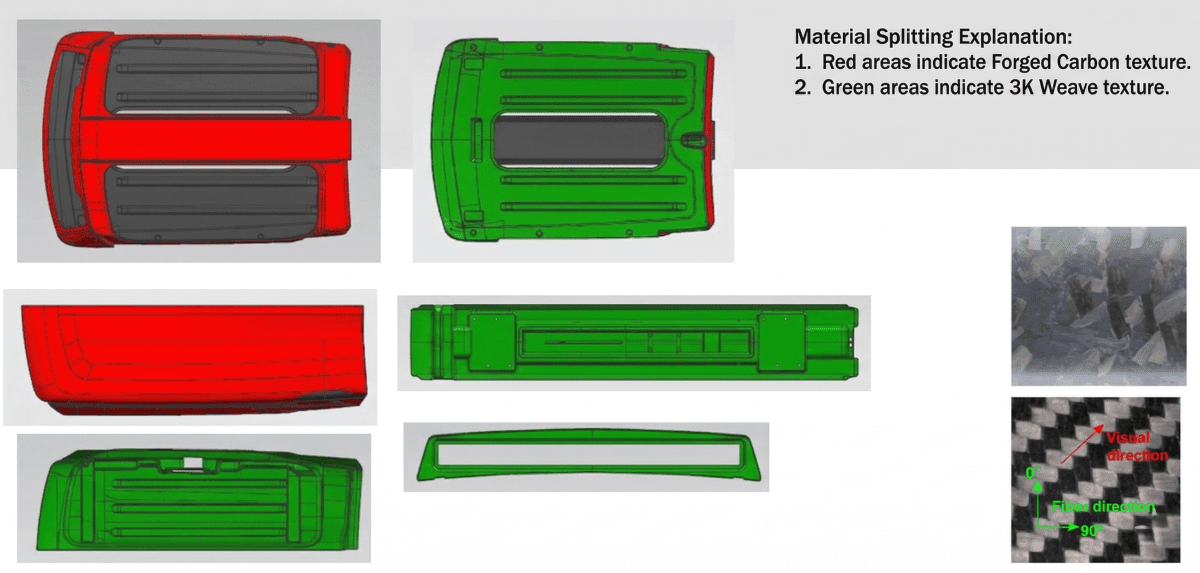
For consumer-facing or premium B2B products, defining exactly how the part will look is the first step. The report will break down the product into specific visual zones to dictate the necessary manufacturing care. For a complex assembly, this might specify that the top exterior surface utilizes a matte forged carbon finish , while the sides, front, and rear surfaces require a glossy black automotive spray paint. The interior, non-visible surfaces might be designated as standard matte regular carbon fiber.
2. Carbon Fiber Material Selection (BOM)
Carbon fiber material selection directly dictates the mechanical performance and cost of the product. The feasibility study will output a preliminary Bill of Materials (BOM) detailing exact specifications. A high-strength, lightweight structure will typically utilize a hybrid of materials to balance cost and performance:
- Surface Layers: 0.3mm resin content (RC) 45% forged carbon materials for aesthetic impact.
- Structural Core Layers: Heavier 12K twill carbon fabric (FAW600 RC35%) to build rapid thickness and strength.
- Inner/Detail Layers: 3K twill carbon fabric (FAW240 RC42%) or unidirectional prepregs (FAW100 RC33%) for targeted stiffness.
- Consumables: The study also details essential auxiliary molding materials like WL7400 vacuum bagging film, WL3900 release film, and breather fabrics necessary for the autoclave process.
3. Lay-up and Stacking Design
Because carbon fiber is anisotropic, a part’s strength depends entirely on how the layers are oriented. A proper carbon fiber product development cycle includes a detailed stacking schedule. If a part requires a uniform 2mm thickness, the engineering report will map out the exact sequence. For example, an outer panel might start with a 0.3mm forged surface layer, followed by three successive layers of 12K FAW600 to achieve the necessary structural rigidity. Components bearing heavier structural loads, like front brackets, may be bumped to a 3mm thickness, requiring a more complex interleaving of 3K and 12K layers.
4. Carbon Fiber Tooling and Process Feasibility Analysis
The heart of carbon fiber manufacturing feasibility lies in the tooling strategy and process parameters. The study will recommend the ideal manufacturing route—such as using an autoclave combined with prepreg materials (PMC) for maximum consolidation and minimal void content.
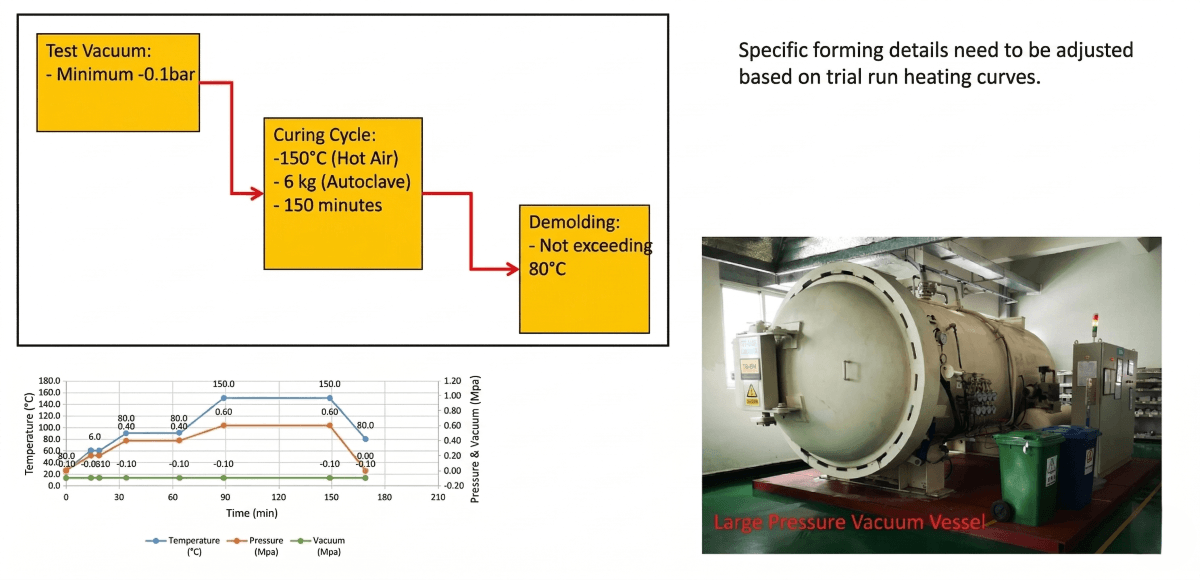
The report will detail the specific molds required, their dimensions, and base materials (e.g., aluminum or cast iron) to ensure thermal stability. Furthermore, it maps the exact curing cycle required for the selected resin matrix. A typical high-performance autoclave cycle might require a vacuum of at least -0.1bar , followed by a curing phase at 150°C for 150 minutes under 6 bar of pressure. The study will also stipulate safe demolding temperatures (e.g., below 80°C) to prevent thermal shock or warping.
5. Assembly and Quality Control Planning
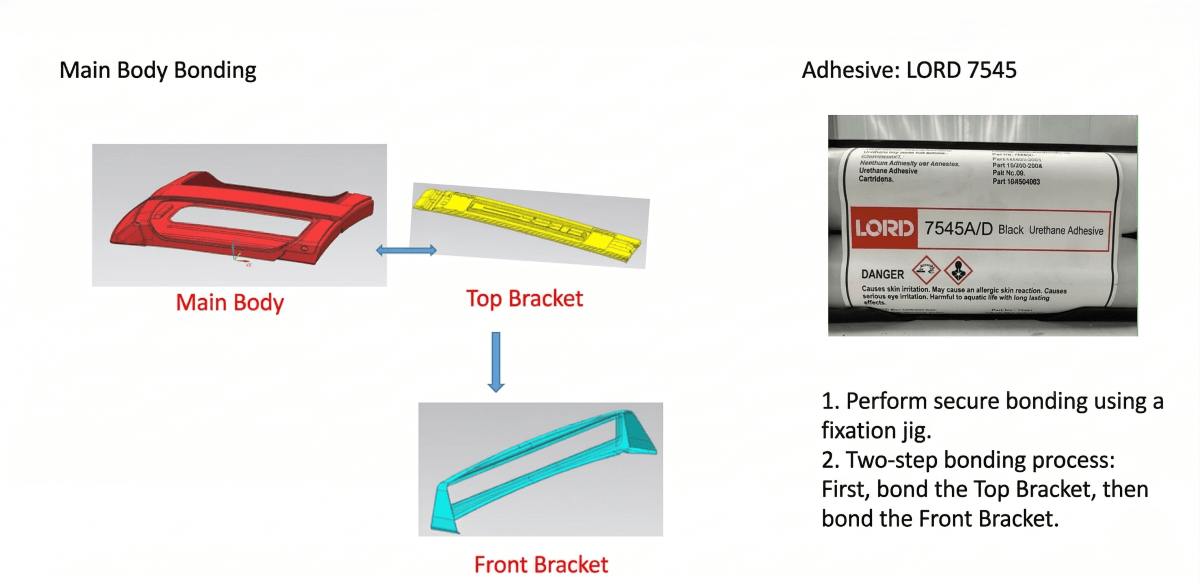
A part is only feasible if it can be reliably assembled and inspected. The feasibility study details the step-by-step assembly protocol. For composite structures, standard mechanical fasteners are often replaced or augmented by high-strength structural adhesives, such as LORD 7545. The report will outline the necessity of custom gluing jigs to hold components perfectly in place during the bonding process—for instance, sequentially bonding upper brackets, then front brackets, and finally marrying metal hardware to the interior composite panels.
Finally, carbon fiber quality control is established. The team will decide if dedicated inspection fixtures (checking fixtures) need to be machined to verify complex profiles and ensure compliance with strict gap tolerances before packaging the final parts in protective non-woven bags and honeycomb cartons.
How to Evaluate Carbon Fiber Composite Manufacturing Feasibility
Understanding how to evaluate carbon fiber composite manufacturing feasibility requires a structured, step-by-step approach executed by experienced manufacturing engineers:
- DFM (Design for Manufacturing) CAD Review: Engineers analyze the 3D model specifically looking for moldability. They check draft angles, simplify sharp internal radii to prevent fabric bridging, and identify potential areas where resin could pool.
- Process Selection vs. Volume: The required annual volume dictates the process. A part that is feasible via high-pressure Resin Transfer Molding (HP-RTM) for 10,000 units per year requires a completely different feasibility study than an Autoclave-cured part destined for a low-volume aerospace run. The evaluation determines the daily production capacity of the proposed tooling—for example, projecting that an autoclave mold can yield one complete set per day.
- Cost vs. Performance Optimization: If the initial lay-up schedule is structurally viable but too expensive, engineers will iterate. They might suggest substituting a layer of high-modulus carbon with standard modulus, or adjusting the fiber areal weight (FAW) in non-critical zones to hit the client’s target B2B price point without sacrificing safety.
The Strategic ROI of Feasibility Analysis
For purchasing directors and lead engineers, committing to a feasibility study is the ultimate risk management strategy. It transforms an unpredictable, trial-and-error prototyping phase into a highly controlled, predictable engineering workflow.
By defining the exact BOM, tooling requirements, and curing parameters upfront, you lock in accurate unit costs and reliable lead times. Most importantly, it prevents the catastrophic scenario of investing tens of thousands of dollars into steel or aluminum tooling, only to discover that the geometric design fundamentally conflicts with the realities of composite fluid dynamics and thermal expansion.
Frequently Asked Questions about Carbon Fiber Product Development
What exactly does a feasibility study evaluate?
A composite feasibility analysis evaluates your CAD design to ensure it can be manufactured reliably. It determines the correct material lay-up, necessary mold structures (like draft angles and split lines), precise curing parameters, and the most cost-effective manufacturing process for your target volume.
Does a feasibility analysis determine exact unit costs?
Yes. By defining the exact Bill of Materials (BOM), the amount of labor required for the lay-up, the necessary curing cycle time, and the assembly steps, the study provides a highly accurate cost model for mass production, preventing unexpected budget overruns.
How does tooling evaluation fit into the study?
Tooling evaluation is central to the process. It dictates whether your project requires single or double-sided molds, what material the mold should be made of (e.g., aluminum vs. cast iron) based on thermal expansion rates, and whether complex sliders or inserts are needed for safe demolding.
Bring Your Next Composite Project to Life with JCSPORTLINE
Skipping the upfront engineering evaluation in advanced composite manufacturing almost always results in downstream failures, delayed product launches, and wasted capital. A comprehensive feasibility study is the ultimate tool to protect your timeline, optimize your budget, and guarantee your product’s performance in the field.
At JCSPORTLINE, our seasoned composite engineering team specializes in turning complex digital concepts into scalable, manufacturing-ready realities. As your dedicated OEM/ODM partner, we provide rigorous Design for Manufacturing (DFM) reviews and deeply detailed feasibility analyses for carbon fiber, fiberglass, and Kevlar components across the automotive, medical, aerospace, industrial, and sports sectors.
Are you developing a new composite product, or struggling with an existing design that refuses to scale? Contact JCSPORTLINE today to schedule a comprehensive technical feasibility review, and let our experts engineer a seamless, profitable path to mass production.