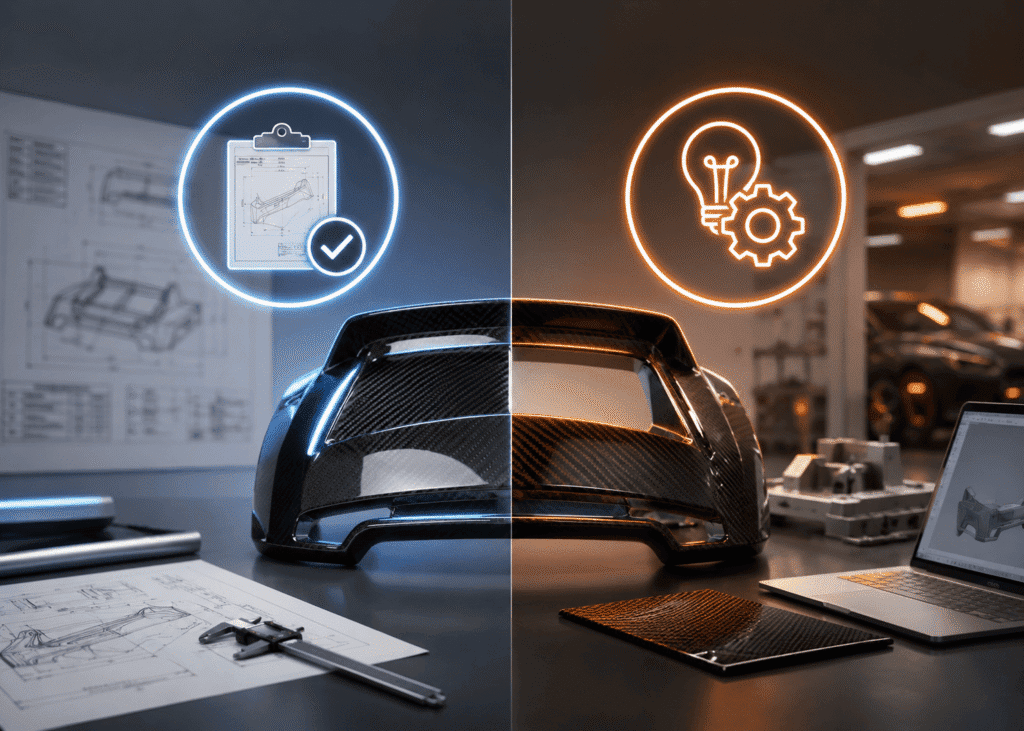
You send an inquiry for a custom carbon fiber part, and the first question back is: “Is this OEM or ODM?” For most brand owners, procurement managers and product developers, that question stalls the conversation before it starts.
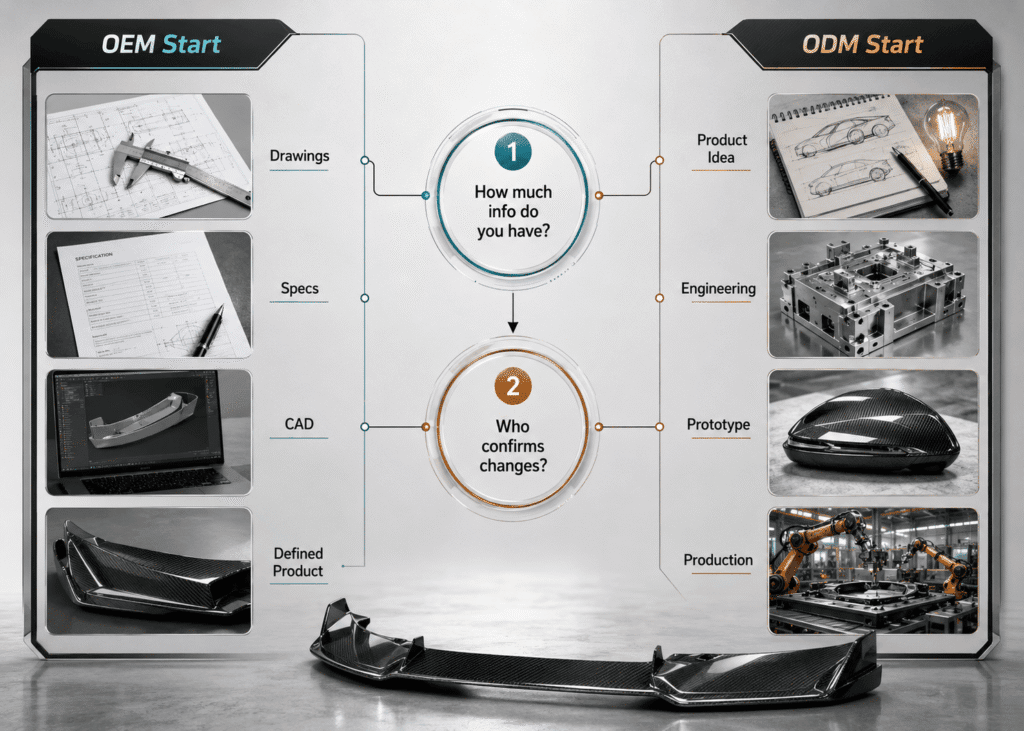
Neither model is the upgrade. oem and odm are not service tiers, and asking which one is better produces no useful answer. Two questions decide it. First, how much mature product data do you already hold? Second, who approves the design and any changes to it?
Answer those two and OEM vs ODM resolves itself. This article gives you the framework to answer them, and tells you exactly what to prepare before you contact any supplier.
What Is OEM and ODM? Two Starting Points, Not Two Service Tiers
what is oem and odm comes down to where your project stands the day it reaches the factory.
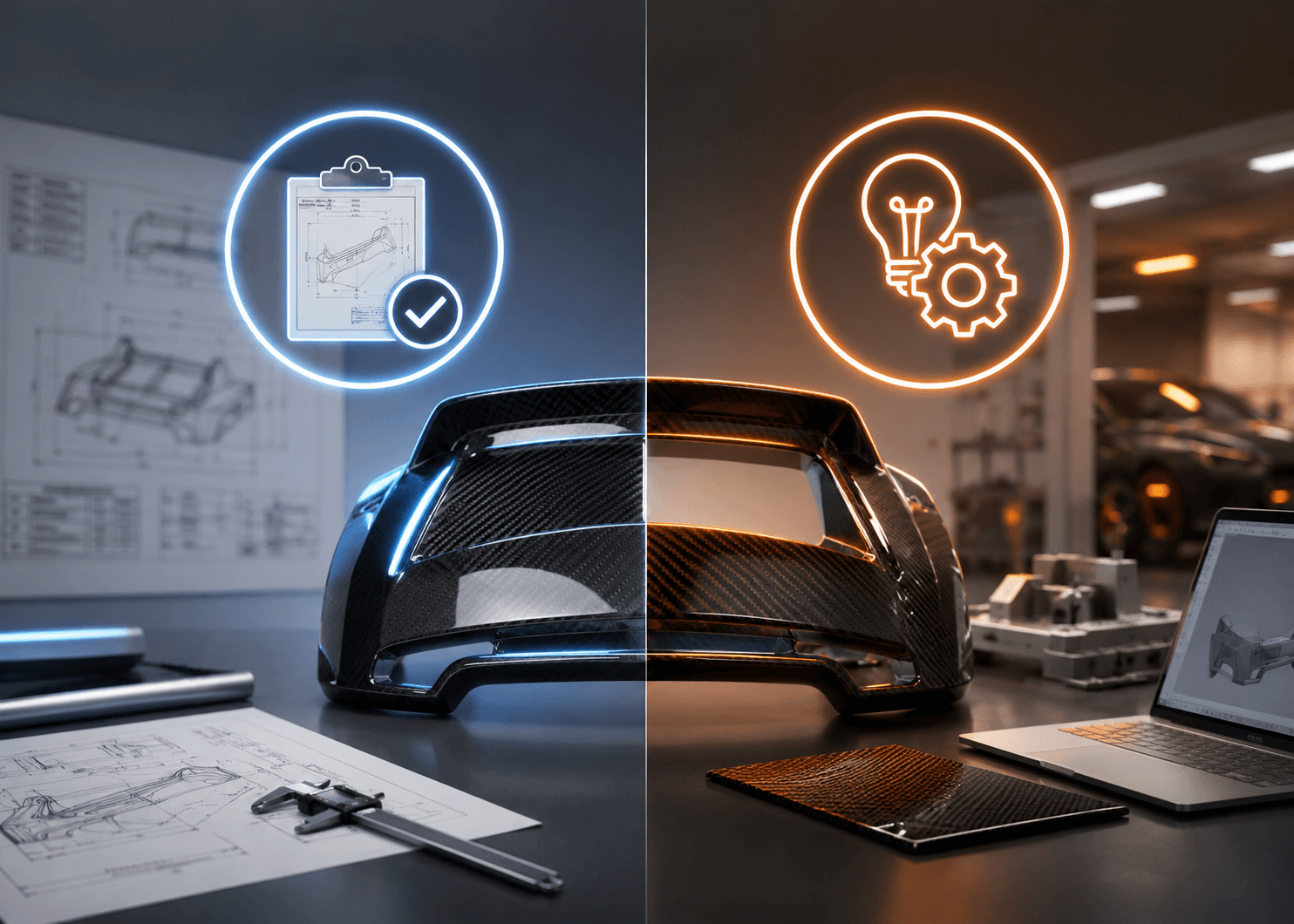
In an OEM manufacturing model, the customer already holds a reasonably complete picture of the product — drawings, specifications, dimensions, a defined structure, or an approved sample. The supplier works from those confirmed inputs and handles manufacturability, process adaptation, tooling, samples and volume output. That is the whole of custom carbon fiber manufacturing under an OEM arrangement: execution against a design somebody has already locked.
In an ODM manufacturing model, the customer knows what they want to achieve but the product is not yet producible. The supplier participates in design, engineering, prototyping and production readiness.
That is the difference between oem and odm. It describes project maturity, not service quality, and not price tier.
One misreading needs correcting before anything else. OEM does not mean the supplier “only produces.” In what is OEM and ODM in composite manufacturing, even a fully specified design still requires manufacturability review, layup planning and process selection on the manufacturing side. Composite parts are made at the same moment the material is made — fiber orientation, mold split lines and demolding behavior all have to survive contact with a real tool. A model that closes cleanly in CAD can still lock in a mold. Engineers and composite specialists know this. Quotation conversations routinely forget it.
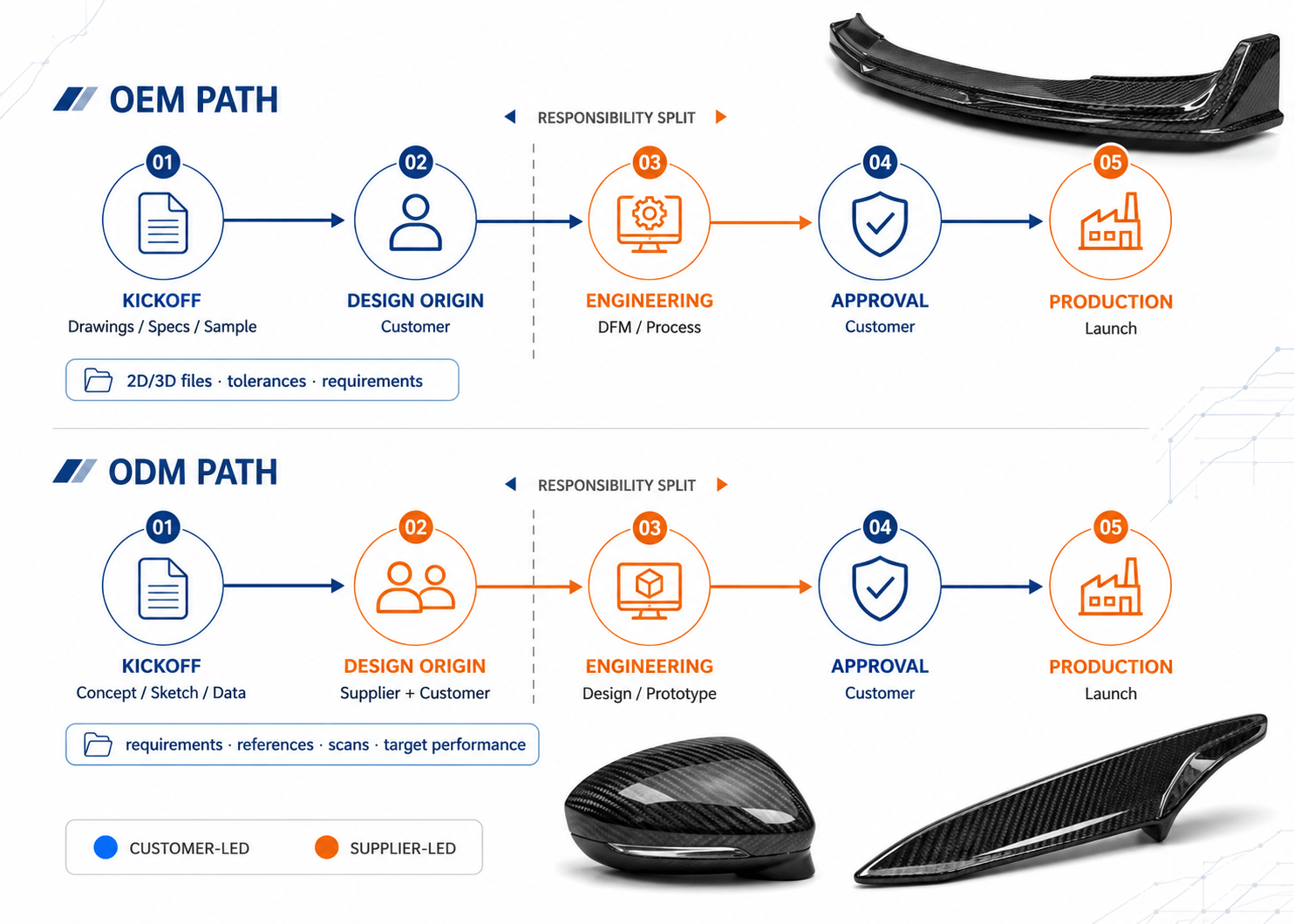
| Dimension | OEM | ODM |
| Design input at kickoff | Mature drawings, specs, approved sample | Concept, reference product, sketch, partial data |
| Who originates the design | Customer | Supplier, developed with the customer |
| Supplier’s engineering role | Manufacturability and process adaptation | Design, engineering, prototyping, production readiness |
| Who approves the final design | Customer | Customer |
| What you send to start | 2D/3D files, tolerances, requirements | Requirements, references, scans, target performance |
The fourth row does not change between columns. That is the point of the table.
The Real Difference Is Who Signs Off on the Design
Who draws the design is the visible difference. Who signs off on it decides whether the project runs.
In an OEM project, design authority sits with the customer. The supplier raises manufacturability feedback, flags structural or tooling risks and proposes alternatives — but the final version is confirmed by the customer’s team. That feedback loop is part of proper carbon fiber manufacturing services, not an add-on.
In an ODM project, the supplier drives the design forward and the customer still confirms it. who is responsible for design approval in ODM projects is the most misunderstood point in the entire ODM vs OEM discussion. ODM does not mean handing the product over and waiting for a shipment. It means the supplier carries more of the development work while approval stays with you.
Projects where each side assumes the other is confirming get reworked. That is not a risk to monitor; it is an outcome to expect.
Design ownership, tooling rights and related responsibilities should be defined in your supply agreement and governed by what both parties actually contract.
Which Model Fits You? Audit What You Already Have
should I choose OEM or ODM for my carbon fiber project is answerable in ten minutes with an honest inventory of your own files.
You Already Have Mature Design Inputs → Start the OEM Conversation
If you hold 2D/3D data, key dimensions and tolerances, a defined structure, surface requirements, or a sample you have already approved, your project starts from a confirmed design. The supplier’s work begins at manufacturability assessment, not at defining the product. Most custom carbon fiber parts programs run by established brands and distributors enter this way.
✅ What “mature enough for OEM” actually means
— 3D model or complete 2D drawings
— Key dimensions and tolerance requirements
— Surface, finish and appearance requirements
— Structural or functional performance targets
— An approved reference sample or confirmed design version
do I need 3D drawings for OEM carbon fiber production? Not strictly. An approved physical sample can serve as the design input. What you need is a version somebody has signed off on.
You Have a Concept, Sample or Partial Data → Discuss ODM
If you have an idea, a functional requirement, a reference product, a sketch, scan data or an early design that has never been engineered, you need development support before you need production support. Industrial designers and R&D teams frequently arrive here with strong intent and thin data, and that is a normal starting point for design and engineering support.
Incomplete data is not a weakness. Treating incomplete data as though it were mature is the actual failure mode, and it is why OEM vs ODM which is better for custom carbon fiber parts is the wrong question. The right one is what your files can support today.
Where OEM and ODM Projects Actually Break Down: Change Management
Requirements change. That is normal. Projects break because nobody agreed in advance on how to manage design changes in OEM and ODM projects.
✅ Three questions to settle before kickoff
1. Who is authorized to request a change?
2. Who confirms the change is accepted?
3. How does the change affect sample approval and the production schedule?
The handover point matters as much as the rules. Sourcing managers and OEM program leads should know precisely where sample-stage responsibility ends and volume responsibility begins, because that transition from prototype to mass production is where undocumented changes surface as fitment problems, appearance variation or missed dates.
A supplier who cannot explain their change process in plain language is not a safer choice because they label themselves OEM or ODM. oem odm services described only in marketing terms tell you nothing about how the project will be run.
How the Right Partner Fills Your Capability Gap
A capable carbon fiber OEM ODM manufacturer configures support around the customer’s gap instead of pushing every project into one template.
One customer built their business on 3D scanning vehicles and developing modification parts for end clients. Their scanning and requirement-analysis capability was strong; they had no in-house product design, tooling development or carbon fiber production. Early in the cooperation, differing interpretations of product standards, production flow and quality requirements meant quality and lead times did not fully meet expectations, and their doubts about working with us long term were reasonable.
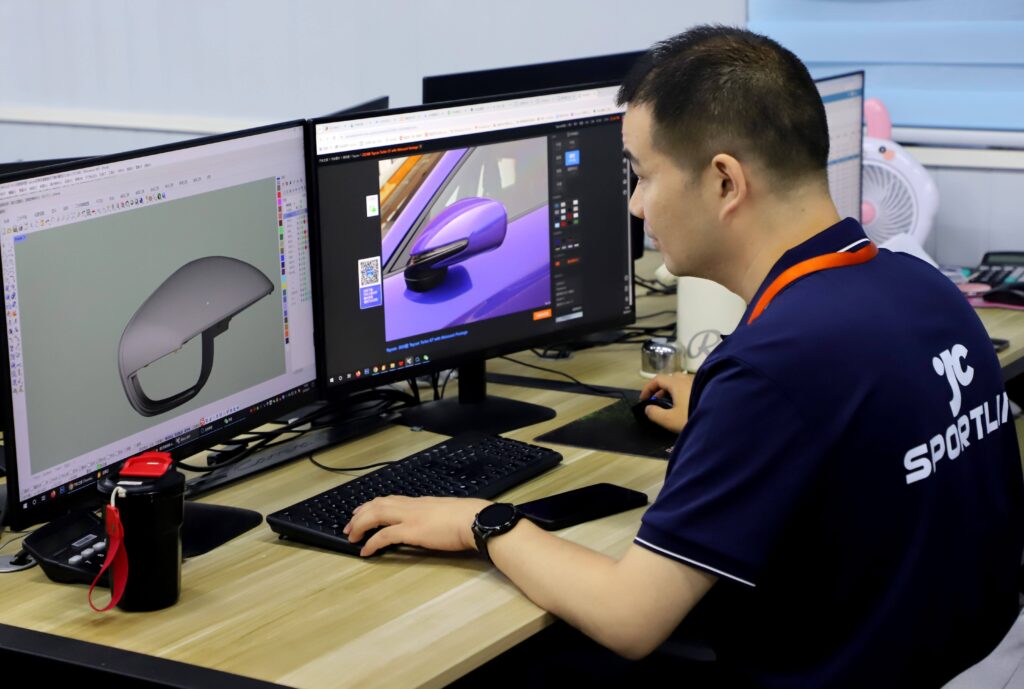
What we supplied was the missing capability, not a service package: 3D data analysis, product structure design, appearance optimization and production implementation, turning raw scan data into a producible part. We also worked through quoting and development flow with them so their end-client projects moved without stalling on our side. The relationship shifted from supply to sustained development partnership, and design, quoting, production and delivery now route through us.
That case does not prove ODM is the better model. It shows that once the capability gap is identified accurately, the model stops being a decision at all. The same engineering input applies to OEM work — manufacturability review and process feedback do not disappear because you brought your own drawings. Our value-added engineering support operates identically in both directions.
Before You Contact a Supplier
This is not about picking the more advanced model. It is about being accurate regarding where you are standing.
Before your next inquiry, prepare three things: a complete list of the design data you actually hold, the name of the person who confirms design decisions on your side, and your expectation for how changes get raised and approved. Bring those, and the difference between OEM and ODM in carbon fiber manufacturing stops being a terminology problem and becomes a five-minute scoping conversation.
Send us your files or your concept. Our engineering team will review what you have and respond with a structured assessment of what those inputs can actually support.
FAQ
Do I need complete 3D drawings before starting an OEM carbon fiber project?
Not always. An approved physical sample, complete 2D drawings with tolerances, or scan data plus confirmed specifications can all serve as design input. What matters is that a version has been confirmed on your side.
If I choose ODM, does that mean I lose control of the design?
No. The supplier carries more of the design and engineering work, but final design confirmation stays with you. Approval authority and change rights belong in your agreement.
Can a project start as ODM and later become OEM?
Yes, and it commonly does. Once a design has been developed and validated, follow-on production and future variants run on confirmed inputs.
Do you have your own R&D and engineering team?
Yes. Our team covers 3D modeling, structural design, material selection and process development for carbon fiber, fiberglass and other composites, working from your 3D files, engineering drawings or physical samples through prototyping to volume production.
Do you support both OEM and ODM services?
Yes. We support OEM ODM services for carbon fiber brands and distributors, product developers and OEM programs, including private-label production, exclusive design development, custom packaging, logo solutions and project-based engineering support across the full from concept to mass production carbon fiber workflow.