You have already decided carbon fiber belongs in your product line. What is not decided is whether to start from an existing catalog or open your own mold — and that single choice determines how much capital is committed before you see a first sales figure.
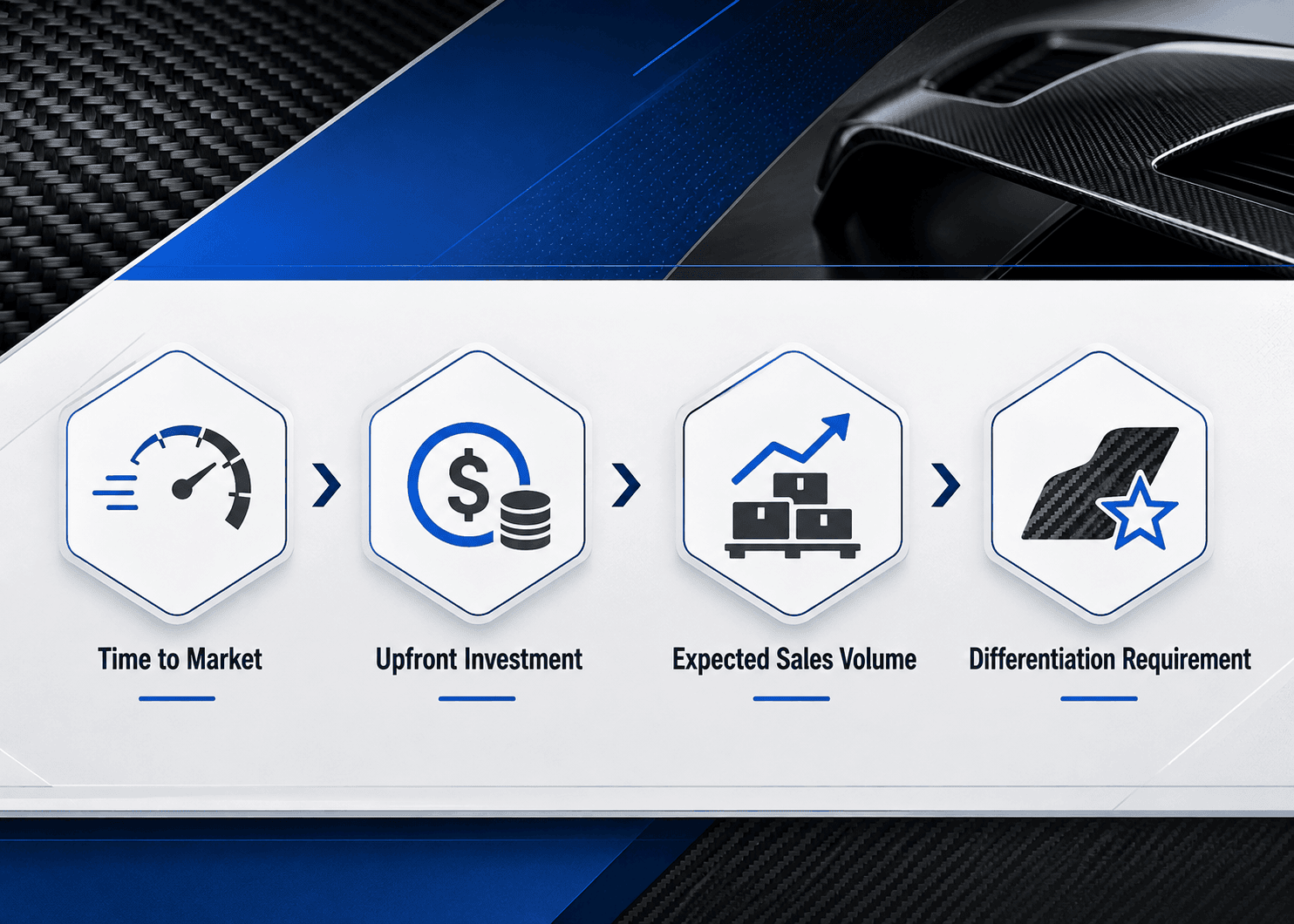
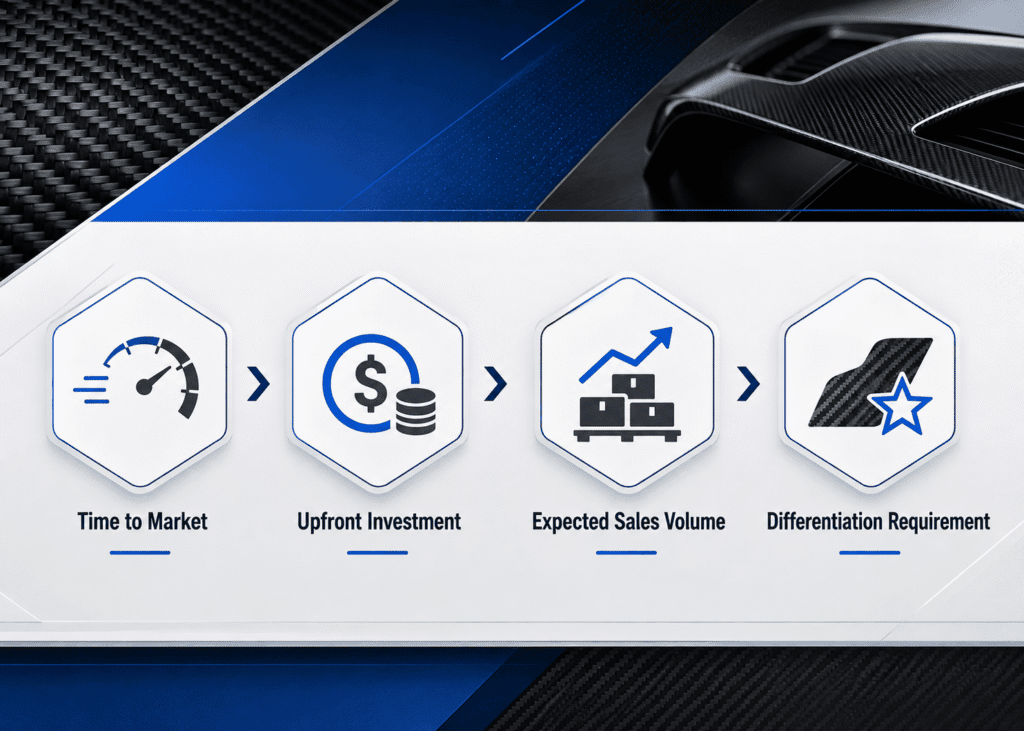
Most brands treat this as a quality question. It is not. The off-the-shelf carbon fiber parts vs custom carbon fiber parts decision is resource allocation, and the right answer moves with your business stage. Four variables settle it: time to market, upfront investment, expected sales volume, differentiation requirement. Nothing else belongs in the discussion.
We run both sides. JCSPORTLINE supplies off-the-shelf carbon fiber parts from an existing mold library and runs full custom development from design through tooling to volume production. Which is why this article will not argue that custom is better. It will tell you when custom is worth it, and when it is money you should not yet be spending.
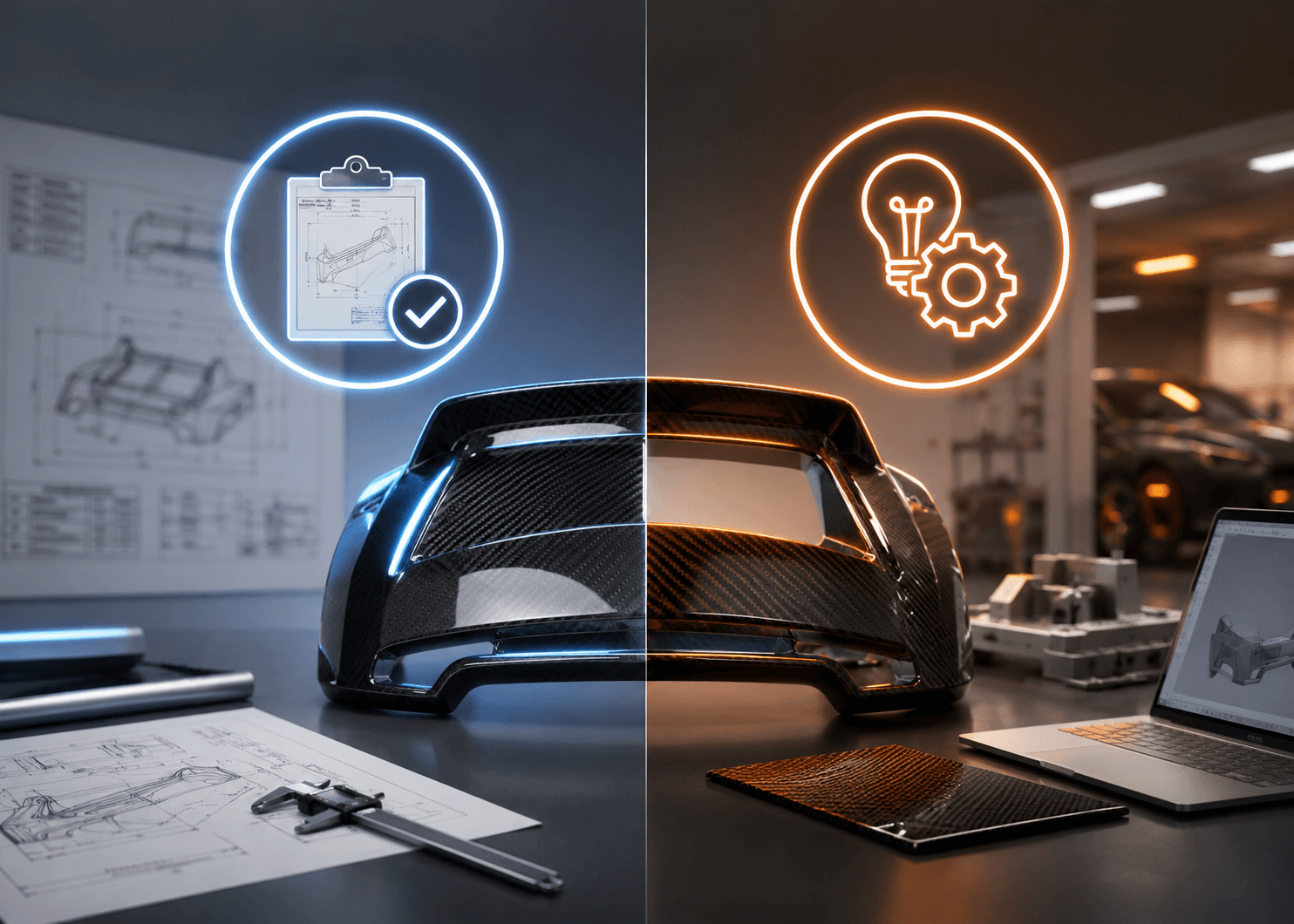
Off-the-Shelf vs Custom Is Not a Quality Hierarchy
The most expensive assumption in this industry is that custom carbon fiber parts sit at the premium tier and catalog parts at the entry tier. That framing costs new brands real money every quarter.
Both come off the same material system and the same process control — same fiber grades, same layup discipline, same curing parameters, same inspection standards. The difference is not what the part is made of. The difference is who owns the shape.
That is the whole value of customization, and it deserves to be stated plainly: a development budget buys you an exclusive geometry and long-term control over it. If exclusive geometry is not currently why your customer chooses you, that budget buys nothing you can sell.
So when a founder asks is custom carbon fiber worth it for a new brand, the answer begins with a counter-question. Has anyone paid you for this shape yet?
The Four Variables That Decide the Answer
How to choose between off-the-shelf and custom carbon fiber parts becomes mechanical once you score the project on four axes. Product developers, sourcing managers, and brand owners routinely score the same project differently — which is the argument for separating the variables before anyone opens the discussion.
Time to Market
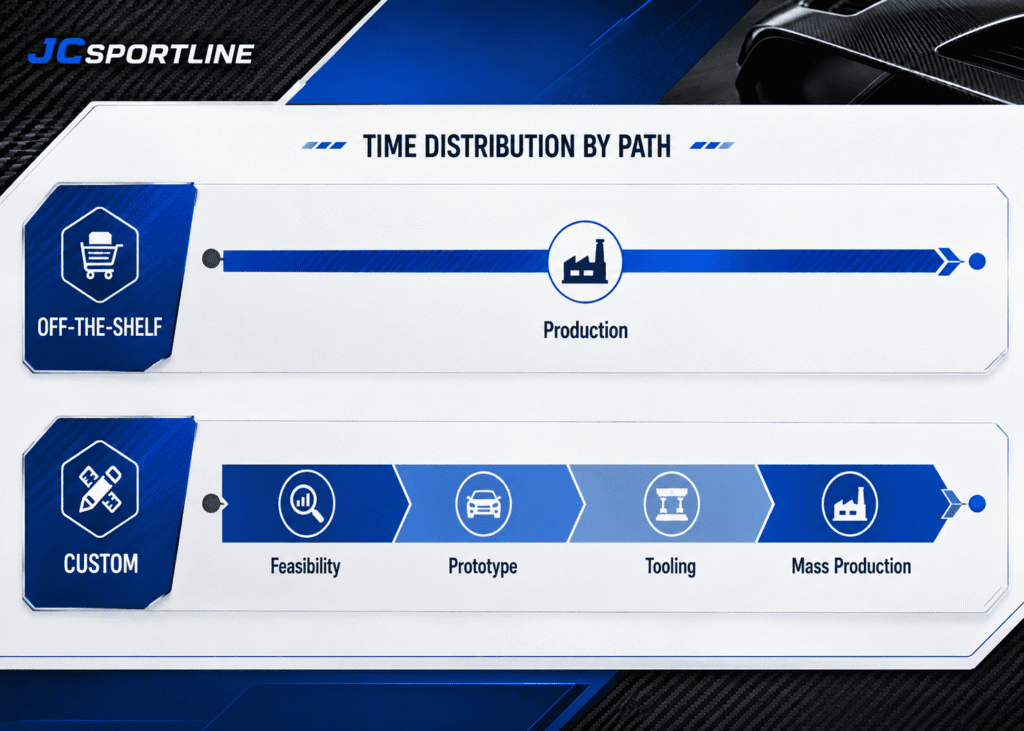
Catalog parts schedule against tooling that already exists; the clock starts at production. Custom parts spend their time before production — engineering review, prototype iteration, mold fabrication. Teams asking how long does custom carbon fiber development take should plan against a documented 58-day development workflow from concept to first sample, with a functional carbon fiber prototype typically returned in 7 to 15 days. That is a well-managed timeline. It is still time a competitor spends selling.
Upfront Investment
Carbon fiber tooling and prototyping are what financially separate the two paths. The upfront investment for custom carbon fiber parts is committed before a single unit sells. Catalog parts carry no tooling charge, because the mold exists and its cost was recovered across earlier programs. How that money is structured, staged, and amortized is a separate conversation, and one worth having in full before you sign anything.
Expected Sales Volume
Development cost amortizes across the product’s lifetime volume, not across your first order. Most brands get this backwards. A small first order is not a reason to avoid custom development. Unclear lifetime volume is.
Differentiation Requirement
Separate “we want to look different” from “we cannot compete without looking different.” Only the second earns a return on tooling. Where the exclusive design is genuinely defensible, settle intellectual property arrangements with your supplier before development begins rather than after.
| Variable | Off-the-Shelf | Custom |
| Time to market | Production lead time only | Development window, then production |
| Upfront investment | No tooling commitment | Tooling and prototype committed before first sale |
| Volume required to justify | Any quantity | Predictable lifetime volume |
| Differentiation delivered | Category presence | Exclusive geometry you control |
| Risk if demand fails | Inventory only | Inventory plus unrecovered development |
When Off-the-Shelf Carbon Fiber Parts Are the Right Call
When to choose off-the-shelf carbon fiber parts is decided by four conditions appearing together: the market is unvalidated, you need to be live quickly, the first order is small, and your capital does more work in traffic and channel than in molds.
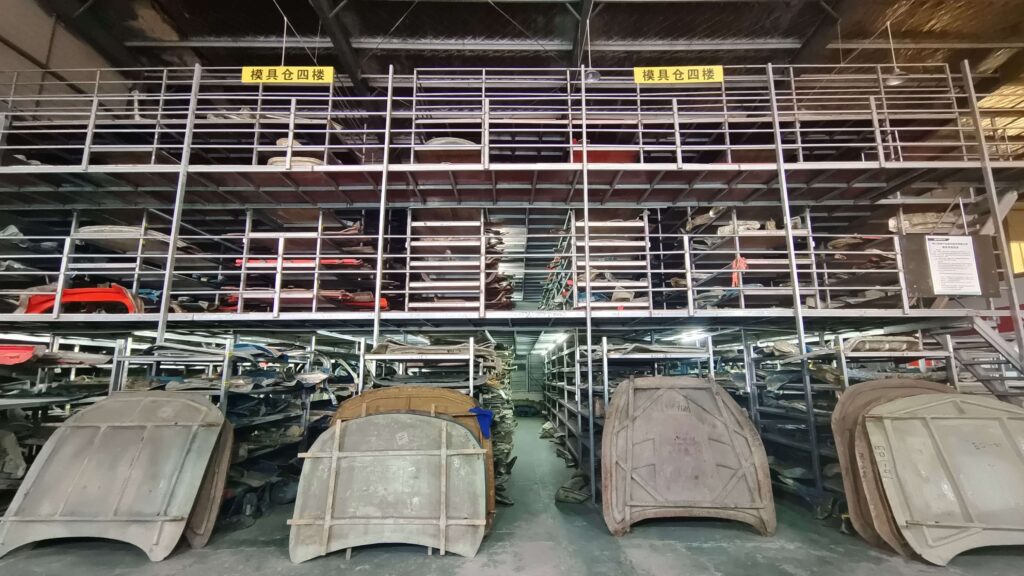
For distributors, cross-border sellers, and startup brands, that is the normal starting position, and treating it as a compromise is a mistake. JCSPORTLINE maintains over 4,000 open mold carbon fiber parts — a library that size changes the calculation in a way most buyers underestimate. You are not forced into custom development simply to fill out a category. Open mold carbon fiber parts for small first orders let you assemble a coherent multi-SKU range and put it in front of real buyers with no tooling capital at risk.
The second effect is on cash. Small trial orders followed by reorders driven by actual sell-through keeps inventory pressure off your balance sheet while you find out which SKUs move. Overseas warehousing and dropshipping arrangements support that model where they fit.
The judgment is simple. Sell-through data from catalog parts is a better basis for your first tooling decision than any market research you can buy.
On stock availability — the honest version. We run a smart inventory system, but carbon fiber aftermarket parts turn over fast and we do not claim every style is in stock at every moment. Our standard mode is production scheduled against confirmed orders, with standing inventory held on high-velocity best-sellers. Build your launch calendar against that, not against an assumption of universal stock.
When Custom Carbon Fiber Manufacturing Is Worth the Investment
When is custom carbon fiber manufacturing worth the investment has a checklist answer. At least three of these should hold before you start:
- Demand for the specific product is confirmed by sales data, not forecast
- Volume is expected to continue rather than spike once
- The shape itself is part of why customers buy
- You intend to build a long-term carbon fiber product line around it
Meet those and tooling stops being an expense. It becomes an asset — an exclusive geometry, control over fitment and specification, and a product you can reproduce on your own terms for years.
Buyers asking do I need a custom mold for carbon fiber parts need the sequence, because skipping steps is where budgets break. Feasibility evaluation first, then a carbon fiber prototype before mass production, then tooling, then custom carbon fiber manufacturing at volume. The prototype stage exists to surface geometry, fitment, and demolding problems while they are still cheap to fix. Find them after a mold is machined and you cut metal twice.
That is also the reasoning behind the free technical feasibility report our engineering team returns within 24 hours of receiving usable 3D data — material route, structural risk, mold strategy, demolding feasibility. An engineering judgment before capital commitment is the cheapest step available to you at this stage.
Before you cut tooling, get three things in writing: who owns the design and the mold, how many prototype iterations are included, and what specifically triggers a tooling change fee. All three are negotiable before machining and fixed afterward.
The Realistic Path: Validate First, Then Customize
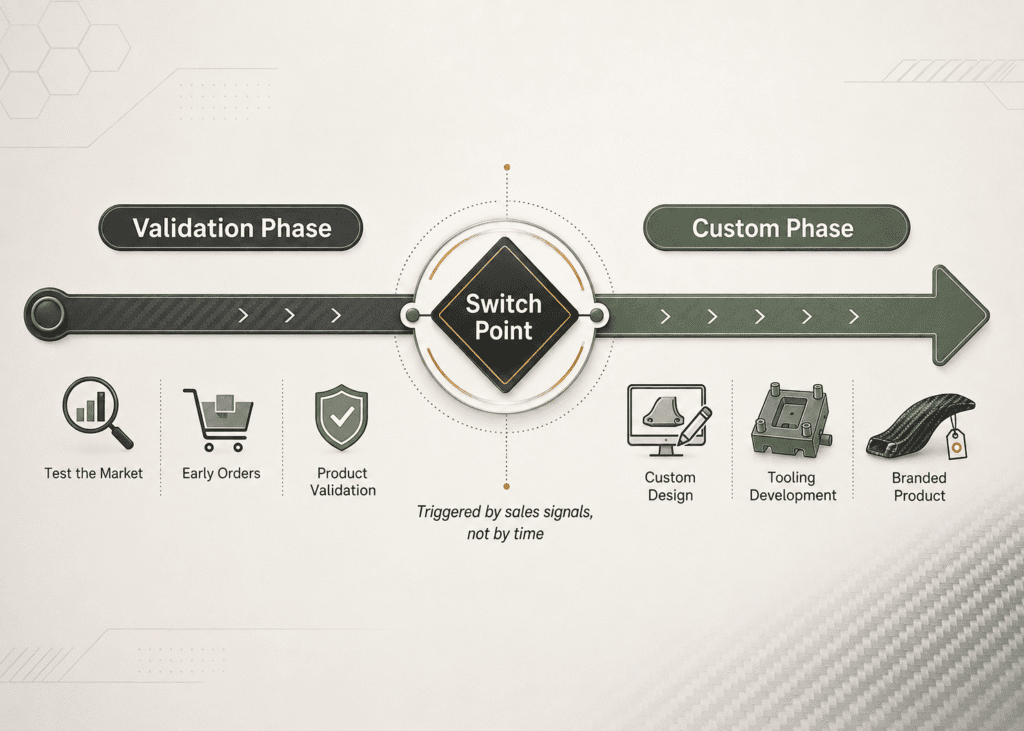
Most brands should not pick a path permanently. They should start on the catalog and move when the signals appear. When to switch from off-the-shelf to custom carbon fiber parts is answered by evidence, not by calendar.
| What you are seeing | What it tells you |
| One SKU shows consistent repeat orders | You have found your first tooling candidate |
| Sell-through outruns your replenishment cycle | Volume is real enough to amortize development |
| Channel partners request exclusivity | Differentiation now carries commercial value |
| Identical products trigger price competition | Catalog geometry has stopped protecting your margin |
| Customers ask for specs your catalog cannot supply | The market has written your custom brief for you |
The reverse failure costs just as much. Brands that stay on catalog parts long after demand has matured are building brand equity on geometry anyone can also order. The purpose of the off-the-shelf phase is not to save money. It is to spend the smallest possible amount learning which product deserves a mold.
The Hybrid Model: Running Both at the Same Time
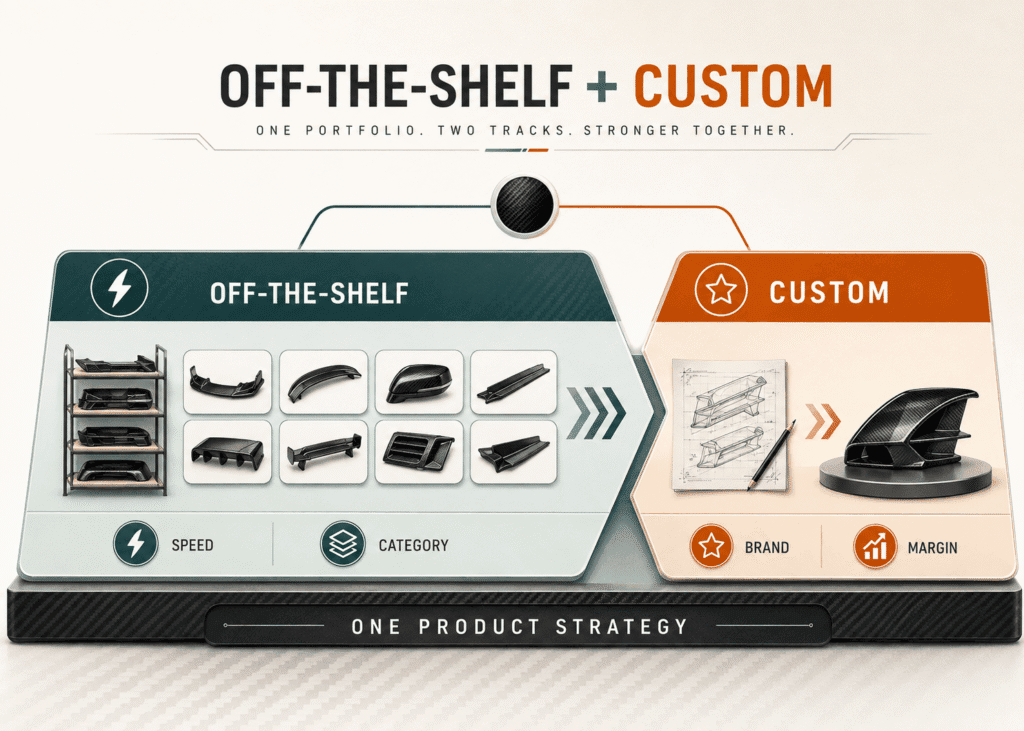
Combining open mold and custom carbon fiber parts is not a halfway position. It is where mature brands end up.
One US specialty automotive parts brand came to us committed to exclusive custom products only, refusing open molds as a matter of policy. That policy produced four structural problems: high unit cost with weak pricing competitiveness, a narrow catalog unable to cover varied customer requests, development cycles averaging one to two months that slowed inventory turnover and tied up working capital, and slow launches that kept missing seasonal and promotional windows.
We worked through their cost structure, turnover rate, and sales conversion cycle before proposing anything. The recommendation was a dual-track model — introduce proven dry carbon open mold best-sellers matched to their existing design language, keep the exclusive custom line as the premium tier. Execution covered rapid sampling and small trial orders on the catalog side, a portfolio plan running roughly 30–40% open mold and 60–70% custom, supply chain adjustments that let higher per-order quantities bring unit cost down, and pricing strategy support. As the market responded, we kept introducing new catalog products and supported light customization on them — custom logo and custom packaging.
Order-to-warehouse time on the catalog portion moved from one to two months down to five to six weeks. Catalog products carry no tooling cost, which lifted gross margin on that portion of the line. Three or more new best-selling SKUs entered the range within a month. The brand moved from custom-only to a working dual-track structure.
These are project-specific outcomes, not universal results. They depend on product strategy, positioning, and execution.
Mature brands do not pick a side. They use open molds for speed and category coverage, and custom development for identity and margin.
Match the Path to Your Stage, Not to Your Ambition
Score yourself honestly. Unvalidated market, fast launch required, small first order, limited budget — start with off-the-shelf carbon fiber parts and let real sales tell you what to build. Validated demand, continuing volume, exclusive design required, long-term product line planned — commit to custom development and treat the prototype and the mold as what they are: the cost of owning a product asset.
On the first path, our catalog is where selection starts. On the second, send your 3D data and take the free 24-hour feasibility report before you spend anything else.
The question was never whether to go custom. It is whether now is the time.
Frequently Asked Questions
I want to enter this category but I don’t want to hold inventory. How do we start?
Start by selecting from our 4,000+ open mold products and placing a small trial order. No tooling commitment, no development window — inventory risk and working capital pressure both stay low while you find out which SKUs actually move in your market.
You list a lot of products online — are they all in stock?
Not all of them, and we will not claim otherwise. Carbon fiber aftermarket parts turn over quickly. Our standard model is production scheduled against confirmed orders, with standing stock on high-velocity best-sellers. Give us your target launch date and we will confirm availability against it before you commit.
If I start with off-the-shelf parts, can I still put my own branding on them?
Yes. Custom logo application and custom packaging are the standard light-customization route on catalog products. You get brand presence at the point of unboxing with no tooling commitment — and it is how most brands bridge the gap before full custom development.
At what point does custom tooling actually pay for itself?
When lifetime volume for that SKU is predictable enough to amortize development, and when the exclusive shape is part of why customers choose you. Send your sales history and target volume and our engineering team will assess it against your specific part before you commit.
Can I run open mold and custom products at the same time without confusing my customers?
That is the normal structure for established brands. Catalog products cover breadth, price accessibility, and fast seasonal response. Custom products carry the signature identity and the higher margin. Positioned as distinct tiers rather than substitutes, they reinforce each other.