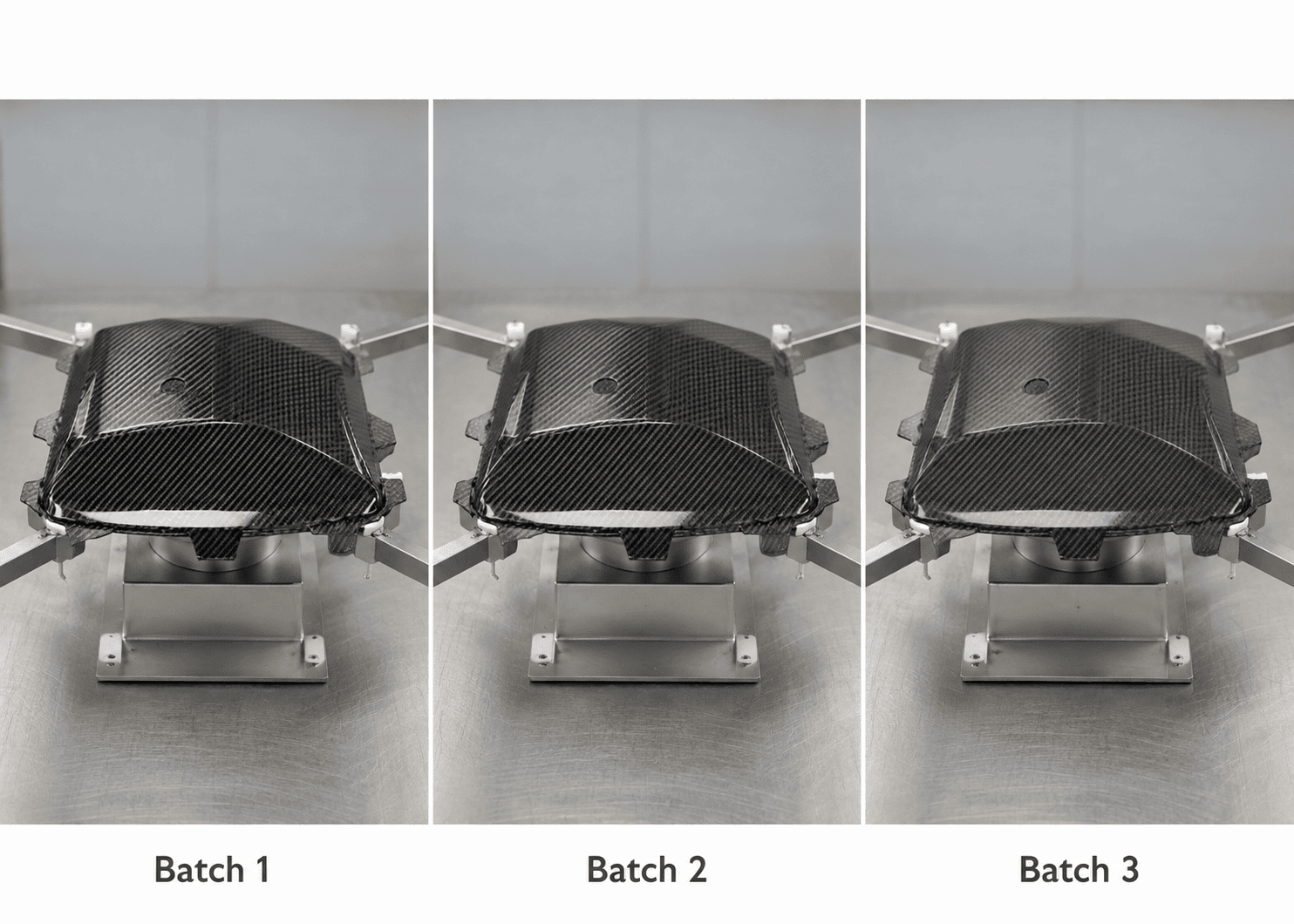
A sample gets approved. The repeat order goes in. Three batches later, a distributor emails to say the gloss doesn’t match the first shipment, and a purchasing manager is explaining to their own customer why two identical SKUs don’t look identical.
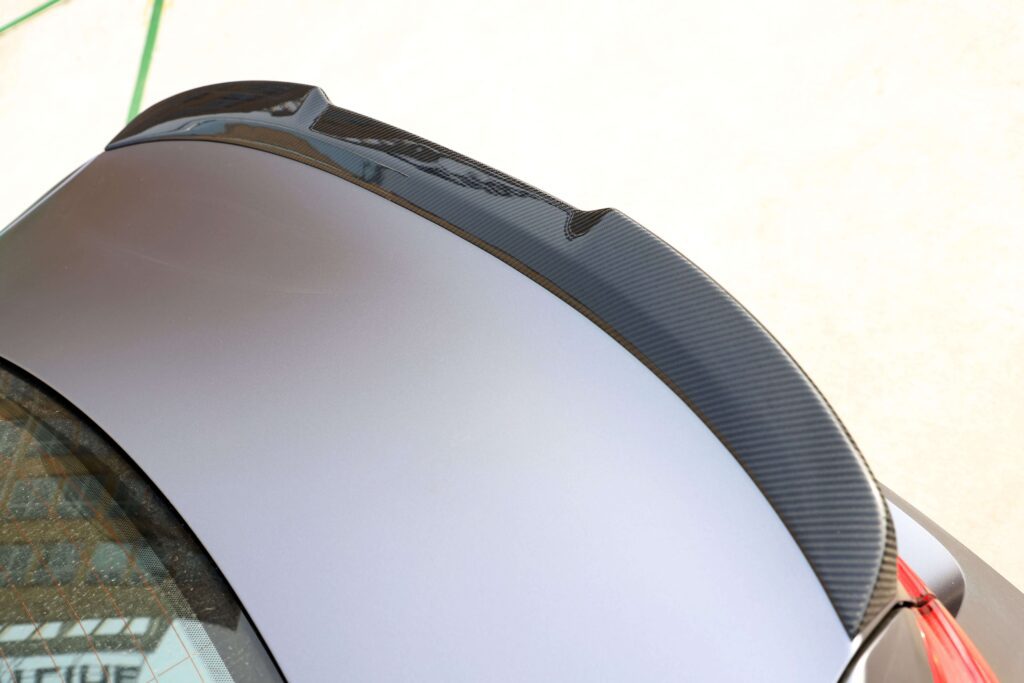
Carbon fiber parts are judged on two tracks. Structure, weight, and fitment are the entry ticket. The visible painted carbon fiber surface is what a brand’s end customer sees, touches, and forms an opinion about. A part can pass every dimensional check and still damage a brand if batch three doesn’t look like batch one.
That gap is what robotic spray painting addresses in carbon fiber automotive parts production. Sample quality is not production quality. Getting the first piece right proves the process is possible. It says nothing about whether the process is repeatable.
Why Surface Consistency Decides More Than Appearance
Why surface consistency matters for carbon fiber parts has little to do with aesthetics and a great deal to do with cost structure.
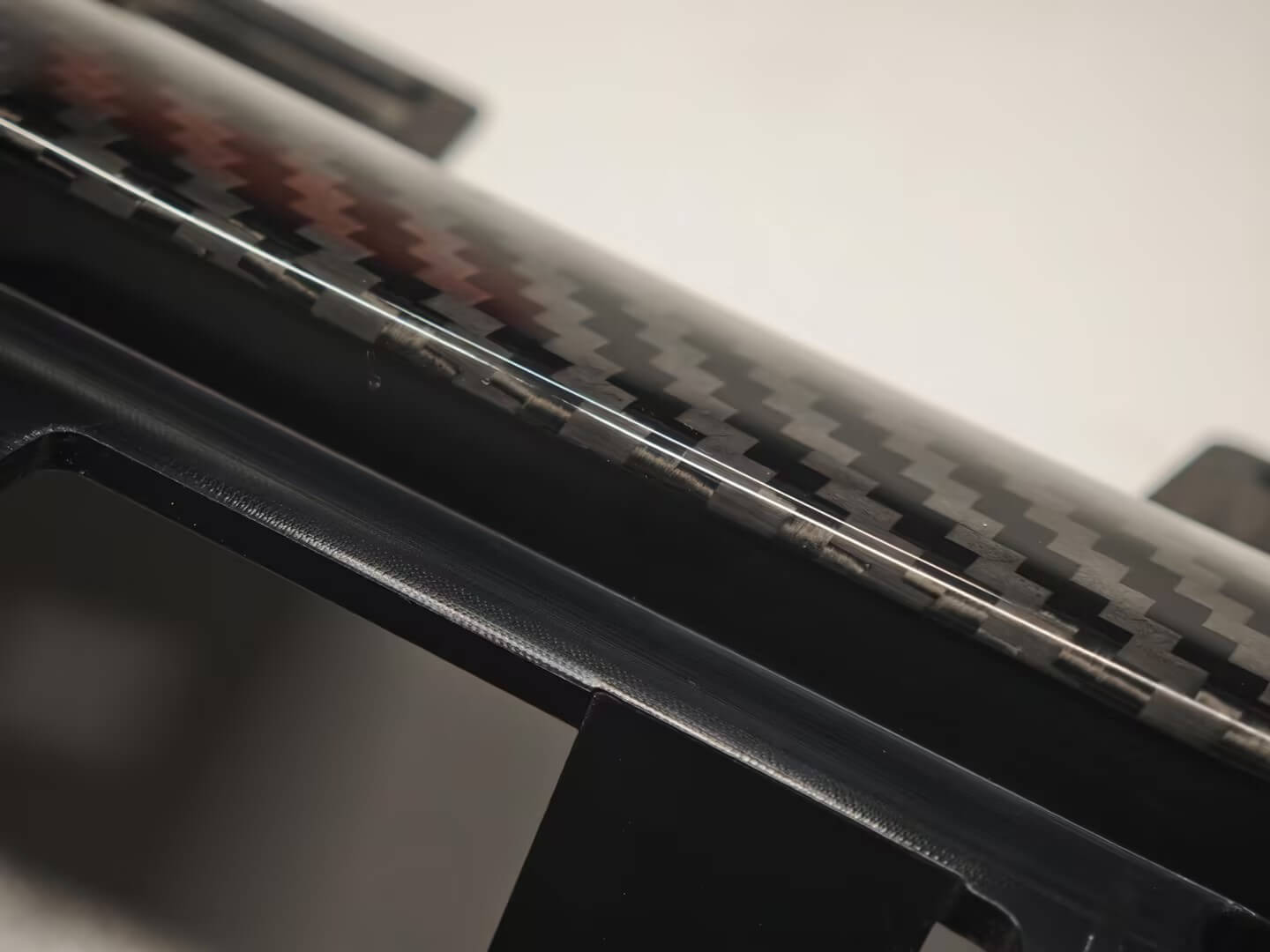
Carbon fiber weave under a gloss or matte topcoat tolerates far less coating variation than a solid-colour plastic part. The same paint at a slightly different film build reads as a different shade. Weave direction under a semi-gloss clear shifts visually with viewing angle, so uneven coverage across a panel becomes obvious the moment two parts sit side by side on a vehicle. On segmented assemblies — a three-piece diffuser, a split spoiler — the eye lands on the seam first, and any difference between adjacent pieces is immediately legible.
Making one part look excellent is not difficult. Batch production consistency is the hard part.
The real cost of carbon fiber batch to batch finish variation never appears on an inspection sheet. It appears downstream: parts re-sanded and re-sprayed after arrival, end-customer returns, replenishment batches that no longer match the original listing photography.
We have seen this play out directly. One European brand client was running a small finishing bay inside their own warehouse, staffed with hired labour, purely to correct gloss level and handling scratches on parts arriving from Chinese suppliers. They were paying finished-goods prices for semi-finished goods and absorbing the lead time to fix them. Their supplier’s samples had been fine. Their supplier’s batches were not.
The same commercial structure exists well beyond automotive. Motorcycle trim, consumer electronics housings, and sports and outdoor equipment share it exactly: a visible carbon surface, a standardized SKU, and recurring replenishment. Wherever those three conditions hold, surface consistency stops being a finishing detail and becomes a condition for the repeat order existing at all.
How Robotic Spray Painting Delivers Repeatability
A boundary worth drawing first: spraying is a post-moulding carbon fiber surface finishing operation. It is not the carbon fiber manufacturing process, and conflating the two leads buyers to ask the wrong questions of the wrong department.
Within that operation, the sources of variation in manual application are finite and well understood.
What Actually Varies in Manual Spraying
Gun-to-part distance. Gun angle relative to a curved surface. Traverse speed. Overlap ratio between passes. Trigger start and stop position. Operator fatigue across a shift. Handover between operators on different shifts.
None of these are failures of skill. A senior sprayer manages all of them well. Managing them well on piece 1 and managing them identically on piece 400 are different problems, and only the second one determines whether a repeat order holds together.
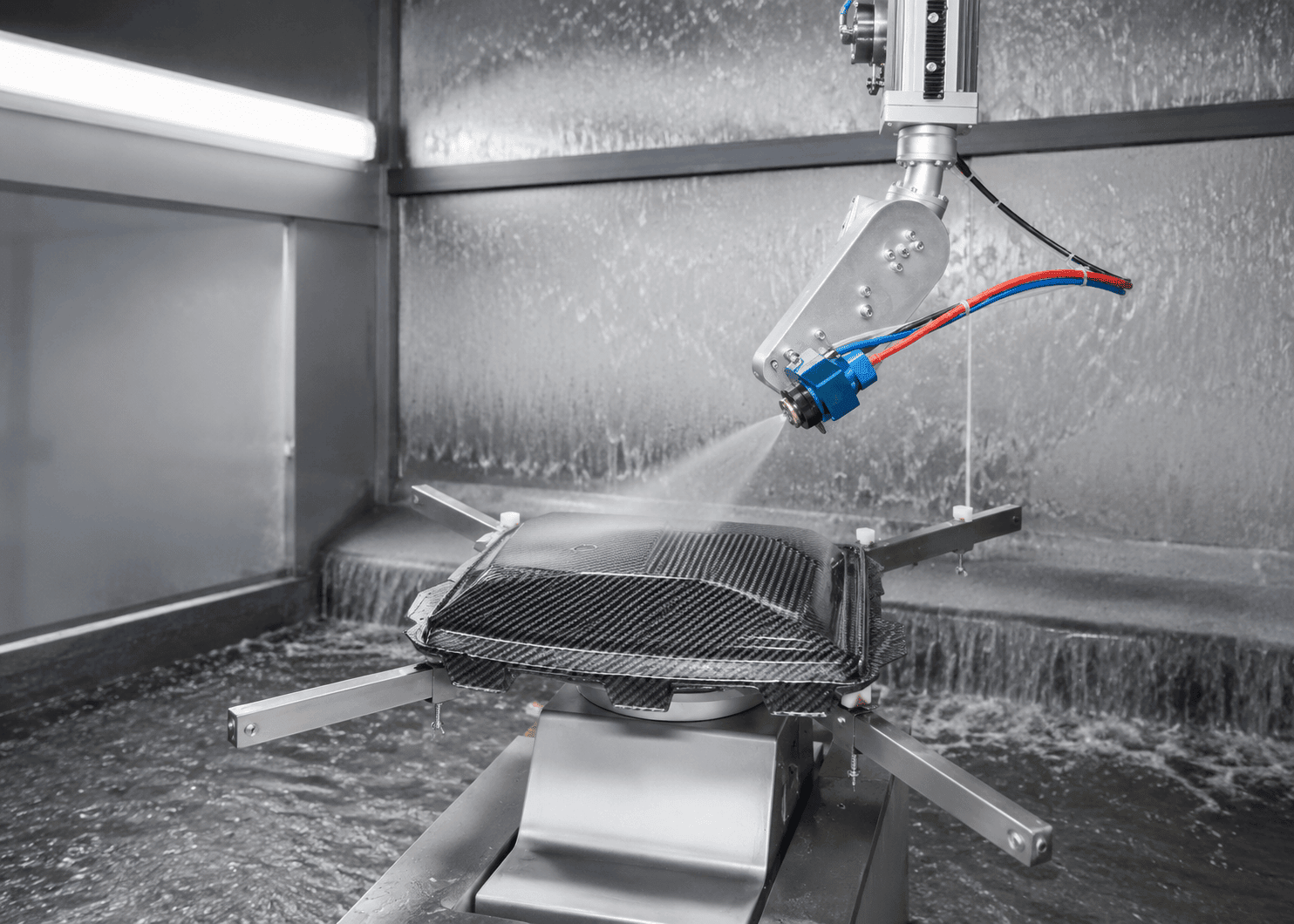
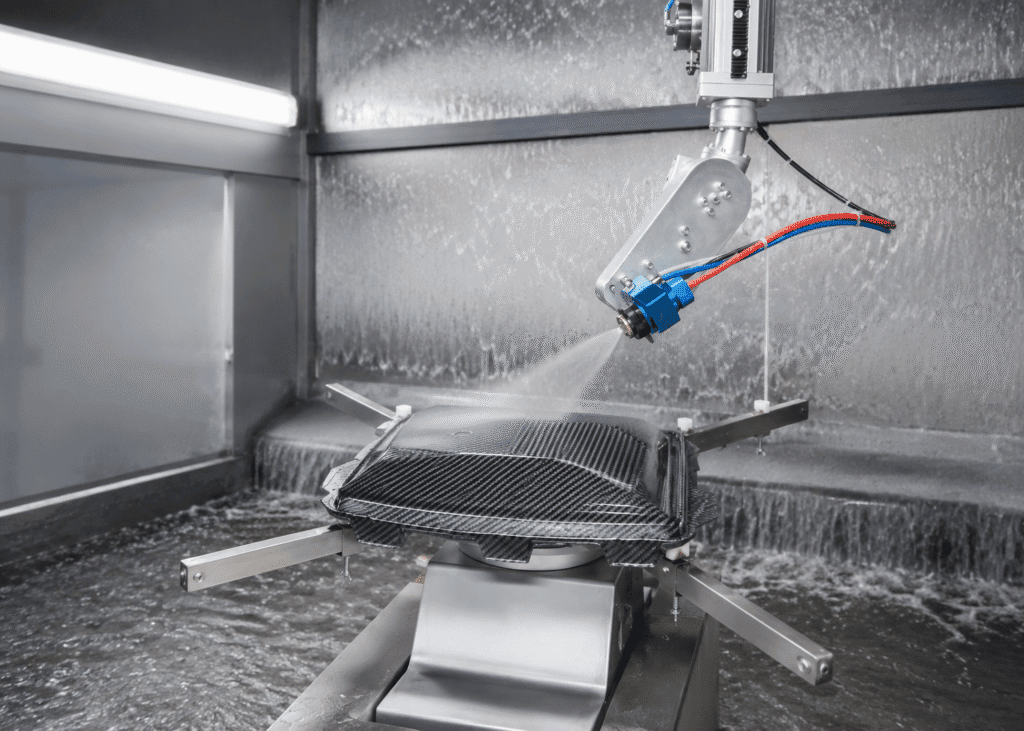
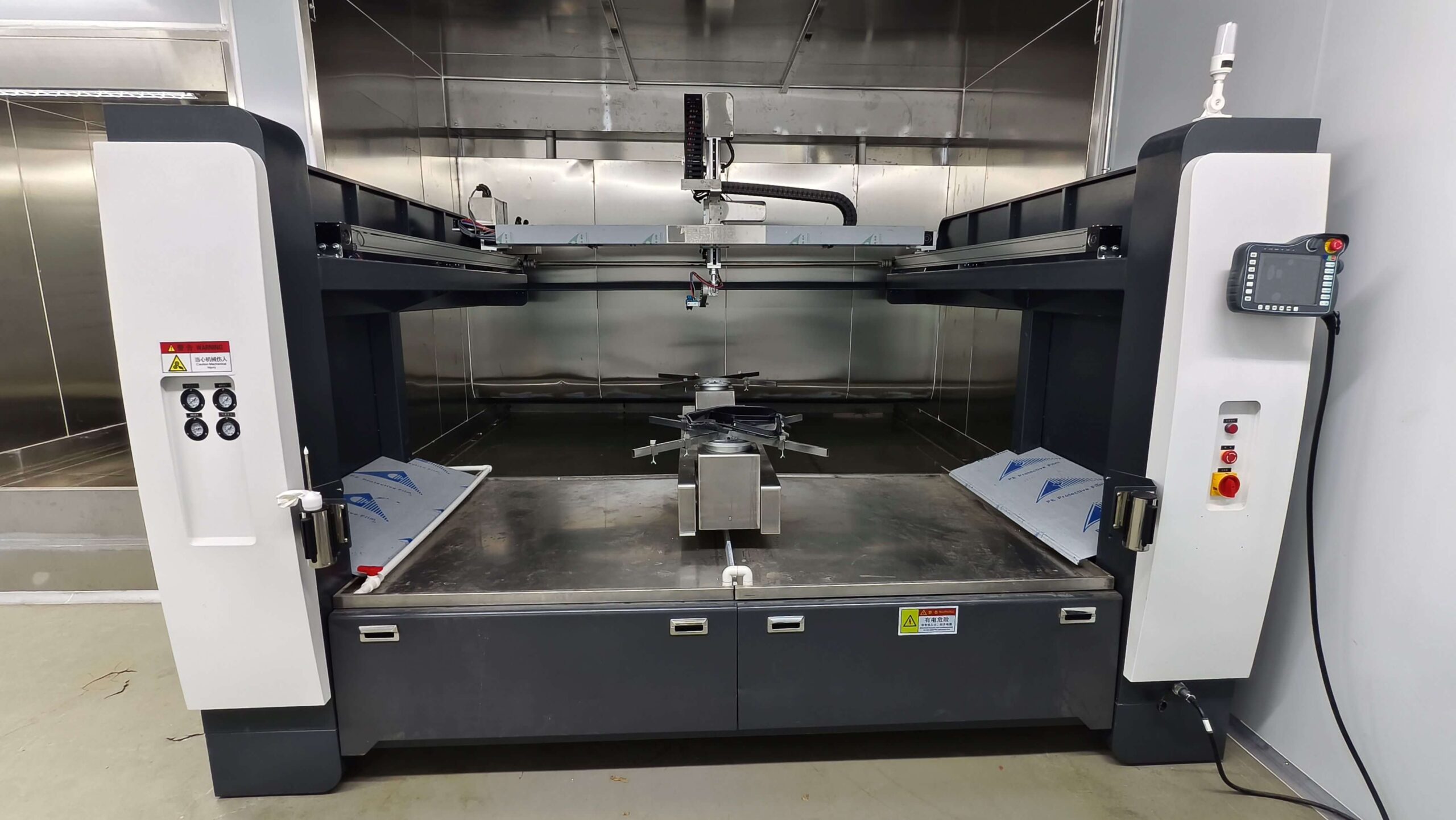
How robotic spray painting improves batch consistency is not that the machine sprays better than a skilled operator. It doesn’t. It reproduces a path that has already been validated — the same distance, the same angle, the same speed, the same overlap, on every cycle, on the last shift of the week as on the first.
The main advantage is not simply automation — it is repeatability.
That distinction carries a condition attached, and it is the part most suppliers skip. A robot copies whatever standard was frozen during sample validation. If film build, gloss level, and coverage were never properly defined upfront, robot spray painting reproduces an incorrect result 500 times with excellent consistency. Automated spray painting does not create a quality standard. It replicates one.
A repeatable spray process for carbon fiber automotive parts therefore only holds together when the output side is verified too. At JCSPORTLINE, painted surfaces are checked through paint adhesion testing, surface hardness testing, white spot testing, and UV and yellowing resistance testing rated to 1,500 hours. Automation reduces input variation. Testing confirms the output met the standard. Neither substitutes for the other, and a supplier offering one without the other is offering half a system. This is the same discipline applied across our manufacturing capabilities, not a policy that exists only at the paint booth.
Automation does not create a quality standard — it replicates one. Projects with poorly defined surface specifications don’t get rescued by automation. They get their problems reproduced at scale.
▶ Watch: JCSPORTLINE robotic spray line in operation
Efficiency and Unit Cost: Why the Advantage Grows With Volume
Where the Time Actually Goes
Buyers consistently underestimate how much of a carbon fiber part’s cost sits in finishing rather than moulding.
In composite parts of this type, surface performance engineering — multi-stage sanding, levelling, and polishing — commonly accounts for around 28% of total part cost, second only to primary materials. Looking at production labour alone, rework and repair typically absorbs somewhere in the range of 42% to 45% of total labour hours on both dry and wet carbon lines.
Those figures are what make this a commercial conversation rather than a technical one. Finishing is not a minor downstream step. It is one of the two largest cost blocks in the part, and it is the block most exposed to human variability.
Manual spraying processes parts one at a time, with setup judgement repeated on every piece. Once a standardized product enters continuous production, the program is already established and does not need to be re-created.
The gain is not raw speed, and any supplier quoting a speed multiple should be asked to show the data behind it. The gain is a predictable takt time — which is what makes scheduling, capacity commitments, and delivery dates calculable in the first place, and what separates mass production from repeated small-batch work carrying a larger order number.
Why Cost Efficiency Scales
Now the limitation. Does robotic spray painting reduce cost at higher volumes — yes. Does equipment make every order cheaper — no.
For one-off parts, samples, or programs where the design changes frequently, amortisation works against you. Programming and validation time spreads across too few pieces, and the flexibility you give up costs more than the consistency you gain.
As a product standardizes and quantities rise, the arithmetic inverts. Repeated manual operation falls as a share of total labour. Per-piece handling becomes more efficient. Production rhythm stabilises. That is the point at which unit cost becomes genuinely controllable rather than merely negotiable.
The cost advantage becomes more meaningful as production volume increases.
The brand client mentioned earlier illustrates the other half of the equation. Rather than treat re-finishing as unavoidable, we rebuilt the repair workflow around their acceptance standard — moving from wet sanding to a dry sanding line, standardising paint adhesion and hardness criteria, and matching the consumables to suit, down to polishing compound and abrasive grade. The second finishing operation on their side was eliminated, along with the labour and the lead time attached to it.
Robotic Spray Coating vs. Manual Spraying
| Manual Spraying | Robotic Spray Coating | |
| Consistency | More operator-dependent | Highly repeatable once validated |
| Production speed | Suitable for flexible, small runs | Better for repeat production |
| Cost at scale | Labour scales with volume | Efficiency improves at higher volumes |
| Change flexibility | Fast response to design revisions | Requires re-validation per change |
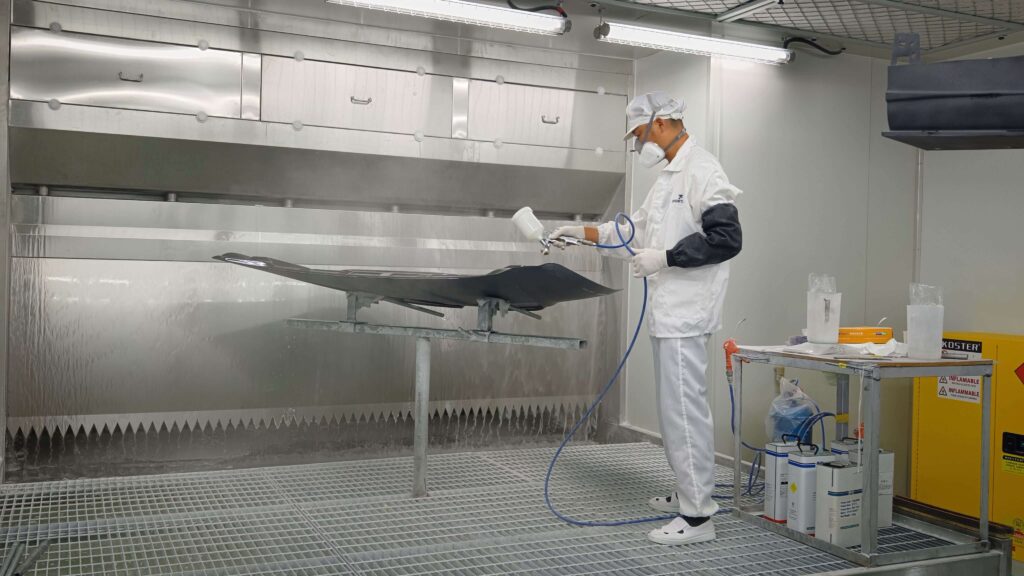
The fourth row is the one buyers overlook, and it is where manual spray painting remains genuinely superior. When a client sends a single photograph of a wing with a red-edged treatment and asks whether it can be reproduced, a skilled sprayer can put a sample in front of them within days. No program handles that. Adaptability is a real capability, not a fallback.
The honest answer to robotic spray painting vs manual spraying for composite parts is that they solve different problems. Manual buys adaptability. Robotic buys reproducibility. A supplier who only offers one of them is limiting which of your projects they can serve well.
Is robotic spray painting suitable for small batch carbon fiber work? Sometimes — but the question is framed wrongly. Batch size is not the variable. Repetition is. Fifty pieces every quarter is a completely different proposition from fifty pieces once.
Process selection follows the repetition structure of the project, not the sophistication of the equipment.
When Robotic Spray Painting Fits Your Project
| Project profile | Volume pattern | Recommended approach |
| One-off prototype, concept validation | 1–10 pcs | Manual |
| Custom, frequently revised designs | Low, irregular | Manual |
| Standardized SKU, seasonal replenishment | Recurring mid-volume | Evaluate robotic |
| Standardized carbon fiber automotive parts, repeat orders | Mid to high volume | Robotic |
| Program scaling from pilot to volume | Growing | Manual first, transition after design freeze |
The last row describes most real programs. When to use robotic spray painting for carbon fiber production is rarely a binary decision taken at kickoff. It is a transition point. Keep manual flexibility while the design is still moving. Introduce robotic spray coating once the design is frozen and the surface standard is locked.
Product developers and OEM program leads tend to recognise this immediately, because it mirrors how tooling decisions already work on their projects. Sourcing managers evaluating quotes across suppliers find it useful for a different reason: it explains why two quotes for the same part can differ structurally rather than simply by margin.
The same logic applies to motorcycle exterior parts, electronics housings, and outdoor equipment lines with recurring replenishment cycles — anywhere custom carbon fiber parts move from a single approved sample into a repeating supply rhythm.
Ask in this order: Is the design frozen? Does it replenish? What is the annual quantity? How demanding is the surface class? Not “do you have a robot?”
From Custom Development to Scalable Production
Robotic spraying is a downstream consequence of a decision made much earlier.
The path is prototype → validation → repeat production → scalable production. Surface standards — gloss level, film build, weave orientation, acceptance criteria — are defined and frozen during prototype development and sample validation. The spray program does not invent them later. It inherits them.
Once a product stabilises, the correct manufacturing and finishing process is selected against part structure, performance requirements, production quantity, surface requirements, and target cost. No single process covers every project, and a supplier claiming otherwise is selling equipment rather than engineering.
Robotic spray painting is one element inside carbon fiber mass production capability. It is not the capability.
Which suggests three better questions for how to evaluate a carbon fiber supplier for batch production. At what stage was the spray standard frozen, and is it documented? How is batch-to-batch conformance verified, and with what test methods? How long does re-validation take when the design changes? A supplier who can answer all three has a system. A supplier who answers by describing their equipment has a purchase.
Manufacturing maturity is not measured by how good the first piece is. It is measured by how little the five-hundredth differs from it. That is what from prototype to scalable carbon fiber production actually means in practice.
Conclusion
Robotic spray painting is not about replacing people. Applied to the right product at the right production scale, it delivers three things:
1. Quality consistency — a validated finish reproduced across batches
2. Production efficiency — predictable takt time and schedulable capacity
3. Cost efficiency at scale — falling manual labour share as volume rises
For prototypes and fast-changing designs, manual spraying remains the right tool, and we will say so. For standardized, repeating programs, automation is what keeps batch four looking like batch one.
If you are developing a carbon fiber product that will move into repeat or volume production, contact JCSPORTLINE to review the right finishing and manufacturing approach for your project.
Frequently Asked Questions
Is robotic spray painting always better than manual spraying for carbon fiber parts?
No. For prototypes, one-off custom work, and designs still under revision, manual spraying is faster and more adaptable. Robotic spraying wins when a design is frozen and the same part is produced repeatedly. Anyone telling you automation is universally superior is describing their equipment, not your project.
Will robotic spraying increase my unit price on a small order?
It can. Programming and validation time has to be amortised across the run. On short, non-repeating orders that cost spreads thinly and the economics favour manual work. The advantage builds as quantity and repetition increase.
Can robotic spraying handle complex or curved carbon fiber parts?
Yes, though geometry affects validation time rather than feasibility. Deeply recessed or highly contoured parts require more path development upfront — another reason the approach suits products that will be produced repeatedly rather than once.
How do I know later batches will match my approved sample?
Require that the standard be documented at validation and verified at production. Ask what gets measured. Paint adhesion, surface hardness, white spot testing, and UV and yellowing resistance testing are the checks that convert “it looks right” into something auditable.
My design is still changing. Should I wait before moving to automated spraying?
Yes. Run manual through the development and revision phase, freeze the design and surface specification, then transition. Automating before design freeze means re-validating every time something moves.