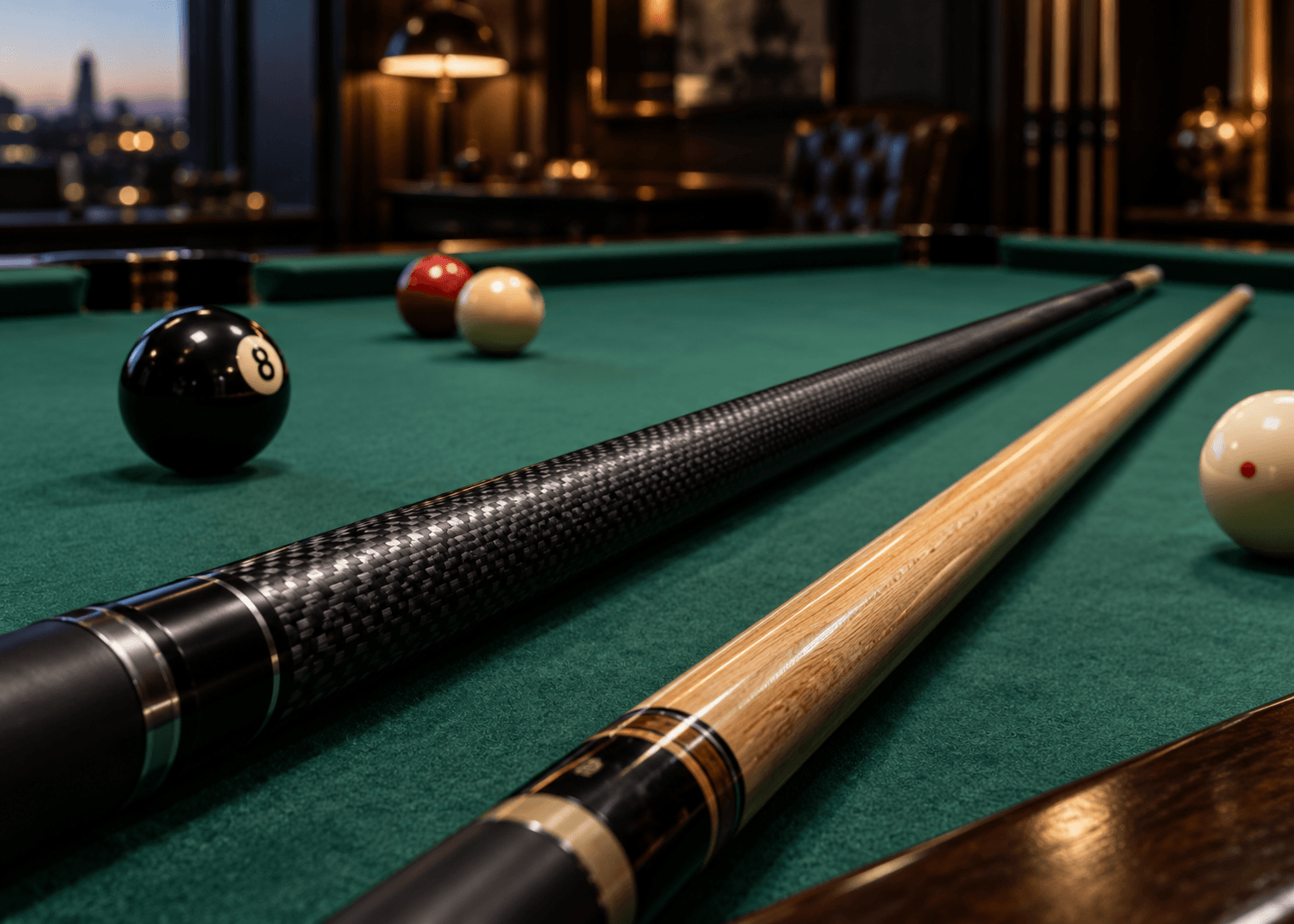
The knee brace category is one of the most crowded in sports protective equipment. It is also one of the most structurally vulnerable to margin compression — because the dominant materials have not changed in two decades, there is no engineering floor preventing a competitor from undercutting your price tomorrow.
Sourcing managers, brand owners, medical device distributors, and OEM program leads reading this are not looking for a product ranking. They are asking whether a carbon fiber knee brace product line can function as a genuine brand asset — something that defends margin, supports premium positioning, and builds a competitive moat that a lower-cost rival cannot simply replicate.
It can. But only when approached as a product strategy decision backed by engineering capability, not a catalog selection. Carbon fiber knee brace OEM development executed through a proper design-to-manufacture process delivers a product that occupies an entirely different commercial tier — one where the technical story is verifiable, the differentiation is structural, and the pricing power is durable.
The Knee Brace Market Has a Structural Problem — And Carbon Fiber Is the Answer
The knee brace carbon fiber category is at an inflection point, and the pressure is coming from both directions. Mass-market products built on EVA foam, neoprene, and aluminum stays are locked in a race to the bottom on price. Meanwhile, the buyer segment willing to pay for demonstrably better performance has no credible product to buy — because most brands have not made the material transition necessary to serve it.
The trap for B2B buyers is familiar. You can compete on price in the commodity segment and watch margins erode every quarter. Or you can attempt to move upstream with a product that cannot justify the premium because the engineering story is not there.
Sports protective gear categories that have broken out of this trap share a common pattern: the brands that moved to advanced composites early captured the premium segment and set new expectations for the entire market. Cycling helmets, motorsport protection, performance orthotic insoles — in each case, the inflection point was a material change, not a design refresh.
A carbon fiber knee brace product line represents exactly this kind of inflection. It is not a marginal improvement over aluminum. It is a platform that gives your brand access to a technically defensible premium tier — one where price comparisons against neoprene competitors become functionally irrelevant because the products are no longer in the same category.
Why Carbon Fiber Outperforms Traditional Knee Brace Materials — The Engineering Case
The claims made about carbon fiber technology in sports and medical markets are frequently vague. Procurement officers and clinical buyers have learned to discount them. To build a product line that actually supports a premium price point, you need specific, verifiable structural data — the kind that holds up when a sophisticated buyer asks for it.
Structural Performance vs. Metal and Polymer Alternatives
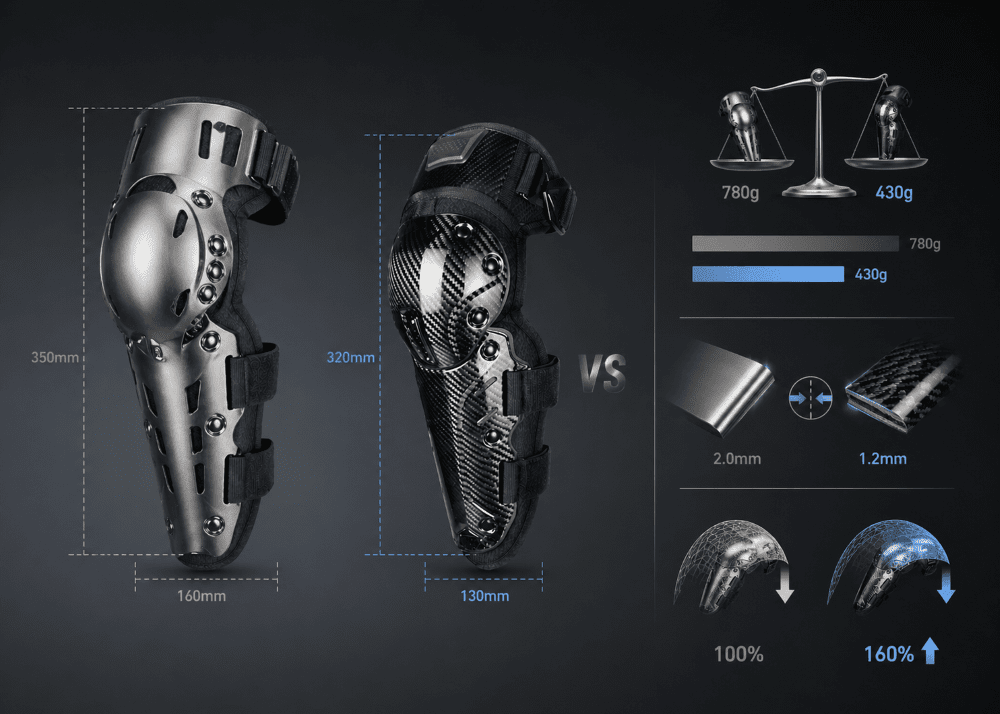
JCSPORTLINE’s finite element analysis comparing carbon fiber composite structures to high-strength steel assemblies of equivalent geometry produces the following results — directly applicable to structural brace design:
- Weight: 0.718 kg (carbon fiber composite) vs. 1.55 kg (metal assembly) — 53.7% reduction
- Bending stiffness: 284.3 N/mm vs. 152 N/mm — 87% higher resistance to deformation under load
- Peak bending load before failure: 2,681 N vs. 1,018 N — 163% greater structural strength
- First constrained modal frequency: 122.7 Hz vs. 76.8 Hz — superior vibration damping under dynamic loading conditions
For a best knee brace for stability application, these figures are not abstract. A lightweight knee brace that is simultaneously 87% stiffer and 163% stronger than its metal-framed equivalent, at 46% of the weight, is a categorically different product — not an incremental upgrade.
This data is the foundation of the commercial case. A product supported by FEA-validated structural numbers can be positioned at $150–$300 retail with a defensible rationale. A neoprene brace with an aluminum stay cannot make the same argument, regardless of how it is marketed.
The carbon fiber vs. aluminum strength, weight, and cost comparison covers the material-level tradeoffs in further detail for buyers working through the technical evaluation.
The core conclusion on difference between carbon fiber and metal knee brace for suppliers is this: metal constrains part performance to the material’s fixed isotropic properties. Carbon fiber lets you engineer the performance.
The Layup Design Advantage — Why Carbon Fiber Is Customizable by Nature
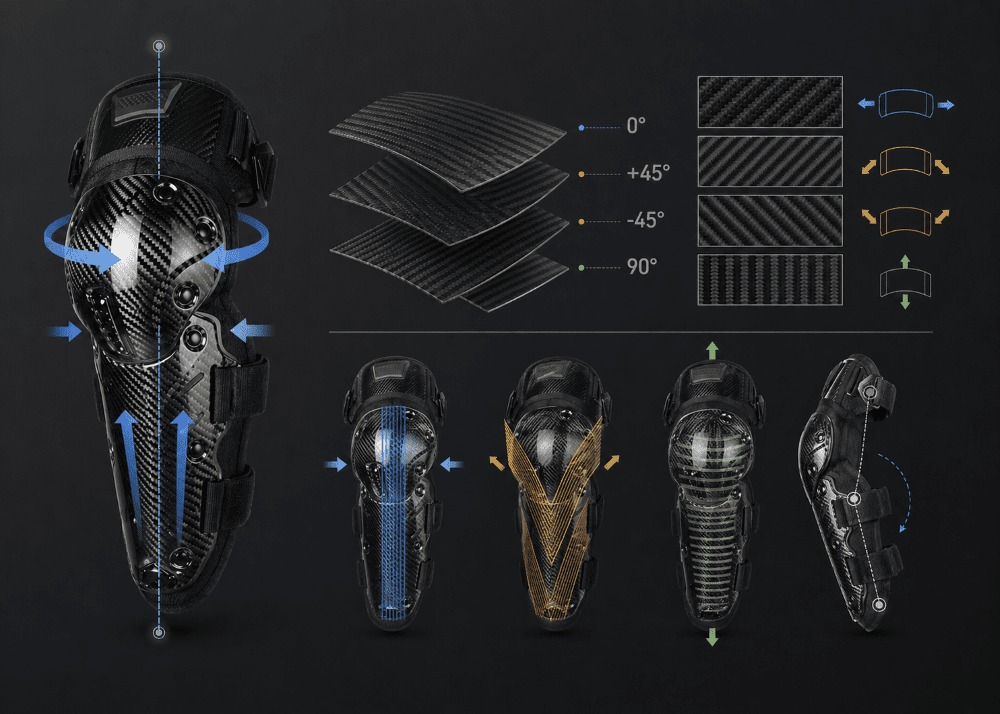
Aluminum, polypropylene, and standard fiberglass behave identically in every direction — their mechanical properties are locked in by material chemistry, not design. Carbon fiber technology operates on a different principle: because carbon fiber composites are anisotropic, the mechanical response of the finished part is controlled by how the fiber layers are oriented during manufacture.
For a knee brace, this means medial/lateral stiffness, flexion-axis compliance, and anterior/posterior support can each be tuned independently through layup design — without changing the part geometry or adding weight. A carbon fiber ACL knee brace requires specific resistance to valgus loading while preserving natural flexion; that performance profile is engineered at the laminate level, not approximated by the choice of a thicker aluminum stay.
This design freedom is not available in any competing material at equivalent weight. It is also the reason that carbon fiber vs traditional knee brace comparison discussions that focus purely on cost-per-unit miss the point — they are treating the two options as substitutes when they are, in engineering terms, not comparable.
Carbon Fiber Knee Brace OEM — What to Actually Evaluate in a Manufacturing Partner
Knowing why carbon fiber knee brace OEM ODM development creates business value is the straightforward part. The harder problem is identifying a manufacturing partner with the engineering capability to execute it — not just supply it.
The Difference Between a Supplier and an Engineering Partner
Most custom carbon fiber knee brace suppliers offer a catalog of existing mold geometries, surface finish selections, and a logo placement service. This is private labeling. It produces a product that is structurally identical to every other brand using the same mold — which means the differentiation advantage disappears the moment a competitor sources the same SKU.
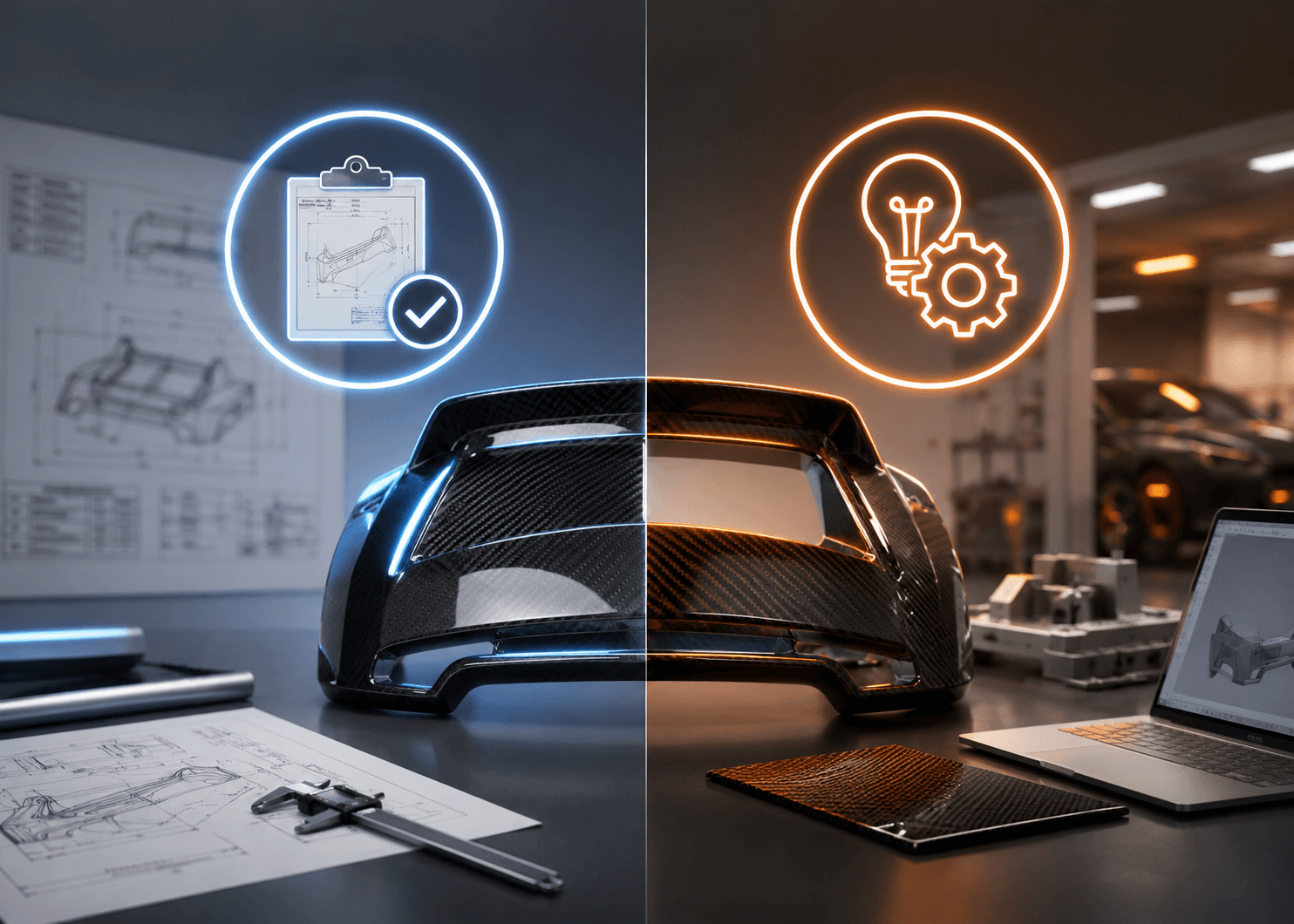
A genuine carbon fiber knee brace product line development engagement starts from your functional specification: the performance targets, the intended use environment, the user profile, and the regulatory requirements. From that brief, the engineering team works through DFM analysis, structural validation, tooling strategy, and process design. The output is a part built around your requirements — not a modification of someone else’s existing design.
At JCSPORTLINE, every OEM program begins with a free technical feasibility report, delivered within 24 hours of receiving the design brief. The report covers material selection, preliminary layup strategy, tooling requirements, and a cost model — giving the client a clear picture of project viability before any capital is committed to tooling. This is not a sales document. It is a structured engineering assessment that defines whether and how the project is manufacturable at target cost and volume.
What the Development Workflow Actually Looks Like
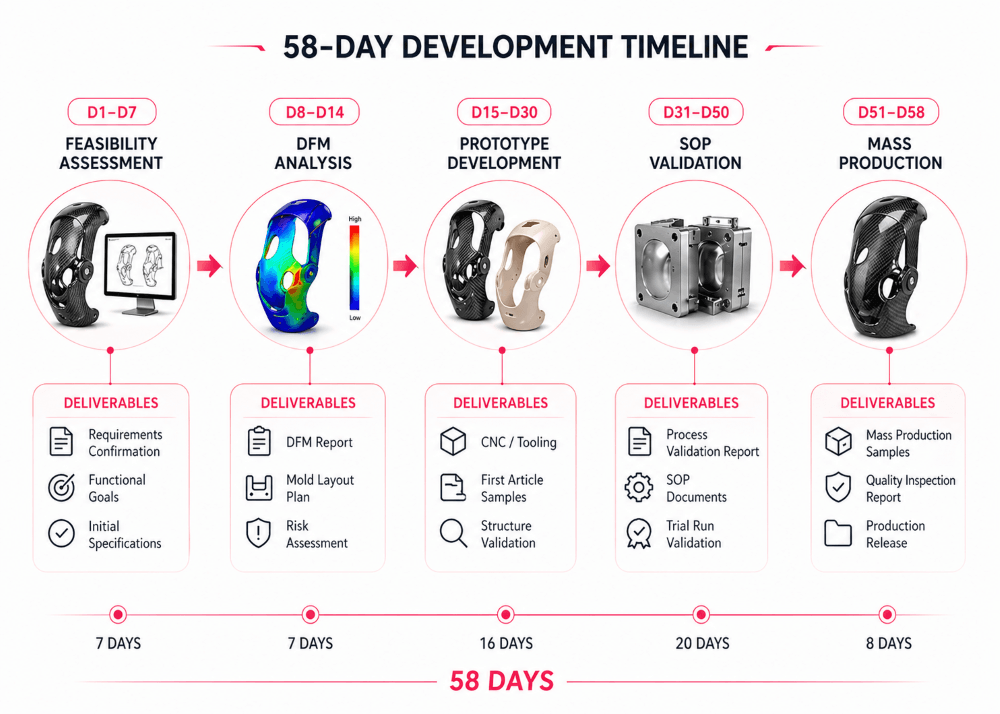
The standard OEM carbon fiber knee brace for sports brands development path follows a 58-day structured workflow:
- Day 1: Free feasibility report delivered within 24 hours — material, layup, tooling, and cost model
- Days 7–15: First functional prototype, using CNC aluminum tooling or cost-optimized non-metallic molds depending on target volume
- Production entry: All process parameters encoded in the MES system; SOP digitized and linked to the specific part number, ensuring batch-to-batch consistency from the first production run
- Ongoing delivery: 98% on-time delivery rate across active OEM programs
Flexible small-batch customization is available for programs requiring market validation before full-volume commitment. For programs with regulatory requirements, JCSPORTLINE provides documentation support and assists with medical device or sports certification applications.
The carbon fiber composite design services page provides further detail on the DFM review and design-to-manufacture workflow for new composite programs.
Material and Finish Customization Options
Custom knee brace development at the material level involves decisions that directly affect structural performance, aesthetics, and unit economics:
- Fiber specification: T300 for standard structural applications; T700 where higher modulus is required for specific stiffness targets
- Fabric architecture: 3K plain weave or twill for visible surface layers; 12K fabric for rapid structural thickness build; unidirectional prepreg for targeted load-path stiffness
- Surface finish: Matte or gloss clear-coat over exposed carbon weave; forged carbon texture for premium aesthetic at lower tooling cost; solid color paint for brand-consistent concealment of the substrate
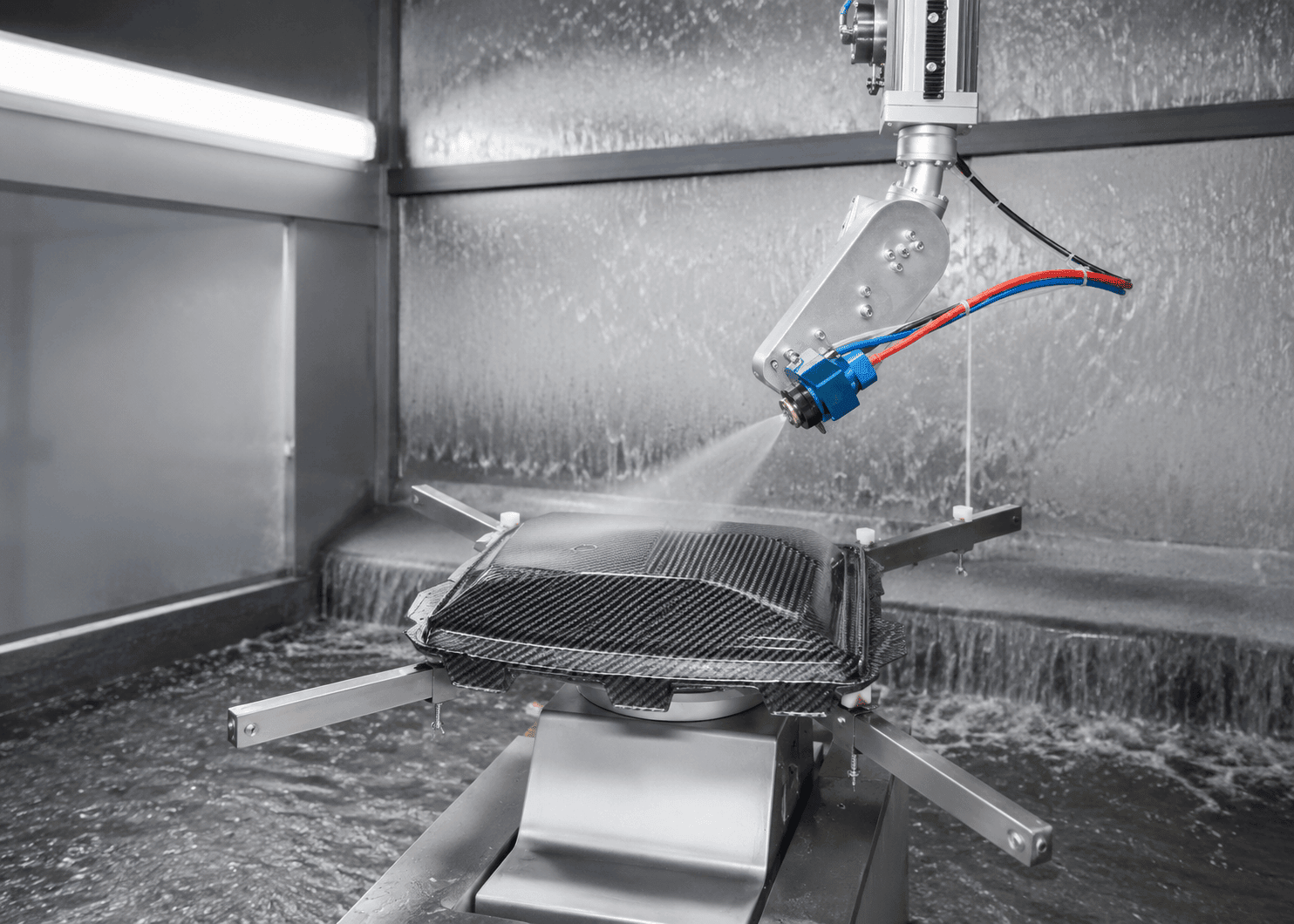
- Resin and process: Autoclave-cured epoxy prepreg for maximum consolidation and void-free surface quality; HP-RTM for higher-volume production efficiency
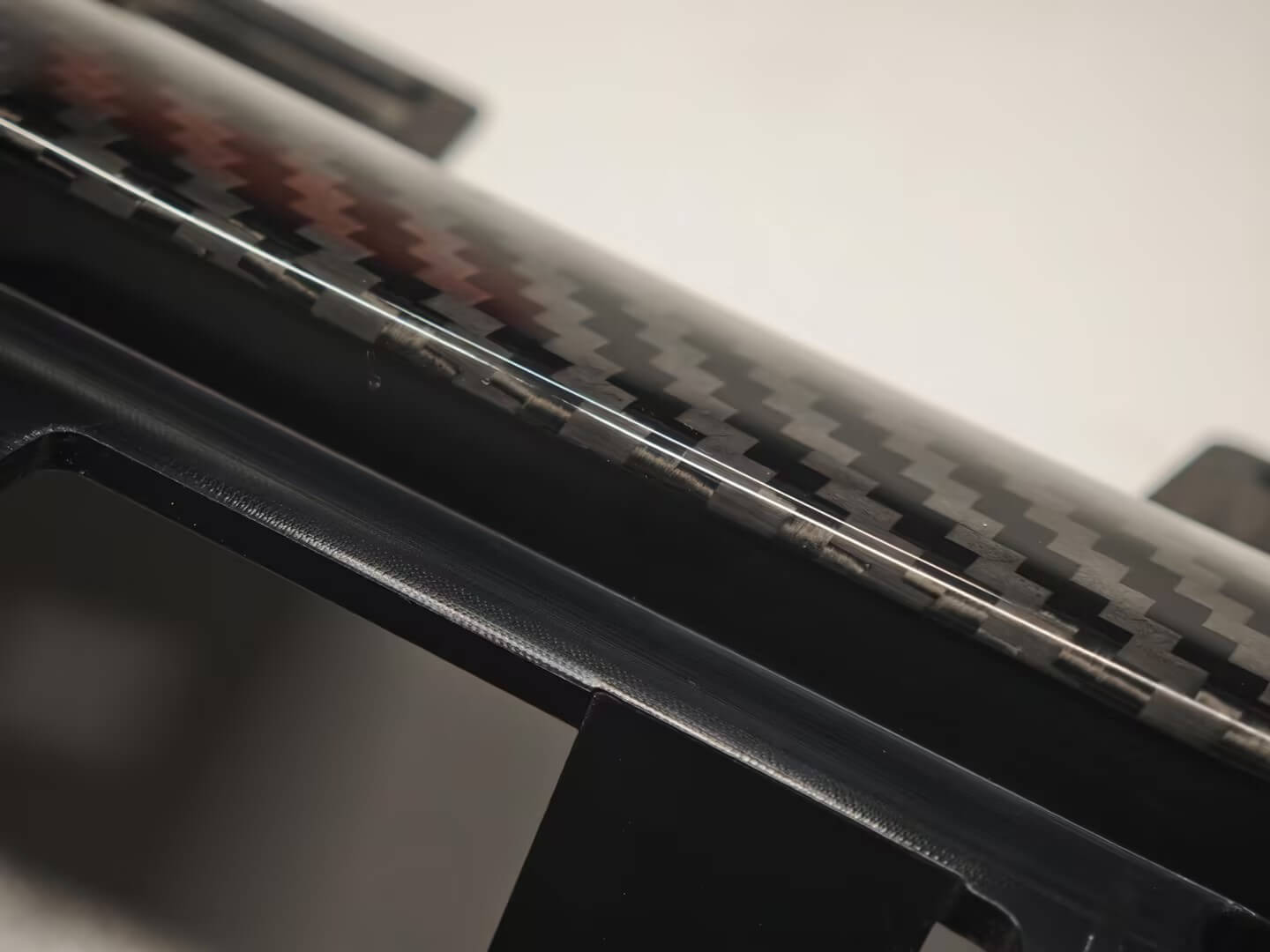
Each of these choices has a direct downstream effect on the product story your brand can communicate. A visible 3K twill carbon surface is a signal to the buyer that the material is real — not a printed film over a plastic shell. That perceptual difference is part of what supports the price premium.
The Real Business Case — How a Carbon Fiber Knee Brace Product Line Creates Brand Premium
The honest answer on carbon fiber economics: it is significantly more expensive than conventional alternatives. Raw industrial-grade carbon fiber technology runs roughly $5–$10 per pound; aerospace-grade fiber reaches $38–$50 per kilogram. Aluminum costs approximately $0.30 per pound. At the OEM component level, that input cost differential is real and it flows through to unit price.
The business case is not that carbon fiber costs less. The business case is that it supports a final product price point that absorbs the input premium — and then builds margin on top of it — while creating competitive barriers that commodity products cannot cross.
For Sports Brands and E-Commerce Sellers
A carbon fiber knee brace for sports brands operates in a different commercial environment than a commodity protective product. The material name carries functional SEO value in performance categories — “carbon fiber” as a product attribute drives qualified traffic from buyers who have already self-selected out of the commodity bracket. On a DTC site, a product page backed by actual structural data — bending stiffness figures, weight comparison, layup specification — converts at higher rates and generates less price resistance than a product page built on adjectives.
A lightweight knee brace wholesale solution built around carbon fiber frames can hold a retail price tier 3–5x above the standard neoprene bracket while maintaining wholesale economics that make distribution viable. That is not a projection — it is the observed pricing behavior in every performance equipment category that has gone through a materials transition.
For Medical Device Distributors and Rehabilitation Buyers
Carbon fiber knee brace for medical distributors programs have a direct material argument to make: light weight, high stiffness-to-weight ratio, corrosion resistance, and radiolucency under imaging — these are the attributes that clinical procurement looks for, and they are intrinsic to the material, not dependent on product positioning. FEA-validated structural performance documentation provides the evidence infrastructure that institutional buyers require for procurement decisions. This article does not make clinical efficacy claims; those are the domain of certified medical evaluation. What it can confirm is that the material properties are verifiable and documentable.
For Traditional Protective Gear Suppliers
Adding a carbon fiber tier to an existing protective gear portfolio does not compete with your standard product line — it anchors it. Distributors and retail buyers who see a technically credible premium product in your catalog treat your standard-tier products differently. The brand permission that comes from engineering credibility at the top of the range is real, and it is one of the underappreciated commercial benefits of a well-executed carbon fiber knee brace launch.
For a broader view of how composite materials are repositioning brands across multiple equipment categories, the carbon fiber materials and brand differentiation overview and industry solutions for carbon fiber composite products provide relevant context.
How to Choose the Right Carbon Fiber Knee Brace Manufacturer
How to source a carbon fiber knee brace manufacturer has one non-negotiable answer: evaluate engineering capability before price.
Price is easy to compare. Engineering capability is harder to assess, and it is the variable that actually determines whether the finished product can support the commercial positioning you are trying to build.
A qualified composite knee brace manufacturing partner should be able to demonstrate the following without prompting:
Structural analysis capability. Can the engineering team run FEA on your design before tooling is cut? Can they identify and resolve DFM issues — draft angles, fiber bridging risks, demolding constraints — at the CAD stage? A supplier who cannot do this can only copy existing designs. They cannot develop a new one.
In-house prototype tooling. A 7–15 day first prototype indicates the supplier controls their own mold production. A 30–60 day prototype lead time indicates outsourced tooling — which means every design iteration cycle goes through a third party, and your development timeline is no longer in your control.
Documented process controls. In carbon fiber composite manufacturing, batch consistency does not come from operator skill. It comes from process parameters that are defined, digitized, and enforced at the production level. MES-linked SOPs are the mechanism. If a supplier cannot describe how they maintain process consistency, they cannot guarantee it.
Cross-border project management. For international OEM programs, communication infrastructure is as important as manufacturing capability. A supplier structured around global clients — with English-language engineering documentation, transparent project tracking, and a dedicated account management process — removes a category of risk that purely domestic-facing factories cannot address.
The best carbon fiber knee brace manufacturing partner is not the one who quotes the lowest price on a standard mold. It is the one who can take a functional specification, engineer a manufacturable and structurally validated product, and deliver it consistently at volume.
The carbon fiber knee brace manufacturer relationship worth committing to is one where their engineering investment is working directly for your product strategy — not just fulfilling a purchase order.
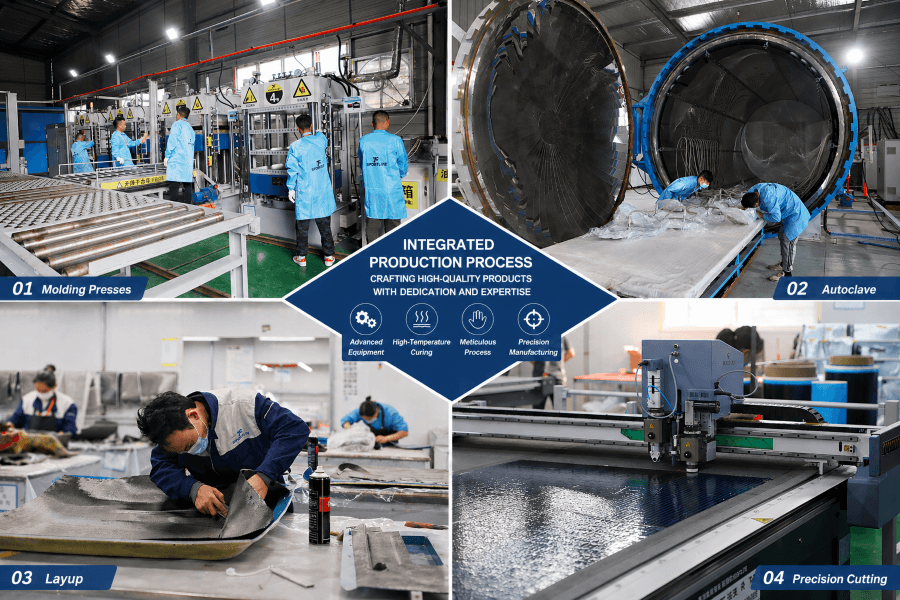
For brands actively evaluating manufacturing options, the composite design and manufacturing services overview outlines the full capability scope, from feasibility through volume production.
Conclusion
The knee brace category’s next competitive boundary will not be defined by a denser foam compound or a lighter aluminum alloy. It will be defined by the brands that build technically credible product lines around advanced composite materials — and do it before the rest of the market catches up.
A carbon fiber knee brace product line is not a niche premium play. It is a structural repositioning move that gives your brand access to a price tier, a buyer conversation, and a competitive moat that conventional materials cannot support. The FEA data is real. The manufacturing process is documented. The commercial logic is not complicated.
The market is ready. The question is whether your supply chain is capable of executing the move.
If you are evaluating carbon fiber knee brace OEM development — for a new product launch, a product line extension, or a full portfolio repositioning — the fastest path to a qualified answer is a direct technical conversation. JCSPORTLINE’s composite engineering team delivers a free, project-specific feasibility report within 24 hours of receiving your design brief: material selection, structural validation, tooling strategy, and cost modeling, at no cost and with no commitment required.
Frequently Asked Questions
What is the minimum order quantity for custom carbon fiber knee braces?
JCSPORTLINE supports flexible small-batch customization for OEM development programs. This allows brand clients to validate product design and test market response before committing to full production volumes. The specific production plan — including batch sizing and phased volume structure — is defined during the initial feasibility review. Contact the engineering team with your project brief to receive a program-specific recommendation.
How long does it take to go from concept to first prototype?
Under the standard 58-day workflow, the first functional prototype is delivered within 7–15 days of design sign-off. The clock starts with the free 24-hour feasibility report, which defines the design parameters, tooling approach, and material specification. Total timeline from initial brief to approved prototype depends on design complexity and revision cycles — both of which are mapped out in the feasibility report before any tooling investment is made.
Can the layup design be engineered for a specific injury type — for example, ACL support?
Yes, and this is one of the primary reasons carbon fiber is architecturally superior to isotropic materials for structural brace applications. Because the fiber orientation controls directional stiffness, the laminate can be designed to provide high valgus resistance for ACL applications while maintaining controlled flexion-axis compliance. The same part geometry with a different layup schedule produces a meaningfully different mechanical response — a level of performance customization that aluminum or polypropylene cannot match within the same weight envelope.
What does the cost premium of carbon fiber actually mean at OEM scale?
Raw industrial-grade carbon fiber carries an input cost of roughly $5–$10 per pound — approximately 15–30 times the per-pound cost of aluminum. That differential flows through to component unit price. The correct way to evaluate this is not input cost comparison, but final product pricing power: a carbon fiber knee brace product can be positioned at a retail price tier that conventional materials cannot reach, with wholesale margin structures that reflect the premium. The input cost is absorbed by the commercial positioning; the question is whether your sales channel can execute that positioning, not whether the material is affordable in isolation.
Does JCSPORTLINE provide structural validation and certification support?
FEA-based structural analysis is part of the standard feasibility and development process for every OEM program — it is how the engineering team validates the layup design before tooling is committed. For programs with formal certification requirements, including medical device regulatory submissions or sports equipment standards, JCSPORTLINE provides documentation support and assists with the certification application process.