
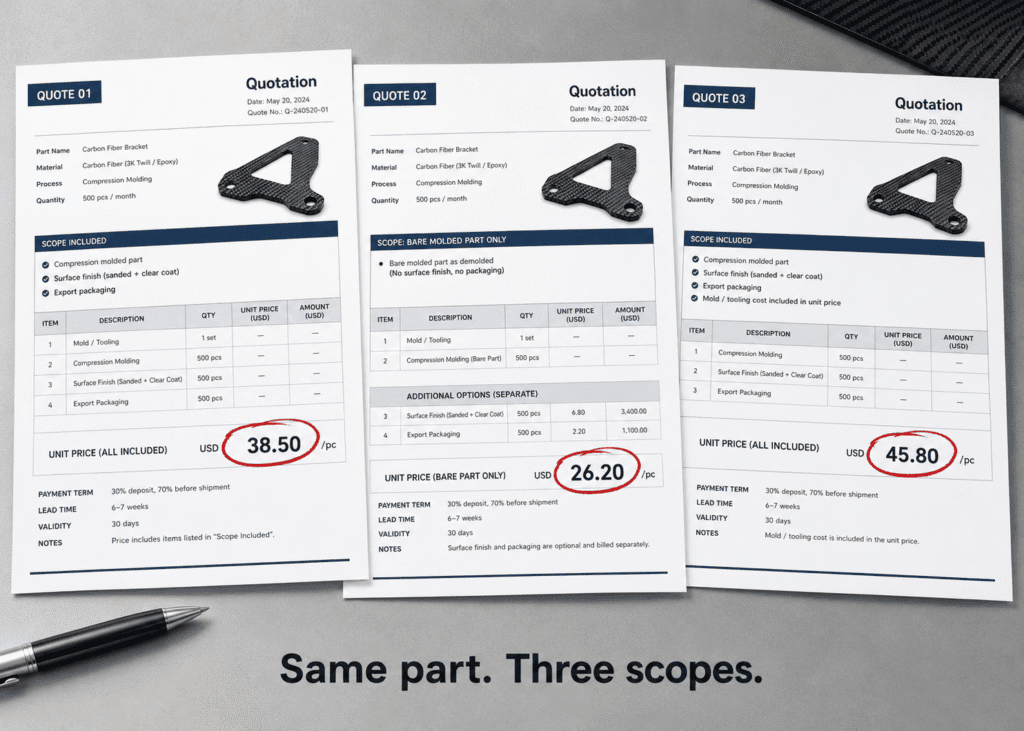
Three quotes for the same part sit on your desk. Three different unit prices. None of them tells you which supplier is cheaper.
One quoted the part with surface finishing and export packaging inside the number. One quoted the bare molded part and will invoice finishing on a separate PO. The third folded the mold into the unit price, so their figure looks high until you notice the quote has no tooling line at all. Three numbers, three definitions of what a number covers.
This is where the custom carbon fiber parts cost conversation fails — buyers compare the smallest figure instead of comparing the same scope. What follows is the method we use on our own quotations: split every quote into three layers, then get three things confirmed in writing before signing. A carbon fiber quote breakdown done properly will not produce a lower price. It produces a budget that survives internal approval and a project that stops generating invoices you did not plan for. Most hidden costs in composite sourcing were never concealed. They were never asked about.
We build custom carbon fiber parts for automotive, marine, medical, and consumer electronics clients, and the quotations that go wrong are almost never the ones with the highest number.
What a Custom Carbon Fiber Parts Quote Actually Contains
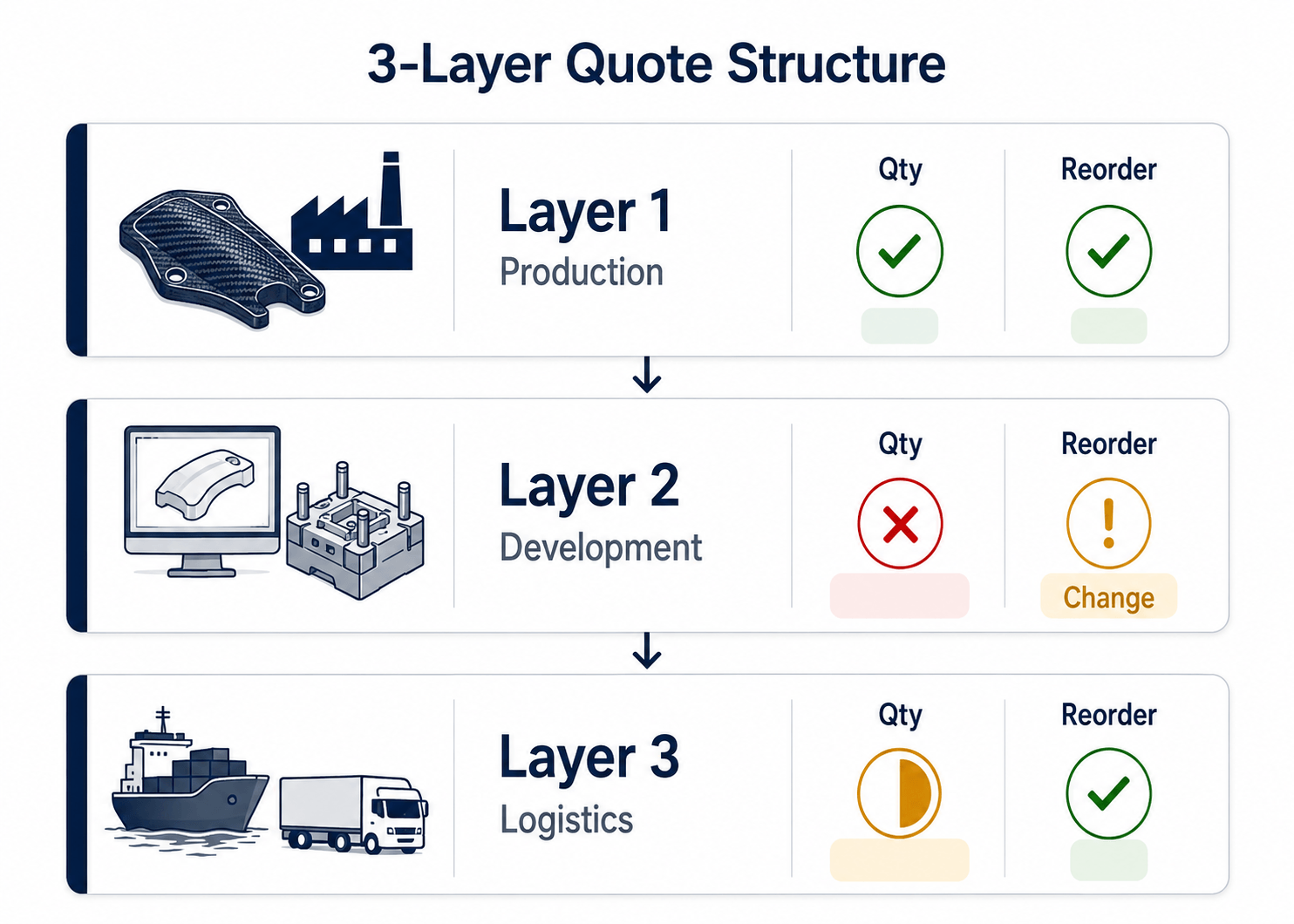
Every quotation for a custom composite part resolves into three layers. Separate them and comparison becomes mechanical.
| Layer | What it covers | Scales with quantity? | Repeats on reorder? |
| Layer 1 — Production unit price | Material, molding, surface finish, trimming, basic inspection, standard packaging | Yes | Yes |
| Layer 2 — One-time development | Tooling, trimming fixtures, first samples, design work, test setup | No | Only if the design changes |
| Layer 3 — Logistics and import | Inland freight, export clearance, port charges, international freight, destination clearance, duties | Partly | Yes |
A quote that merges the three into a single figure cannot forecast anything. Ask what the second order costs and the number moves — you have no way to calculate by how much, because Layer 2 was never disclosed as a separate quantity.
The split also matches how the money is actually approved on your side. Layer 2 is a one-time capital request. Layer 1 feeds your product margin model. Layer 3 belongs to logistics. A supplier who cannot present the quotation this way is transferring their internal disorganization into your approval process. What is included in a custom carbon fiber parts quote is a structural question before it is a pricing question.
Layer 1 — What Belongs Inside the Unit Price
Normally inside
Raw material and consumables, molding and curing labor, surface finishing, trimming and drilling, basic dimensional and cosmetic inspection, standard export packaging.
Usually outside
Client-specified third-party testing, industry certification, custom retail boxes, molded foam inserts, wooden crates, pallets, drop-test validation, dedicated transport protection structures. Whether any of these is charged depends on your project requirements and what the quotation commits to — there is no industry default that covers you.
When you ask does the unit price include surface finishing and packaging, the answer that matters is the definition, not the yes. “Standard packaging” is bubble wrap at one factory and a honeycomb carton with a die-cut foam insert at another. Both are accurate descriptions. One of them survives ocean freight on a 1.6-meter hood.
Surface finish carries the widest silent spread inside Layer 1. Matte clear coat, gloss clear coat, and partial painted zones differ in labor hours, sanding cycles, and rework rate. Two quotes that both read “twill carbon, clear coat” can sit far apart and both be honest. The variable is the quality standard behind the finish, which has to be defined in writing before it can be priced.
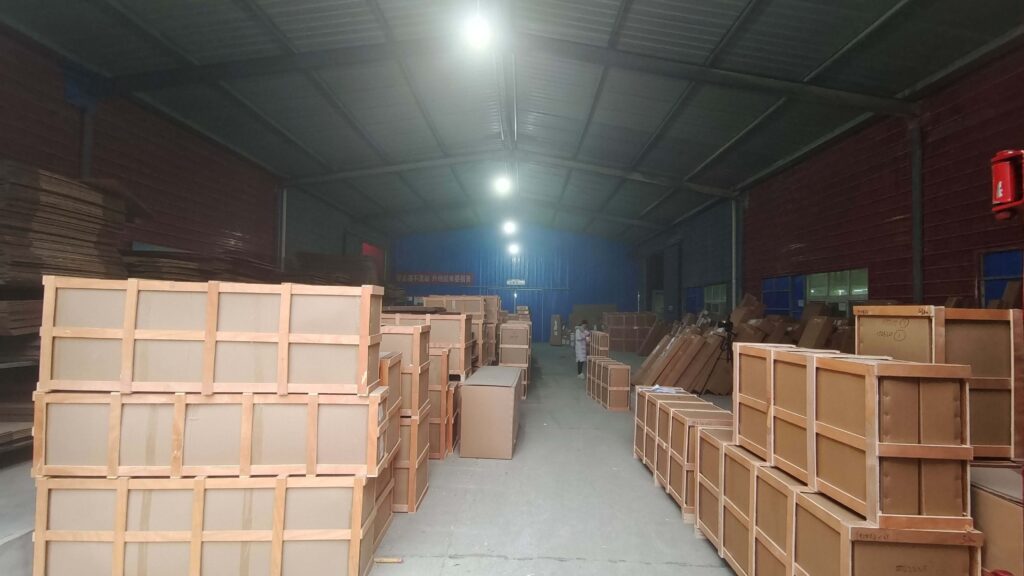
On large, fragile, or asymmetric parts, packaging is a transport yield item rather than a cost item. Foam, crating, and pallet requirements should be assessed against part dimensions and shipping risk during quotation, with a written statement of whether that assessment sits inside standard packaging or becomes a separate development item. Our packaging and value-added services scope is defined at quotation stage for this reason — a crate discovered at shipment is a schedule problem, not just a cost one.
One sentence to send your supplier: “Does the quoted unit price include surface finishing, trimming, dimensional inspection, and standard export packaging? If yes, please define standard export packaging for this part size.”
Layer 2 — Tooling, Samples, and One-Time Development
What drives carbon fiber tooling cost
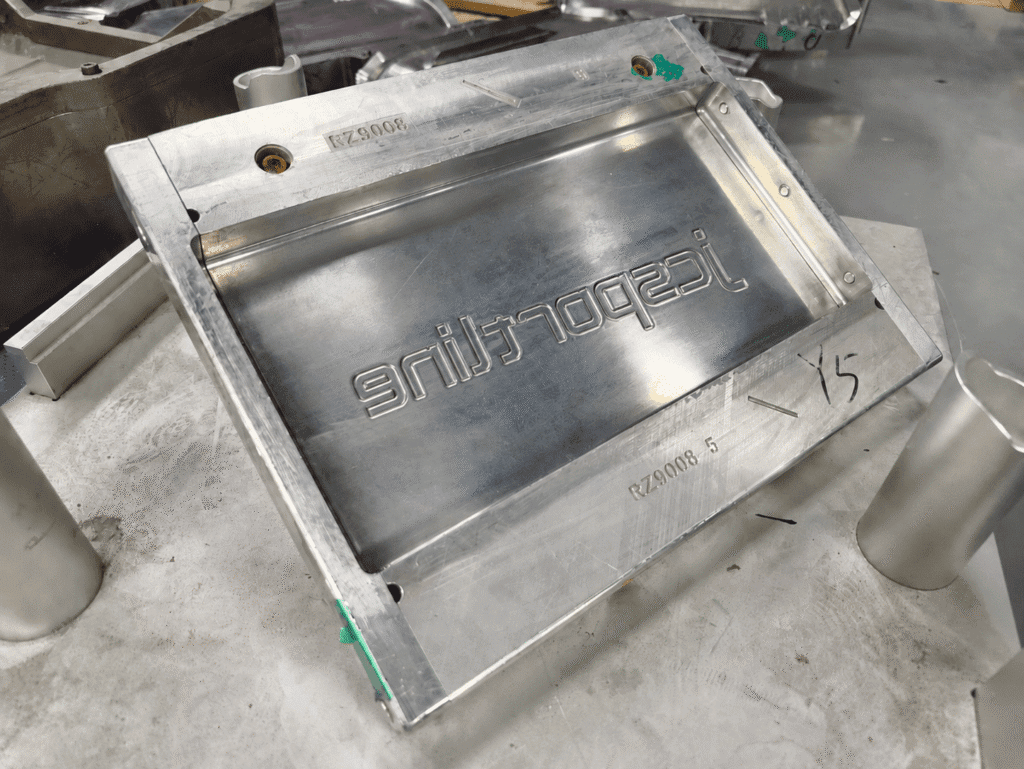
Carbon fiber tooling cost is set by part size, structural complexity, number of split lines, whether sliders or inserts are needed for demolding, and mold base material. A flat panel and a deep-draw part of identical surface area are not comparable tooling jobs.
Buyers searching how much does a carbon fiber mold cost for a car hood want a figure, so here is a working reference: hood tooling typically lands around USD 5,000. That number moves with dimensions and structural complexity, and it only becomes a commitment after our engineering team reviews the 3D data. At JCSPORTLINE the review runs through our Shenzhen R&D center, and the technical feasibility report — material route, structural risk, mold strategy, demolding feasibility — is returned within 24 hours of receiving usable data. A tooling price quoted before anyone has opened the file is a sales estimate, not an engineering number, and it will be revised later.
How the mold fee is paid
How is the mold fee paid — upfront, split, or amortized per part? Three answers exist across the industry, with completely different cash flow profiles. The carbon fiber mold fee may be invoiced once before tooling starts, split against milestones, or absorbed into the unit price through tooling amortization. The quotation has to state which one applies. A quote with no tooling line is not a quote without tooling cost.
Who owns the mold after production?
Who owns the mold after production? Ownership, storage duration, maintenance responsibility, and modification cost after a design change are four separate commercial terms. A single line reading “mold fee included” settles none of them, and we would treat that line as an unanswered question rather than an inclusive one.
The consequence is not on this purchase order. Mold ownership and transferability determine what leverage you hold in year two, when you want a second source or a design refresh.
Sample charges
Are first article samples charged separately? Usually, and there is rarely only one sample stage. First article, revised sample after feedback, and pre-production approval sample can each carry cost. Confirm how many rounds the quoted carbon fiber sample cost covers, and the price of one more.
| One-time item | Triggered by | Amortizable? | Must be defined in the quote |
| Production mold | New part geometry | Yes | Ownership, storage, maintenance |
| Trimming / drilling fixture | Tolerance-critical parts | Sometimes | Whether included in mold fee |
| First article sample | Every new tooling | No | Number of rounds covered |
| Revision samples | Design or fitment changes | No | Cost per additional round |
| Custom packaging development | Size, fragility, retail requirement | No | Standard vs. developed |
Engineers and product developers reading a quotation should treat this table as the minimum itemization. Anything collapsed into one figure will resurface as a change request later. Our carbon fiber tooling process itemizes these lines before mold machining begins.
Tooling Amortization and MOQ: Why Two Unit Prices Are Not Comparable
How tooling amortization affects carbon fiber unit price: the tooling cost is divided across an agreed quantity and folded into the per-part figure. Upfront spend drops to zero, unit price rises.
Amortization is a relocation, not a discount. Two questions make it safe — over how many units is tooling amortized, and does the unit price drop once that quantity is reached. Without the second answer, your reorder pays again for a mold already recovered.
Minimum order quantity is the other reason two unit prices sit on incomparable bases. Quantity drives material batching, layup scheduling, and curing cycle utilization, so a price quoted at one MOQ carries no information about the price at another. Normalize every quote to the quantity you actually intend to order before you compare anything.
What happens to unit price below minimum order quantity is recalculation, generally upward, because fixed setup spreads across fewer parts. Split deliveries and mid-project quantity changes trigger the same recalculation. Get the rule before the first order — the terms available to you on low-volume and small-batch projects are negotiable at quotation stage and non-negotiable after.
| Quote structure | Unit price (index) | Tooling paid upfront | Total for 50 units |
| A — Tooling billed separately | 100 | USD 5,000 | 5,000 + (50 × 100) |
| B — Tooling amortized over 50 | 118 | 0 | 50 × 118 |
| C — Tooling amortized over 200 | 105 | 0 | 50 × 105, balance due if project stops |
Illustrative index only — not a quotation.
Structure C shows the lowest unit price and carries the highest exposure. Stop short of the amortization base and the unrecovered tooling comes back to you as a settlement, usually at the least convenient point in the program.
Normalize before comparing: total project cost ÷ actual order quantity = comparable unit cost. Every other comparison is arithmetic performed on different definitions.
EXW vs FOB vs DDP: Who Pays for What
Layer 3 is where cross-border budgets break, because the omitted costs arrive from third parties months later. The exw vs fob and ddp vs fob distinction sets your landed cost, the only number your finance team treats as real.
| Cost item | EXW | FOB | DDP |
| Factory to port inland freight | Buyer | Seller* | Seller |
| Export customs clearance | Buyer | Seller | Seller |
| Origin port charges | Buyer | Seller* | Seller |
| International freight | Buyer | Buyer | Seller |
| Destination clearance | Buyer | Buyer | Seller |
| Duties and import taxes | Buyer | Buyer | Seller* |
*Confirm in writing — supplier practice varies.
A FOB quote does not include destination clearance or import duties. That is definitional. It is also still described in email, routinely, as “the price delivered to you.”
Suppliers do not apply EXW, FOB, and DDP identically — inland freight allocation varies most. A DDP quote is not automatically all-inclusive either. The written scope of the quotation governs, not the three-letter abbreviation, and a buyer who accepts the abbreviation as the scope has accepted an undefined liability.
Distributors and cross-border sellers evaluating exw vs fob vs ddp for carbon fiber parts from china should know our standard quotations are FOB or EXW. Where a client prefers not to manage freight and clearance, DDP pricing inclusive of freight and duties can be arranged through our logistics partner network.
Before You Sign: Included, Not Included, and What Triggers Extra
The three questions
Every quotation needs written answers to three things: what is included, what is not included, and what triggers extra. Most quotes answer the first. Some answer the second. Almost none answer the third, and the third is where budgets break.
What triggers extra fees
What additional fees apply to custom carbon fiber parts? Added cost is triggered by change, not by usage.
| Change | Typical cost impact |
| Drawing or geometry revision after tooling | Mold modification + new sample |
| Material substitution | Unit price re-quote, possible re-testing |
| Surface effect or weave pattern change | New sample round, possible new surface tooling |
| Mounting structure change | Fixture rework, fitment re-validation |
| Quality standard upgrade | Additional inspection, higher reject allowance |
| Quantity change vs. MOQ | Unit price recalculation |
| Packaging upgrade | Packaging development cost |
Do design changes trigger extra tooling fees? After mold machining, yes. Geometry changes are cut into aluminum or steel, not into a file. The change-control clause belongs in the quotation, written before there is anything to change.
Our DFM review runs before tooling for exactly this reason — draft angles, internal radii, split line position, and demolding feasibility get resolved on the model, where a change costs engineering hours instead of mold rework and a lost sample cycle.
How to compare carbon fiber supplier quotes
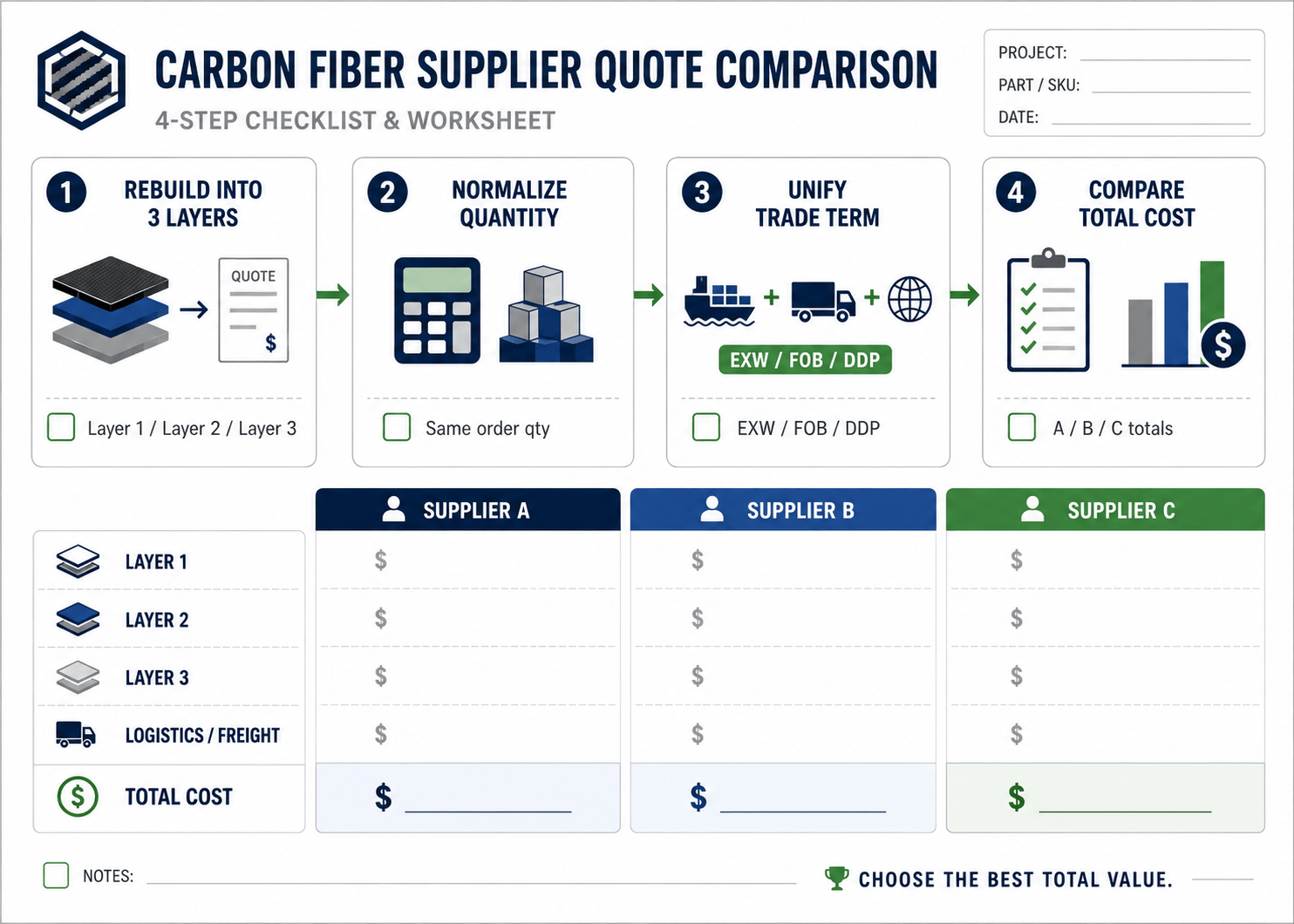
How to compare carbon fiber supplier quotes on a single basis: rebuild each quote into the three layers, normalize Layer 1 to your real order quantity, add Layer 3 under one trade term, then compare totals.
This is also how a price gap closes without cutting quality. A client came to us with a target unit price well below our first quotation. We did not discount. We rebuilt the quote layer by layer — recalculated the batch price against the appropriate MOQ, reviewed which surface process steps the application genuinely required, and re-sourced the metal hardware supply chain. The price entered an executable range and the specification held. When a unit price will not close, the structure of the quote is what needs to move, not the number.
Program managers running a first composite project can get the same structure applied upfront through our project feasibility and quotation support, where the quotation is built from the engineering review rather than backfilled after it.
Conclusion
A transparent quotation reads as more expensive on first pass, because it puts on page one the costs other quotations leave for month three. Treat that as information about the supplier, not a reason to disqualify them.
The buyers who run composite programs well — procurement managers, OEM/ODM program leads, distributors, brand founders shipping a first product — are not the ones who negotiated the lowest unit price. They are the ones who knew, before signing, which layer each cost belonged to and what would move it.
JCSPORTLINE quotes against product stage, order quantity, and application requirement, covering design support, samples, tooling, and mass production as one defined scope, so the quotation range and the delivery range describe the same project.
Send your 3D data or sample details with target quantity and application scenario. Our engineering team returns a feasibility assessment within 24 hours and a quotation broken out by production unit price, one-time development, and delivery terms.
Frequently Asked Questions
Who owns the mold after production, and can it be transferred?
Ownership, storage period, maintenance responsibility, and transfer conditions are four separate terms and belong individually in the quotation or contract. A line reading “mold fee included” does not establish ownership. Get all four in writing before tooling starts.
Is the mold fee refundable or creditable against repeat orders?
It depends on the supplier and on whether the fee was billed separately or amortized. If tooling is amortized into the unit price, confirm the amortization base quantity and whether the unit price drops once that quantity is exceeded. Without that clause, reorders keep paying for tooling already recovered.
Does a FOB quote include destination customs clearance and import duties?
No. FOB ends at the origin port. International freight, destination clearance, duties, and import taxes fall to the buyer. If you want them covered, request DDP pricing and confirm its written scope — DDP practice differs between suppliers.
Why does the unit price change when we reduce the order quantity?
Material batching, layup scheduling, and curing cycle utilization are largely fixed per production run. Fewer parts spread the same setup across a smaller base. Ask for the recalculation rule at quotation stage, so quantity flexibility is priced before you need it.
Which design changes will trigger additional tooling or sampling fees?
Any change to geometry, mounting structure, material, surface effect, or weave pattern after mold machining. Before tooling, changes cost engineering time. After machining, they are physical modifications with their own lead time and cost. Lock the drawing, then confirm the change-control terms in the quotation.