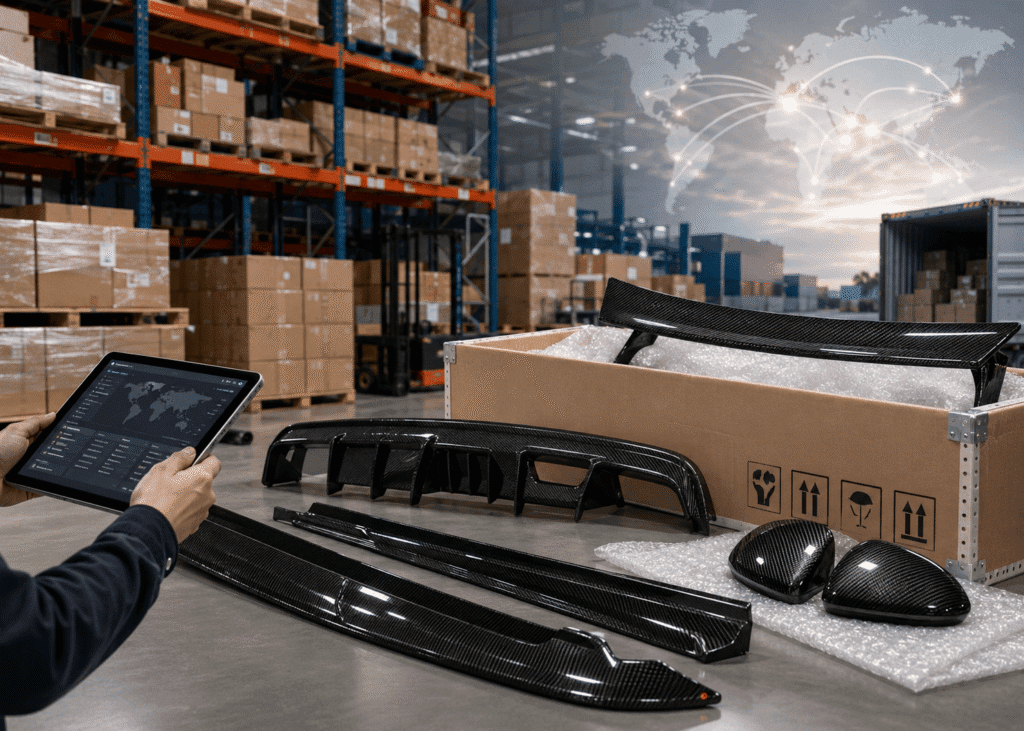
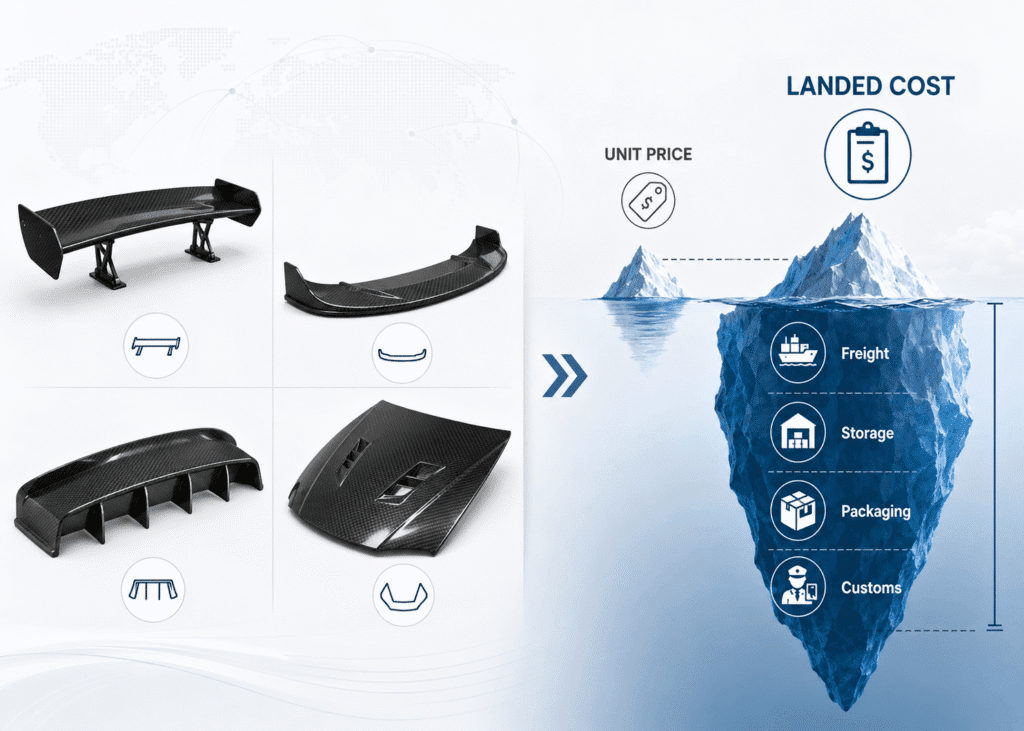
Most sellers start their search for auto parts dropshipping suppliers by comparing one number: the unit price. For carbon fiber, that’s the fastest way to pick the wrong partner. A rear wing, front lip, diffuser, or hood is large, fragile, and expensive to move — the unit price is a fraction of what actually lands the part on your customer’s doorstep.
If you sell aftermarket carbon fiber parts on Amazon, eBay, or your own store, the question is not “who’s cheapest.” It’s whether a supplier can fulfill single orders, hold accurate stock, label and pack oversized panels without breakage, push tracking to your platform, and tell you who clears customs. This guide approaches how to dropship carbon fiber auto parts the way a procurement decision should be made — by landed cost and fulfillment capability, not headline pricing.
Beyond Unit Price: What a Real Carbon Fiber Dropshipping Supplier Must Do
A supplier that only quotes parts is a vendor. Reliable auto parts dropshipping suppliers operate across seven capabilities, and any gap becomes your problem after a customer has already paid.
Supplier evaluation checklist — work through this before you list a single SKU:
1. Product supply — will they truly accept single-piece orders, not just bulk?
2. Inventory planning — is stock real-time and protected against overselling?
3. Dropshipping fulfillment from the right location
4. Packaging and labeling built for fragile, oversized parts
5. Auto parts dropshipping order tracking synced to your store
6. Customs coordination with a clear duty split
7. Room to grow — bulk pricing, regional cooperation, customization later
Lay-up, mold quality, and surface finish define the product. These seven points define whether you keep the customer. The cheapest car parts dropshipping suppliers rarely close all seven, which is why a slightly higher unit price routinely produces a lower landed cost and far fewer cancellations. A carbon fiber auto parts dropshipping supplier worth listing is judged on the full chain — not the quote — which is exactly the kind of capability set we group under our value-added services.
Where Your Parts Actually Ship From: China Factory vs Overseas Warehouse
The single most decisive question in car parts dropshipping is where the part physically ships from. That one fact sets your delivery time, defines who owns the stock, and determines whether you can oversell.
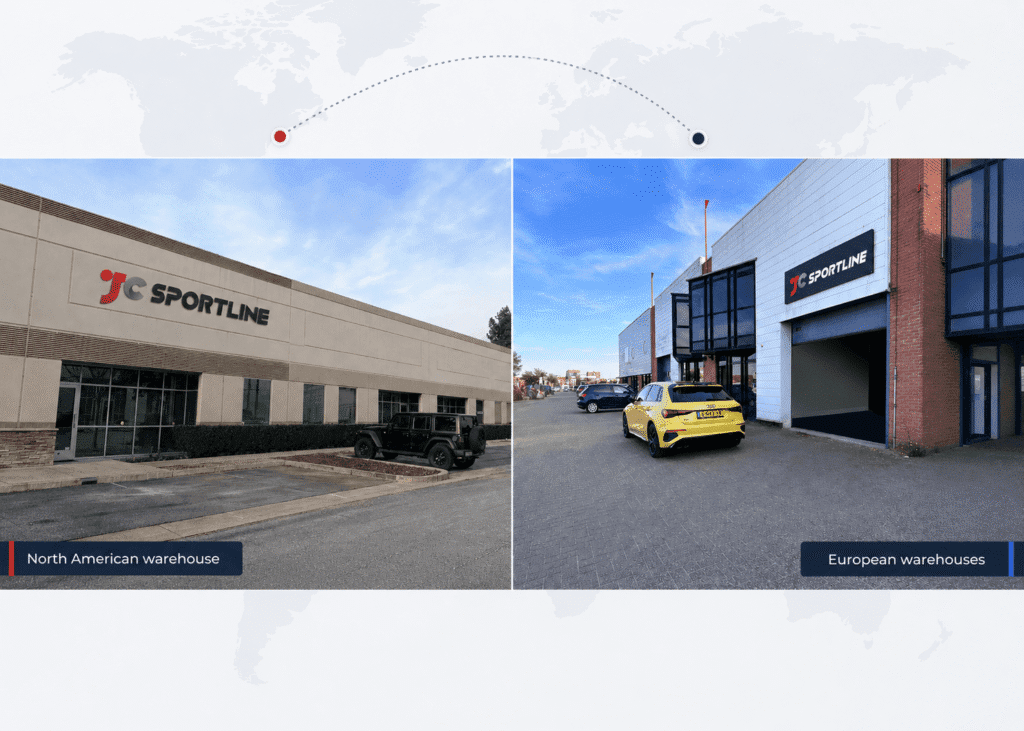
Shipping single carbon fiber parts from China works, but the transit time is long — and that delay is what cancels orders in hot markets. The alternative is an overseas warehouse: pre-stocking validated SKUs in the US or Europe so the part is already in-market when the order lands. This is where auto parts dropshipping suppliers with overseas warehouses separate themselves from plain auto parts warehouse distributors, who hold and forward bulk freight but don’t fulfill your single orders.
A Canada-based seller we work with sold mostly into the US and Europe but held no stock in either, so international auto parts shipping out of Canada was too slow and orders slipped away. We stocked their best SKUs in a US overseas warehouse, relabeled inventory on a weekly cycle, and shipped each order by FedEx. Under that arrangement, end customers received parts in two to three business days, and the account grew more than 100% year over year — without the client renting a single square meter of warehouse space themselves. Read that as a result of that project’s setup, not a fixed promise for every country or SKU. Matching the right fulfillment route to each product is the core of how we structure carbon fiber supply solutions.
An overseas warehouse is not the default for everything. Tier your SKUs by sales volume, part size, inventory turnover, and target country — pre-stock proven sellers, dropship the rest from China. Stocking a slow SKU overseas just moves dead inventory closer to the customer.
Zero-Inventory Testing vs Pre-Stocking Your Hot SKUs
Pre-stocking is a cash commitment, so don’t make it blind. For any SKU whose demand you haven’t proven, use carbon fiber auto parts dropshipping without inventory to test: list it, sell it, and let the supplier dropship auto parts order by order from China. You carry no stock and no cash-flow risk while the market tells you what sells.
Once a SKU proves itself, move it to a warehouse to cut delivery time. Test zero-inventory, then pre-stock the winners — that two-step discipline is how carbon fiber auto parts dropshipping scales without dead stock piling up overseas.
A Japanese aftermarket dealer ran exactly this path. With no warehousing and modest early volume, they tested through zero-inventory dropship auto parts fulfillment. As orders stabilized, we added steady supply and bulk pricing; as they grew, a regional cooperation arrangement; and eventually OEM/ODM support so they could take on local brand customers. They went from an e-commerce reseller to a stable, customized regional partner — a progression a single-transaction vendor can’t support.
Zero inventory is not zero risk. Fitment accuracy, stock accuracy, and replenishment lead time still need managing, which is why the supplier behind the model matters more than the model itself.
Packaging, Labeling & Protecting Oversized Carbon Fiber Parts
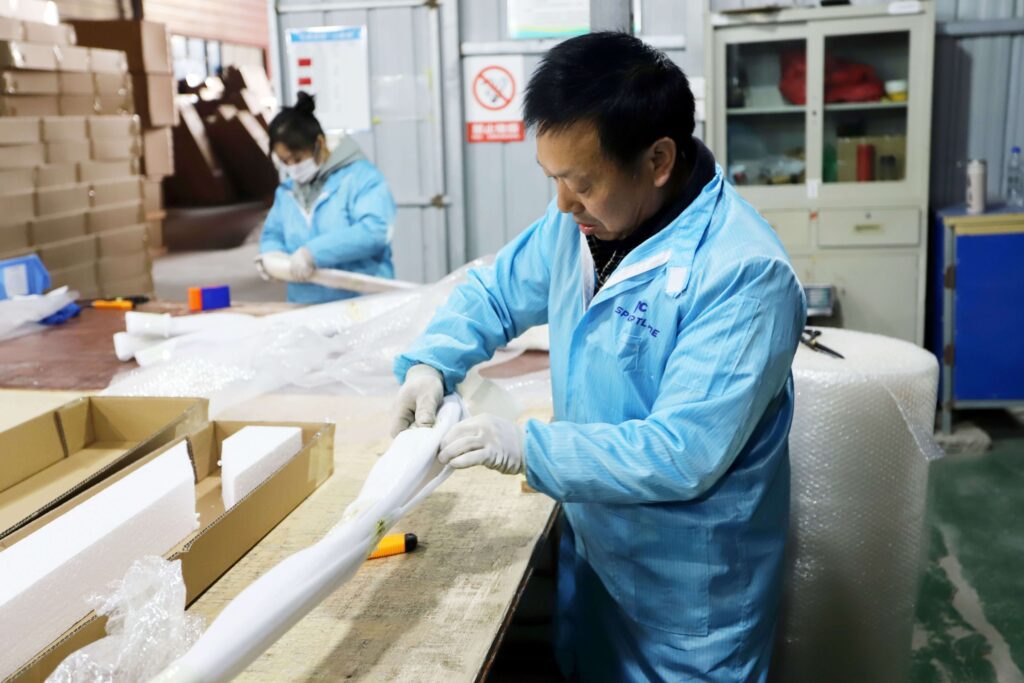
Carbon fiber body panels are the hardest thing in car parts dropshipping to fulfill well. They’re large, the freight is awkward to standardize, and they crack when packed carelessly. For e-commerce sellers and small import teams with no packing crew, this is where most suppliers quietly fail — and where a broken panel turns a sale into a refund and a bad review.
The best dropshipping suppliers for carbon fiber body kits solve three problems at once: protective packaging for fragile panels, brand-ready labeling, and clean listing data. On packaging, private label auto parts support — neutral boxes, your labels, your packing documents — keeps the supplier invisible to your buyer and the listing unmistakably yours. Knowing how to ship large carbon fiber car parts internationally is its own discipline: oversized cartons, internal bracing, and freight selection that won’t erase your margin. When damage or a mis-ship does occur, we handle it on inspection at receipt, case by case — a defined contact point beats a vague “warranty” that no one honors. Protecting both the part and your brand identity in transit is the practical side of brand protection for carbon fiber products.
A Swiss e-commerce client needed a stable carbon fiber source but had limited staff for packing and labeling, and a thin roster of carbon suppliers. Because our factory runs on a large, stable technician base, we could supply consistently and add one-stop dropshipping fulfillment — from product selection through custom packaging — so their small team didn’t have to. For another seller expanding into carbon fiber, we supplied a full catalog with descriptions, materials, fitment data, and images; they listed carbon fiber mirror covers and spoilers quickly, and in that account carbon fiber grew to roughly 30% of their other-category sales while lifting those categories too. Both are project-specific outcomes, not blanket guarantees.
Order Flow, Tracking & Customs: The Mechanics That Decide Landed Cost
Two things blindside sellers after the sale: tracking and customs. Get either wrong and the margin you calculated on the unit price evaporates.
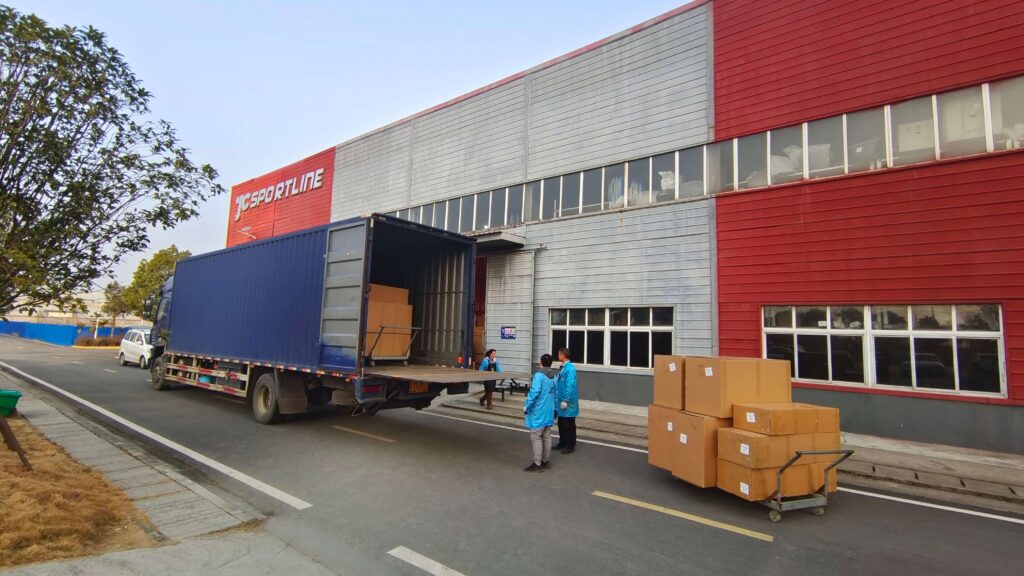
Your buyer expects a tracking number the moment they order. Real auto parts dropshipping order tracking means information flows cleanly from supplier → seller → carrier → buyer, with numbers you can sync straight to your marketplace orders — not a figure you chase by email two days later.
On customs, the recurring question is who pays customs duties on dropshipped auto parts, and there’s no universal answer. Customs clearance for dropshipping auto parts depends on the destination country, the trade term, and local rules. What protects you is fixing the term up front — EXW, FOB, DAP, or DDP shipping for auto parts — so the importer of record and the duty responsibility are settled before anything ships. We keep this case-by-case and don’t quote HS codes or tax rates, because they shift by country and shipment; the right move is to scope it deliberately, which is part of our carbon fiber consulting.
Then total it honestly — your real landed cost is never just the part:
| Cost component | Who usually defines it |
| Product unit price | Supplier quote |
| Warehouse handling / pick-pack | Overseas warehouse fee |
| Packaging & labeling | Per private-label spec |
| Freight (express / air / sea) | Shipping method & part size |
| Duties, taxes, import fees | Destination country + trade term |
Comparing auto parts dropshipping suppliers on unit price alone ignores four of these five lines — which is how a “cheap” supplier ends up costing the most.
A Stage-Based Partner, Not a One-Off Vendor
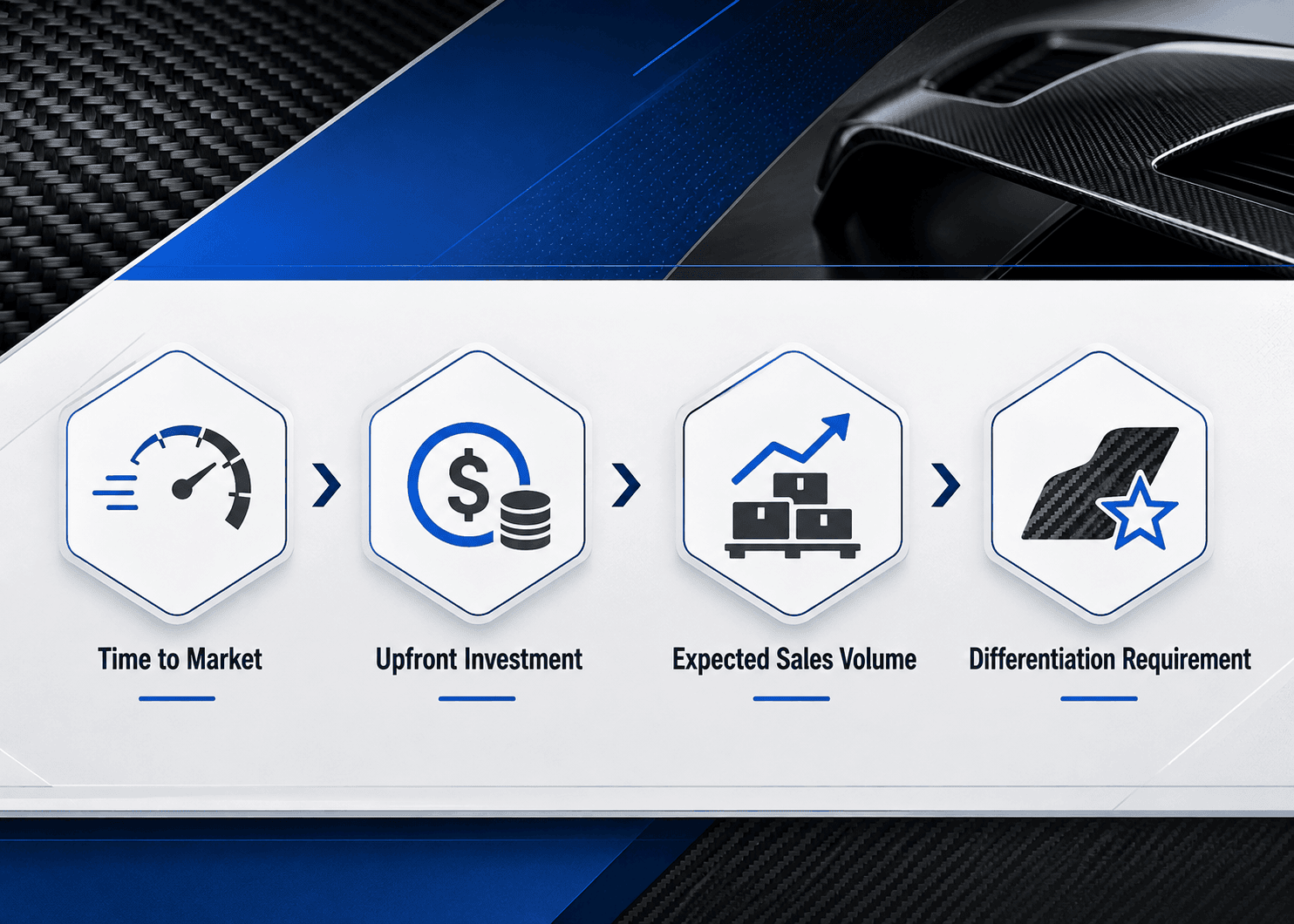
The supplier you choose at zero inventory is the one you’re stuck with at scale, so choose for where you’re going. The seven capabilities map onto four stages:
| Stage | What you need from the supplier |
| Startup | Zero-inventory dropshipping to test SKUs |
| Growth | Overseas-warehouse stocking + labeling + fulfillment |
| Operation | Catalog, materials, fitment, images to speed listing |
| Brand | Custom packaging, logo, OEM/ODM, regional cooperation |
This is the real divide between car parts dropshipping suppliers: almost any of them can sell you a part today; few can still serve you when you need bulk pricing, stable supply, regional cooperation, and OEM/ODM next year. Switching suppliers mid-growth is expensive — re-listing, re-testing fitment, rebuilding fulfillment from scratch — which is precisely why the wrong early choice costs the most. Pick reliable auto parts dropshipping suppliers that can climb the ladder with you instead of capping your growth at their ceiling.
Conclusion
Don’t buy carbon fiber by the unit price — buy fulfillment capability and landed cost. Confirm where parts ship from, who owns the stock, how orders and tracking flow, which trade term applies, and how duties are split. Then decide which SKUs to dropship auto parts from China and which to pre-stock in a US or European overseas warehouse. The strongest auto parts dropshipping suppliers don’t just hand you aftermarket carbon fiber parts — they grow your supply chain from your first test order to your own brand.
Frequently Asked Questions
Do you support single-piece (dropship) orders, or only bulk?
Yes — we support dropshipping cooperation for selected products, especially when stock is available in an overseas warehouse. We provide product data, images, and warehouse-based fulfillment depending on the cooperation model.
Where do you ship from — China or overseas warehouses?
Depending on inventory and order requirements, products ship from our China factory or from overseas warehouses in regions such as North America and Europe. If overseas stock isn’t available, we arrange production and shipment from China.
What shipping options do you offer for large carbon fiber parts?
Express, air freight, sea freight, and project-based logistics. For some B2B accounts we can also discuss DDP and overseas-warehouse stocking with local delivery.
Can you provide neutral or private-label packaging?
Yes. For supported products we can use neutral packaging, your labels, and custom packing documents, so your end customer never sees the supplier.
How and when do I get order tracking numbers?
We provide tracking updates and project-progress visibility through our tracking system. For custom projects, key stages include design, mold development, first sample, revision, mass production, QC, packing, and shipment.
Who pays customs duties and taxes?
Duties, taxes, and import fees depend on the destination country, shipping terms, and local regulations. We agree a suitable term — EXW, FOB, or DDP — before shipment so cost responsibility is clear.