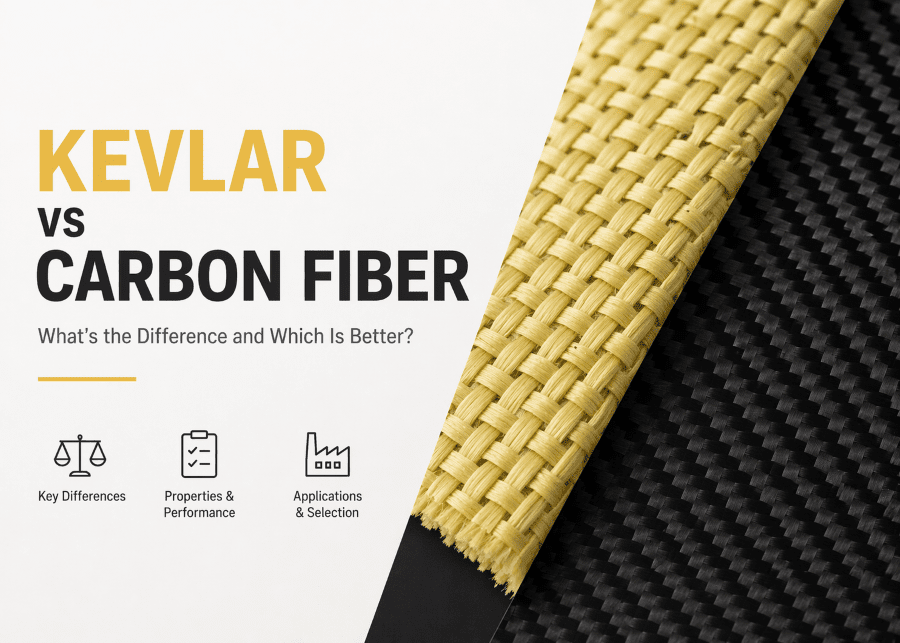
“Which is better, Kevlar or carbon fiber?” is the wrong question — and answering it directly is the fastest way to make an expensive material selection mistake.
These two materials do not compete. They solve different engineering problems. Carbon fiber vs Kevlar is a decision about which failure mode your product is designed to resist: stiffness loss under sustained structural load, or catastrophic fracture under sudden impact. Define your failure mode first. The material choice follows automatically. This guide gives you the technical data, the application logic, and a three-question decision framework to make that call with confidence.
What Is Kevlar?
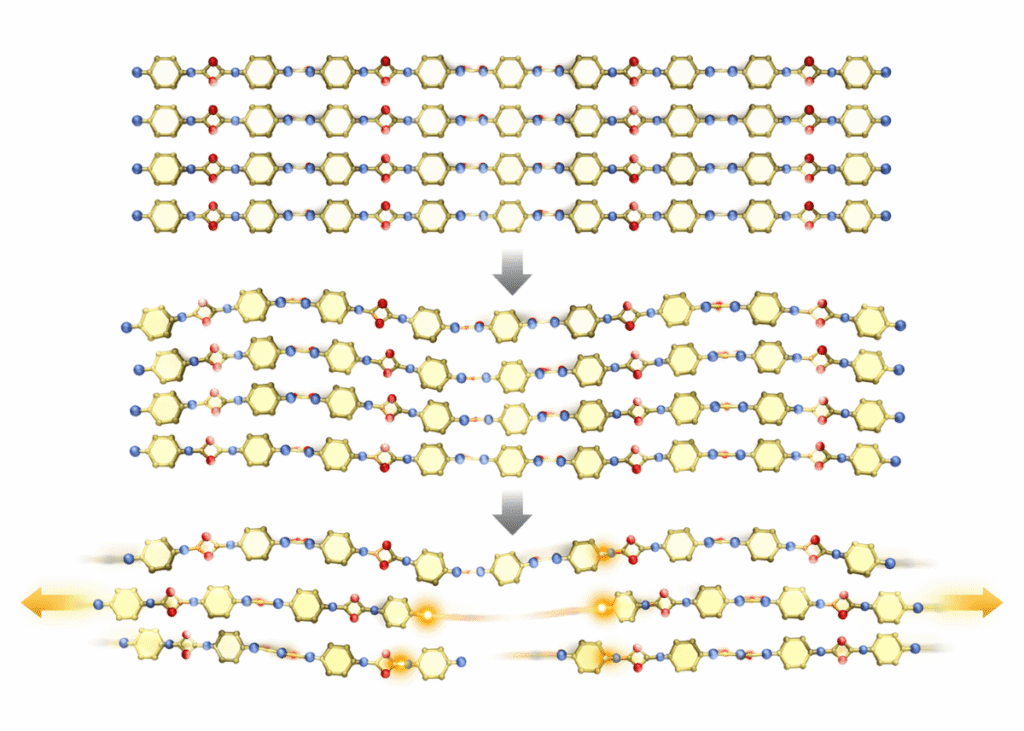
Kevlar is a DuPont brand name for para-aramid synthetic fiber — which is why searches for aramid fiber vs carbon fiber and kevlar vs carbon fiber lead to the same technical territory. Knowing what is Kevlar material at the molecular level explains every performance characteristic that follows.
Para-aramid polymer chains are highly ordered but retain a degree of rotational flexibility in their molecular bonds. Under tensile load, these chains stretch and rotate progressively before fracturing — producing a failure elongation of 2.5–4.0%, more than twice carbon fiber’s 1.5%. The structural consequence: Kevlar absorbs energy one strand at a time rather than releasing it all at once. For engineers specifying parts that must survive sudden or repeated impact without shattering, this is not a secondary benefit. It is the reason the material exists.
Properties of Kevlar in composite form: tensile strength 3.0–3.6 GPa, elastic modulus 60–120 GPa, density 1.44 g/cm³. As a composite materials Kevlar reinforcement, these Kevlar material characteristics combine to deliver a toughness-to-weight profile that no structural fiber can match for impact-critical applications.
What Is Carbon Fiber?
Carbon fiber is built from carbon atoms organized into a crystalline graphite microstructure. The alignment of these crystals along the fiber axis produces an elastic modulus of 200–800 GPa — a range that no polymer fiber approaches. This structural stiffness is carbon fiber’s defining engineering contribution, and it is irreplaceable.
The properties of carbon fiber that structural engineers actually design around: tensile strength 3.5–6.0 GPa, density approximately 1.6 g/cm³, and a fundamentally anisotropic behavior — performance is directionally dependent on ply orientation during lamination. The carbon fiber advantages and disadvantages split cleanly along this line: extraordinary performance when the fiber orientation matches the load path; vulnerability to off-axis loading and interlaminar shear when it does not.
Carbon fiber also produces Class A surface finishes that Kevlar cannot replicate — making it the material of choice for products where surface quality carries brand value as well as structural function.
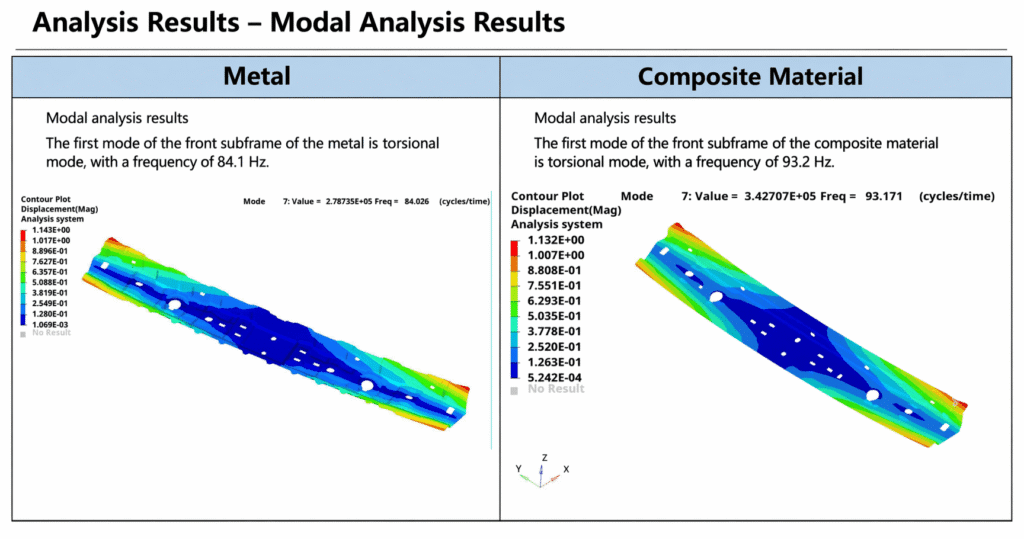
The performance difference versus metal is not marginal. At JCSPORTLINE, FEA-validated testing of a T300 carbon fiber front roof cross-beam produced via HP-RTM returned a total assembly weight of 0.718 kg against 1.2 kg for the equivalent metal structure — a 53.7% weight reduction — while outperforming the metal component across every tested load case including axial stiffness, bending stiffness, and peak bending load.
Why Do Kevlar and Carbon Fiber Have Such Different Properties?
The performance gap between these two materials originates in their molecular failure mechanisms — not in their headline tensile strength numbers, which are surprisingly close.
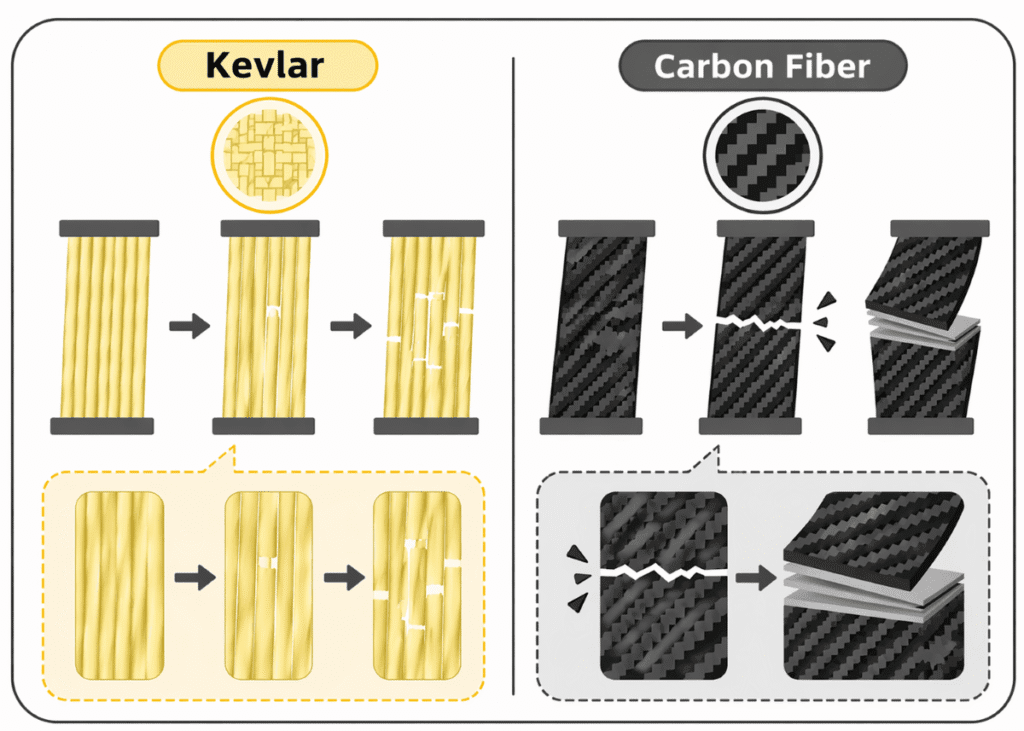
Kevlar fails through progressive fiber stretching. Para-aramid chains rotate and elongate under impact load, dissipating kinetic energy across the full fiber length before fracturing. Failure is predictable, localized, and non-catastrophic. The structure signals distress before it gives out. This is why ballistic protection, pressure vessel liners, and impact-critical structural layers specify Kevlar: the material’s failure behavior is as important as its strength.
Carbon fiber fails through brittle fracture. Graphite crystal layers are bonded to each other by weak van der Waals forces. Under impact, these interlayer bonds break suddenly — typically as delamination propagating through the laminate — without any plastic deformation phase to absorb or redistribute the energy. The structure does not warn you. For procurement managers and product engineers moving from metal to carbon fiber composites for the first time, this is the single most important behavioral difference to design around.
What are the downsides of Kevlar in structural applications? Three limitations have direct engineering consequences. First, compressive strength: under compressive loading, Kevlar fiber performance degrades to approximately 20–30% of its tensile capacity — meaning Kevlar cannot function as the primary structural reinforcement in any compression-dominated component. Second, Kevlar UV degradation outdoor use: prolonged ultraviolet exposure progressively degrades tensile properties, requiring protective coatings in any outdoor application. Third, machinability: Kevlar resists clean cutting. Edges fray rather than sever, CNC drilling produces inconsistent hole geometry, and trimming operations require specialist tooling and manual finishing that add measurable cost per part.
Carbon fiber’s limitations fall in different places: it conducts electricity, excluding it from radar-transparent radomes and EMI-sensitive UAV structures where Kevlar’s non-conductivity is a functional requirement. Its brittle fracture mode also means post-impact inspection and repair are more technically demanding than equivalent operations on metal or Kevlar structures.
How Do Kevlar and Carbon Fiber Compare Across Key Performance Metrics?
The table below addresses Kevlar vs carbon fiber strength, Kevlar vs carbon fiber weight, Kevlar vs carbon fiber durability, and Kevlar vs carbon fiber price in a single reference. The “Deciding Factor” column is the part most material comparison guides skip — and the part that actually drives correct selection.
| Performance Dimension | Kevlar | Carbon Fiber | When It’s the Deciding Factor |
| Tensile Strength | 3.0–3.6 GPa | 3.5–6.0 GPa | Pure tension loading → CF wins |
| Elastic Modulus (Stiffness) | 60–120 GPa | 200–800 GPa | Structural rigidity → CF required |
| Compressive Strength | ~20–30% of tensile | High | Compression-dominated structure → CF only |
| Impact / Energy Absorption | High (elongation 2.5–4%) | Low (~1.5%) | Repeated or sudden impact → Kevlar wins |
| Density | 1.44 g/cm³ | ~1.60 g/cm³ | At equal stiffness targets, CF parts are lighter |
| UV Stability | Poor without coating | Excellent | Long-term outdoor exposure → CF wins |
| Electrical Conductivity | Non-conductive | Conductive | Radomes, EMI-sensitive UAV → Kevlar required |
| Machinability | Difficult (fraying) | Moderate (brittle) | High-precision features → CF more reliable |
| Raw Material Price | $15–25/lb | $10–20/lb | Kevlar raw fiber costs more in most grades |
What fiber is stronger than Kevlar? Carbon fiber is two to six times stiffer by elastic modulus. But in energy absorption under sudden impact, Kevlar is the superior material. “Stronger” is not a single number — it is a function of the load type your part must survive.
Where Is Kevlar Used?
Applications of Kevlar concentrate in scenarios where the primary engineering requirement is impact energy absorption, progressive fracture resistance, or non-conductivity — not stiffness, and not surface appearance.
Ballistic protection is the most recognized application: body armor, ballistic helmets, and blast shields use Kevlar’s progressive failure mode to absorb projectile kinetic energy without fragmentation. Marine hull protective layers specify Kevlar for toughness and tear resistance in collision and grounding scenarios. In UAV airframes and radar enclosures, Kevlar’s non-conductivity is a functional requirement — carbon fiber’s electrical conductivity would interfere with onboard electronics and signal transmission. Sports applications including kayak hulls, canoe paddles, and hockey sticks leverage Kevlar where fatigue from repeated impact cycles matters more than maximum stiffness.
The common thread: when to use Kevlar instead of carbon fiber comes down to one question — does the part need to absorb impact without catastrophic failure? If yes, Kevlar belongs in the specification.
Where Is Carbon Fiber Used?
Carbon fiber for automotive parts and aerospace structures represents the material’s highest-value applications — precisely because these industries demand the combination of structural rigidity, mass reduction, and dimensional stability that no alternative delivers at equivalent weight.
The structural performance data from JCSPORTLINE’s validated engineering analysis is specific: a carbon fiber front roof cross-beam processed via HP-RTM with a six-ply T300 laminate delivers bending stiffness of 284.3 N/mm versus 152 N/mm for the metal equivalent — an 87% increase. Peak bending load reaches 2,681 N against the metal’s 1,018 N, a 163% improvement. Axial tensile stiffness of 18,518 N/mm compares to 12,500 N/mm for metal. The constrained modal frequency reaches 122.7 Hz first mode versus 76.8 Hz for metal. Total assembly weight: 0.718 kg versus 1.2 kg. These numbers come from five-case finite element analysis, not marketing estimates.
In aerospace, carbon fiber structural parts — wing skins, fuselage frames, control surface assemblies — benefit from thermal stability, fatigue resistance, and anisotropic behavior that can be engineered to match complex multi-axis load profiles. Medical imaging equipment uses carbon fiber for radiolucency combined with structural rigidity. For product developers in consumer goods and premium industrial equipment, CF’s Class A surface finish capability makes the material carry brand identity as effectively as it carries structural load.

When Should You Choose Kevlar Over Carbon Fiber?
Three questions replace the “which is better Kevlar or carbon fiber” debate with a structured engineering decision. Answer them in order.
1. What is the primary failure mode your part must resist?
Compression or sustained structural stiffness → carbon fiber. Sudden or repeated impact without catastrophic fracture → Kevlar. Both simultaneously → hybrid laminate design.
2. Does surface appearance carry functional or brand value in your product?
Yes → carbon fiber. Kevlar’s woven texture and natural yellow color are not compatible with Class A automotive or premium consumer product specifications. No → proceed to question 3.
3. Are there EMI sensitivity or long-term outdoor UV exposure requirements?
EMI-sensitive enclosure or radome → Kevlar (non-conductive). Long-term UV exposure without protective coatings → carbon fiber (UV-stable without treatment).
If your answers point in different directions across these three questions, the correct solution is not a compromise between two materials — it is a hybrid composite laminate. At that point, your supplier’s laminate engineering capability and material characterization process matter more than the materials themselves.
How Much Do Kevlar and Carbon Fiber Cost?
Kevlar vs carbon fiber price comparisons built around raw material cost alone are consistently misleading — and they lead procurement teams to the wrong supplier evaluation criteria.
Raw fiber: Kevlar costs $15–25 per pound against $10–20 per pound for standard carbon fiber grades. Kevlar is not the cheaper input. Beyond material cost, Kevlar’s processing disadvantages compound the gap at production scale. Its resistance to clean mechanical cutting makes automated CNC trimming unreliable. Fraying edges require manual finishing. Drilling consistent-geometry holes demands specialized tooling and post-processing. These translate directly into higher per-part labor cost and elevated scrap rates.
Carbon fiber, processed through mature manufacturing routes — RTM, HP-RTM, autoclave prepreg — achieves dimensional consistency at scale through SOP-controlled production systems. At JCSPORTLINE, MES-driven process scanning locks in validated lay-up and cure parameters across large production batches, holding carbon fiber quality control in ways that Kevlar’s manual processing requirements cannot match. The total cost of a composite part — material plus tooling, processing, scrap rate, and assembly — will favor carbon fiber at any volume above small prototype quantities.
Can You Combine Kevlar and Carbon Fiber?
Can you combine Kevlar and carbon fiber? Yes — and for applications that require both stiffness and impact survivability, a hybrid composite materials architecture is often the most technically correct answer rather than a compromise.
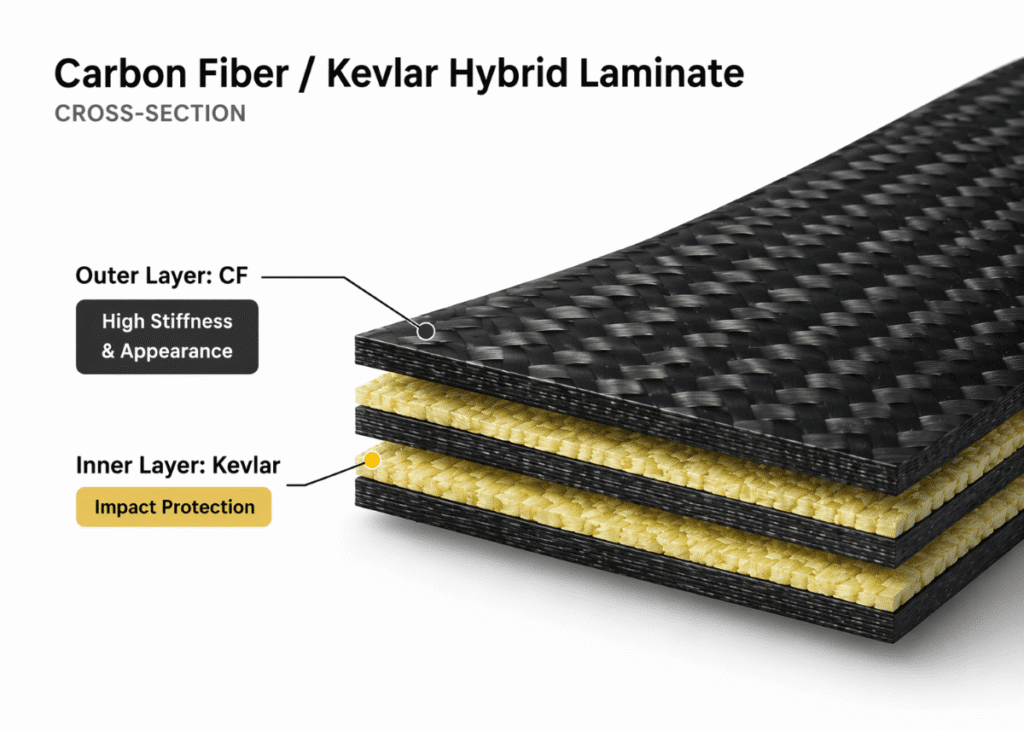
The laminate logic is straightforward: carbon fiber outer plies deliver structural rigidity and surface finish. Kevlar inner plies arrest crack propagation after an impact event, preventing delamination from spreading through the full laminate cross-section. This architecture appears in high-performance motorsport bodywork, unmanned aircraft frames, and structural protective enclosures where both failure modes — stiffness loss and impact fracture — are present in the operating load profile.
Hybrid laminates are not a simple layering of two materials. The interaction between CF’s brittle failure mode and Kevlar’s ductile energy absorption behavior is load-path-dependent and must be resolved through ply sequence optimization, fiber orientation analysis, and validated resin system selection — not assumed from generic laminate tables.
Case Study: Kevlar Reinforcement in Automotive Hoods
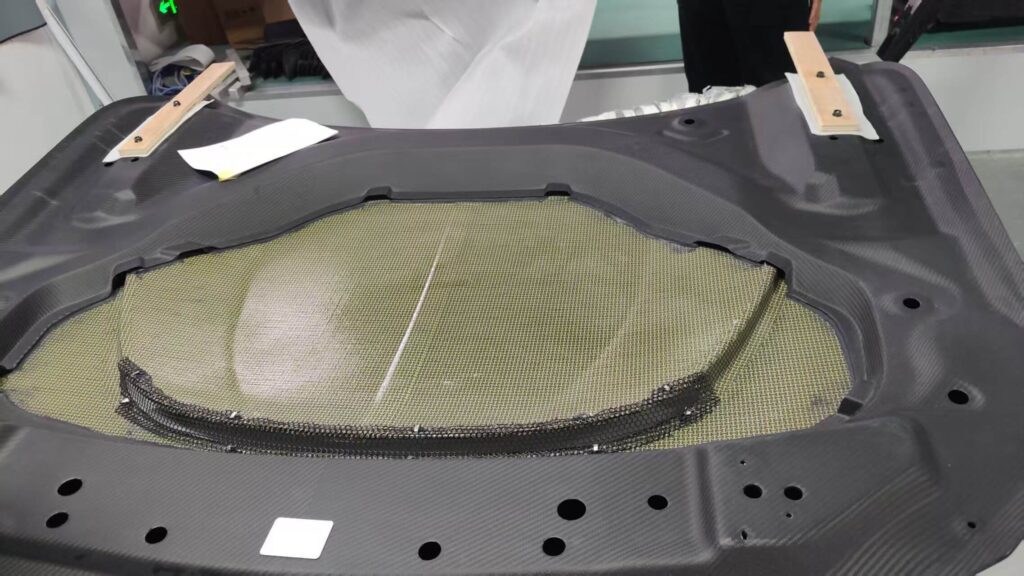
In real-world automotive applications, Kevlar is often used as a critical reinforcement layer in carbon fiber hood construction. While carbon fiber provides the necessary rigidity and lightweight structure, adding a final inner layer of Kevlar significantly enhances impact resistance and structural integrity.
Due to Kevlar’s excellent energy absorption and tear resistance, it helps prevent catastrophic failure under high-speed conditions. For example, in performance car hoods, a Kevlar backing layer can reduce the risk of fragmentation or detachment, ensuring the hood remains intact even under aerodynamic stress at high speeds.
This is why many automotive components that meet strict European safety standards—such as those certified by TÜV in countries like Germany, Sweden, and France—often incorporate Kevlar in their composite structures. By combining carbon fiber and Kevlar, manufacturers achieve both stiffness and safety, creating parts that are not only lightweight but also more reliable in real-world driving conditions.
Conclusion
Kevlar and carbon fiber are not competitors. They are material solutions to different failure modes.
Carbon fiber is the correct choice when the primary requirement is structural stiffness, weight reduction at equivalent rigidity, dimensional stability under sustained load, and surface finish quality. Kevlar is the correct choice when the primary requirement is impact energy absorption, fracture resistance, and predictable non-catastrophic failure behavior. When both requirements are present in the same structure, hybrid composite laminates designed around specific load cases deliver what neither material can achieve alone.
At JCSPORTLINE, our engineering team works across the full development cycle — finite element analysis, DFM review, material characterization, and MES-controlled production — for carbon fiber, Kevlar, and hybrid composite structures across automotive, aerospace, marine, medical, and industrial applications. Contact us to receive a technical feasibility assessment for your composite project within 24 hours.
Frequently Asked Questions
Is Kevlar stronger than carbon fiber?
Measured by elastic modulus — stiffness — carbon fiber is two to six times superior. Measured by impact energy absorption and fracture toughness, Kevlar outperforms carbon fiber decisively. Neither material is universally stronger. The relevant question is which type of mechanical performance your application requires.
What are the main disadvantages of Kevlar in structural applications?
Three limitations are engineering-critical: compressive strength degrades to approximately 20–30% of tensile capacity, making Kevlar unsuitable as primary reinforcement in compression-dominated structures. UV exposure progressively degrades tensile properties without protective coatings. Machining quality is difficult to control — CNC cutting produces frayed edges and inconsistent hole geometry that increase per-part finishing costs at scale.
Can Kevlar and carbon fiber be used together in the same part?
Yes. Hybrid laminates are a proven engineering approach. Carbon fiber outer layers deliver stiffness and surface quality; Kevlar inner layers arrest crack propagation after impact. The ply sequence, fiber orientation, and resin system must be optimized for the specific load case through engineering analysis and material characterization — not assumed from generic laminate tables.
Which is actually more expensive, Kevlar or carbon fiber?
Kevlar raw fiber costs more per pound ($15–25) than standard carbon fiber ($10–20). When total manufacturing cost is included — processing labor, scrap rate, tooling complexity — carbon fiber is consistently more cost-effective at production scale due to automatable processing routes and mature quality control systems.
Does Kevlar degrade over time in outdoor environments?
Yes. UV radiation progressively degrades Kevlar’s tensile properties with prolonged exposure. Outdoor applications require a protective coating to maintain long-term performance. Carbon fiber is UV-stable without additional surface treatment, giving it a clear durability advantage in unprotected outdoor environments.
For automotive structural parts, should I use carbon fiber or Kevlar?
Carbon fiber. JCSPORTLINE’s FEA-validated testing on a front roof cross-beam demonstrates 87% higher bending stiffness, 163% higher peak bending load, and 53.7% weight reduction versus the equivalent metal assembly. Kevlar is appropriate only as a secondary impact protection layer within a hybrid laminate — not as primary structural reinforcement in compression or bending-dominated automotive applications.