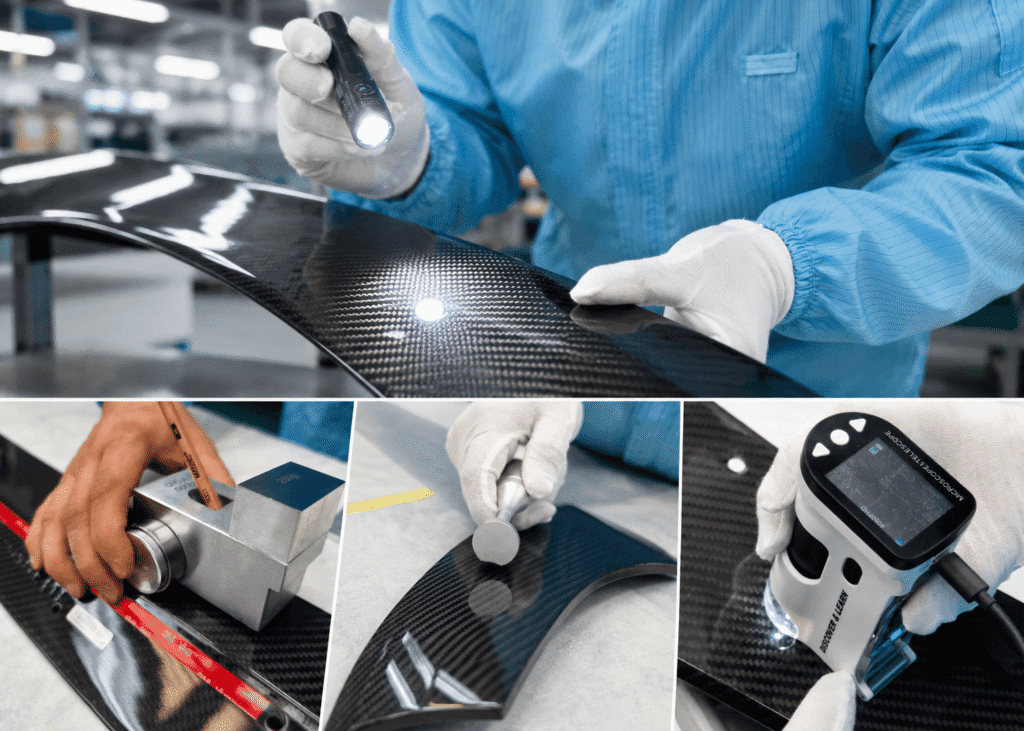
A carbon fiber part can look flawless under showroom lighting and still fail the moment it reaches your customer. The gloss shifts across batches, a mounting hole sits half a millimeter off, an edge cracks in transit, the weave drifts on the next run. For a B2B buyer, none of these are cosmetic annoyances. They are returns, rework, after-sales tickets, and a dent in the brand you’ve spent years building. That is why carbon fiber testing before shipment decides far more than most procurement teams give it credit for.
Our position is blunt: a final glance before packing is not quality control. High-quality carbon fiber is not “seen” at the end of the line — it is measured, controlled, and traced from raw material to the moment it ships. The question that actually matters isn’t whether a supplier inspects. It’s what tests are performed on carbon fiber products, and whether those tests are backed by equipment, written procedures, and batch records you can audit. This article lays out exactly that, so sourcing managers, OEM/ODM program leads, wholesalers, cross-border sellers, and automotive brand owners can separate a supplier with real capability from one that ships and hopes.
Why a Final Visual Check Isn’t Carbon Fiber Quality Control
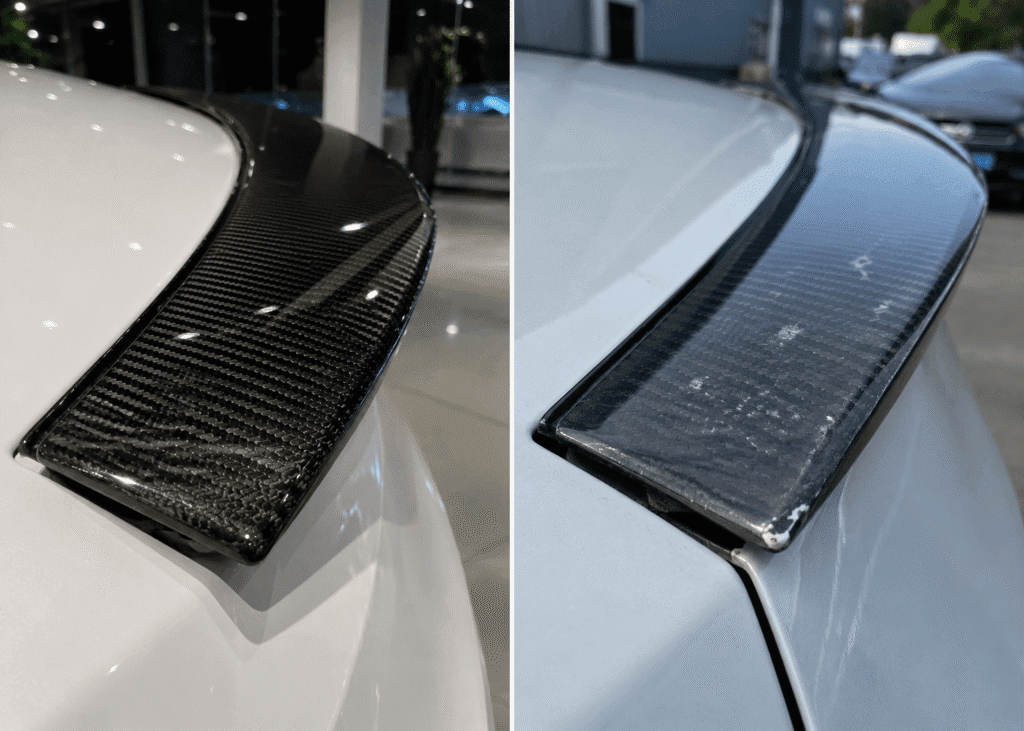
Carbon fiber is anisotropic, and in composite molding the material and the part are created in the same moment. A defect can hide between layers, inside the laminate, or drift quietly across production batches — none of which the naked eye catches. So carbon fiber inspection built on a final look alone is structurally inadequate, not just incomplete.
Real carbon fiber factory quality control intervenes before, during, and after production. That is the whole difference between “we inspect” and “we run a system.” A factory that can show you its carbon fiber quality testing flow and the records behind it has capability; a factory that can only show you finished-product photos has done a visual sort and called it QC. For any buyer, understanding how carbon fiber products are tested in factory conditions is the fastest filter available.
The buyer’s test: Ask a supplier to walk you through their inspection process and show the data behind one shipped part. The answer separates a systematic carbon fiber quality control process in mass production from guesswork.
Appearance and Surface Defect Inspection
For automotive exterior parts, the surface is the product. Before any carbon fiber surface defect inspection starts, the acceptance standard has to be defined — Class A finish, forged-carbon versus twill texture, gloss level, weave alignment. Skip that step and “looks good” means something different to every inspector on the floor.
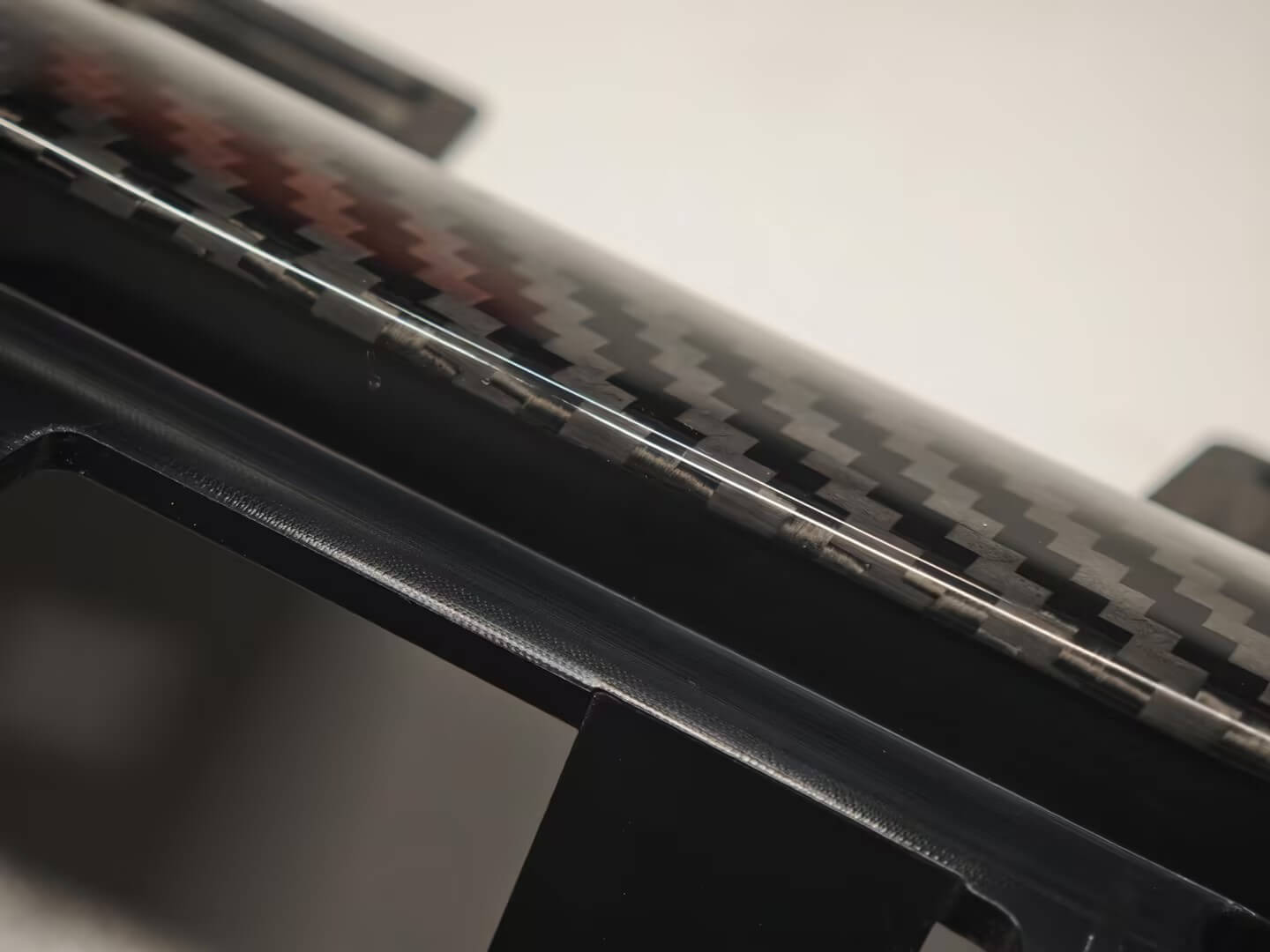
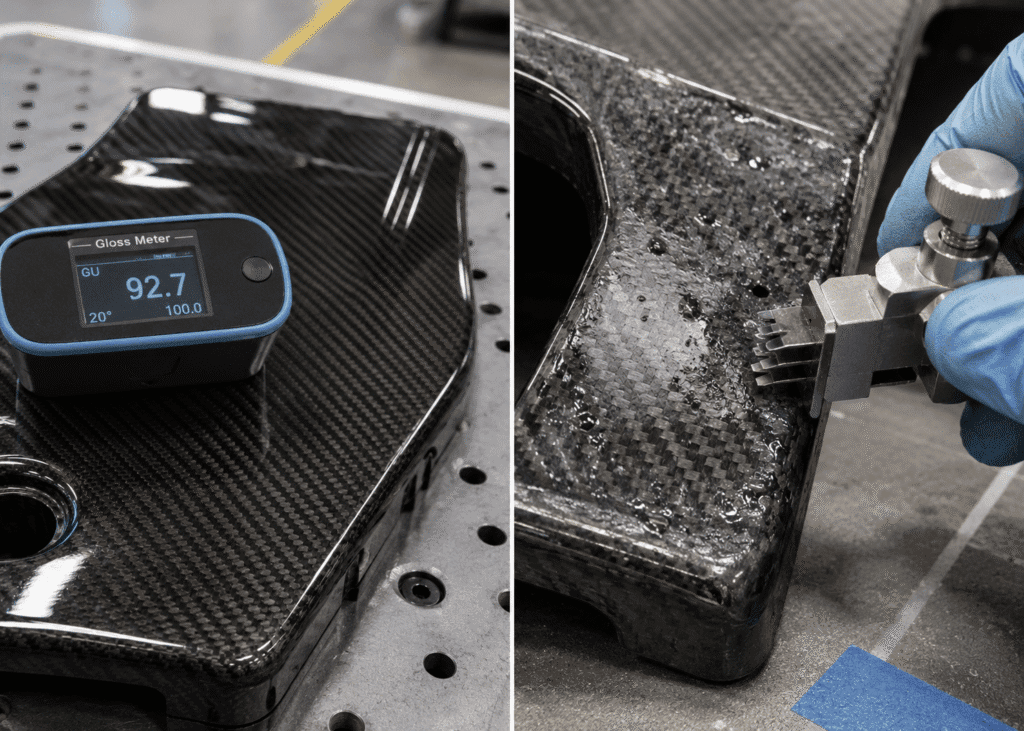
We check for pinholes, resin pooling, fiber bridging, and weave distortion around sharp radii — the exact flaws that drive end-user complaints. And this carbon fiber product quality check is quantified, not eyeballed: a gloss meter records surface-finish consistency batch to batch, and a cross-hatch tester verifies coating adhesion against a measurable scale. Which fabric, weave, and resin content a part starts with directly sets what “acceptable surface” even means, so the standard traces back to the carbon fiber materials themselves. Surface defects are not a “touch it up later” problem. They form the first impression your end customer has of your brand, and they are the number-one source of rejection in carbon fiber product lines, where rigorous carbon fiber product inspection earns its place.
Dimensional Accuracy and Assembly Fit Inspection
The most expensive failure in B2B carbon fiber isn’t an ugly part — it’s a part that won’t bolt on. Misaligned holes, oversized gaps, poor fitment: these are the failures buyers describe most, and they are where carbon fiber dimensional inspection stops being optional.
We verify complex profiles and hole positions with a non-contact vision measurement system, and for tight tolerances, a CMM coordinate measuring machine — both used specifically for precise measurement and assembly-alignment checks. Resin shrinkage during curing can pull a part out of tolerance, so dimensions are validated against the CAD model, never assumed from the mold. In premium automotive work, holding a door-to-body gap under 1mm has to be planned on day one and proven at inspection, not discovered after delivery. This is also where custom carbon fiber products demand more than generic capability: a serious supplier builds dedicated checking fixtures around your vehicle’s mounting points, because credible carbon fiber parts inspection matches the real application, not a standard template. A beautiful part that doesn’t fit is still scrap. Dimensional testing turns “fit” from an opinion into a number.
Structural Integrity and Mechanical Testing
Structural performance has to be proven with data, never described with the word “strong.” This is the heart of credible composite material testing, and it begins in engineering, before a physical part exists.
Finite element analysis (FEA) is run during feasibility to confirm a project should use carbon fiber at all — to reinforce structure, not just swap the skin. The payoff is measurable, not rhetorical. In our own metal-versus-composite roof crossbeam study, the carbon fiber part delivered a 53.7% weight reduction (1.2 kg down to 0.718 kg) while raising bending-strength peak load from 1018 N to 2681 N and axial tensile stiffness from 12,500 to 18,518 N/mm. That is what carbon fiber structural testing produces when it’s done properly — a number you can put in front of an engineering director.
| Performance metric | Metal crossbeam | Carbon fiber crossbeam |
| Weight (kg) | 1.2 | 0.718 |
| Axial tensile stiffness (N/mm) | 12,500 | 18,518 |
| Bending stiffness (N/mm) | 152 | 284.3 |
| Bending-strength peak load (N) | 1,018 | 2,681 |
| Constrained mode 1st freq. (Hz) | 76.8 | 122.7 |
Simulation, then proof: FEA predicts performance; the test bench confirms it. A claim is only as good as the load-displacement curve behind it.
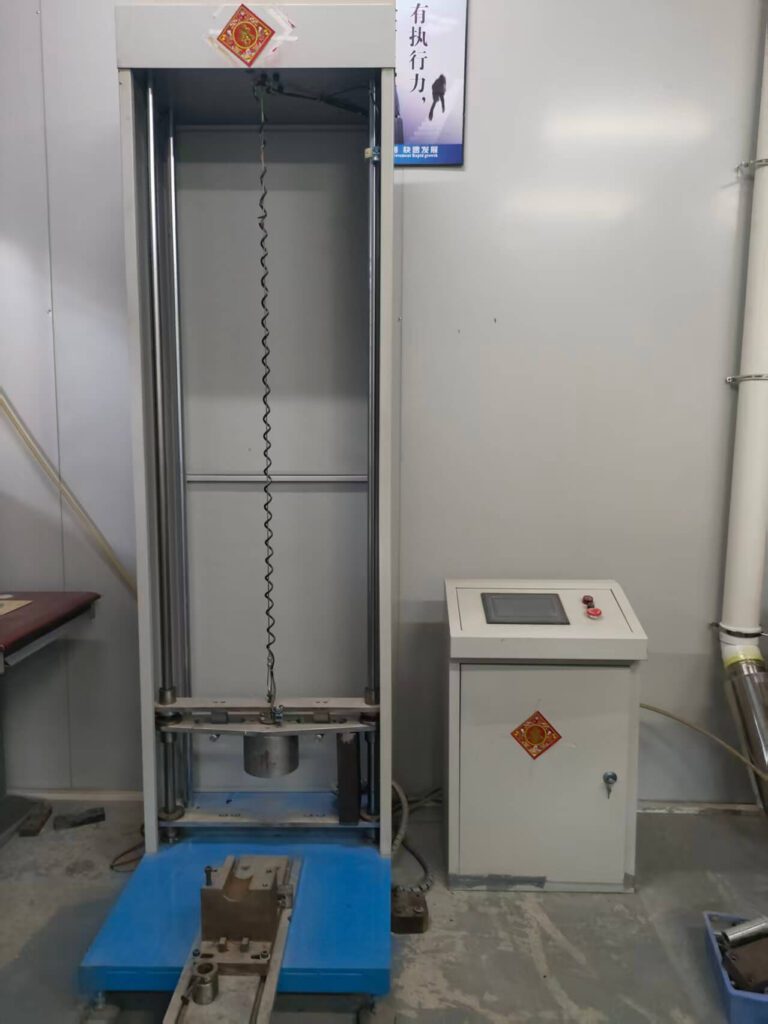
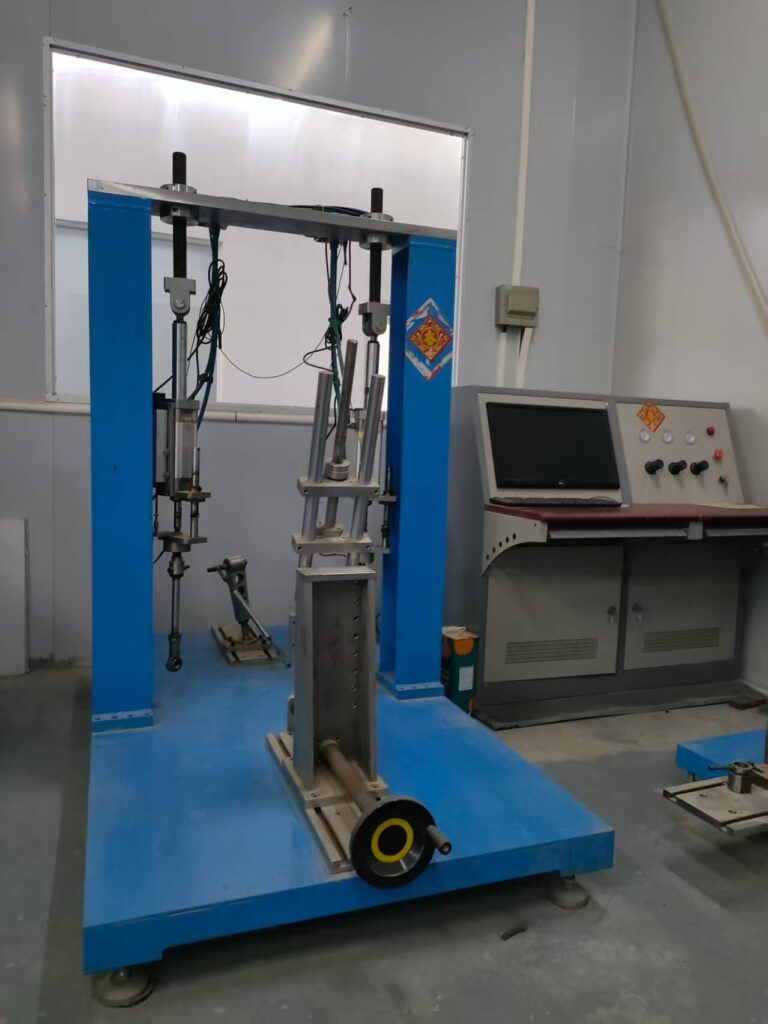
Physical validation backs every simulation. A tensile testing machine and universal strength testing machine measure tensile, compression, bending, stiffness, and failure limits, while a fatigue testing machine applies repeated dynamic load to confirm load-bearing zones survive long-term use — the carbon fiber fatigue testing logic that protects structural and sports parts. This is the depth of carbon fiber testing equipment aerospace, marine, and medical-device buyers should expect, and the kind of carbon fiber testing methods for finished products that separates an engineering partner from a job shop.
Durability, Aging and Real-World Condition Testing
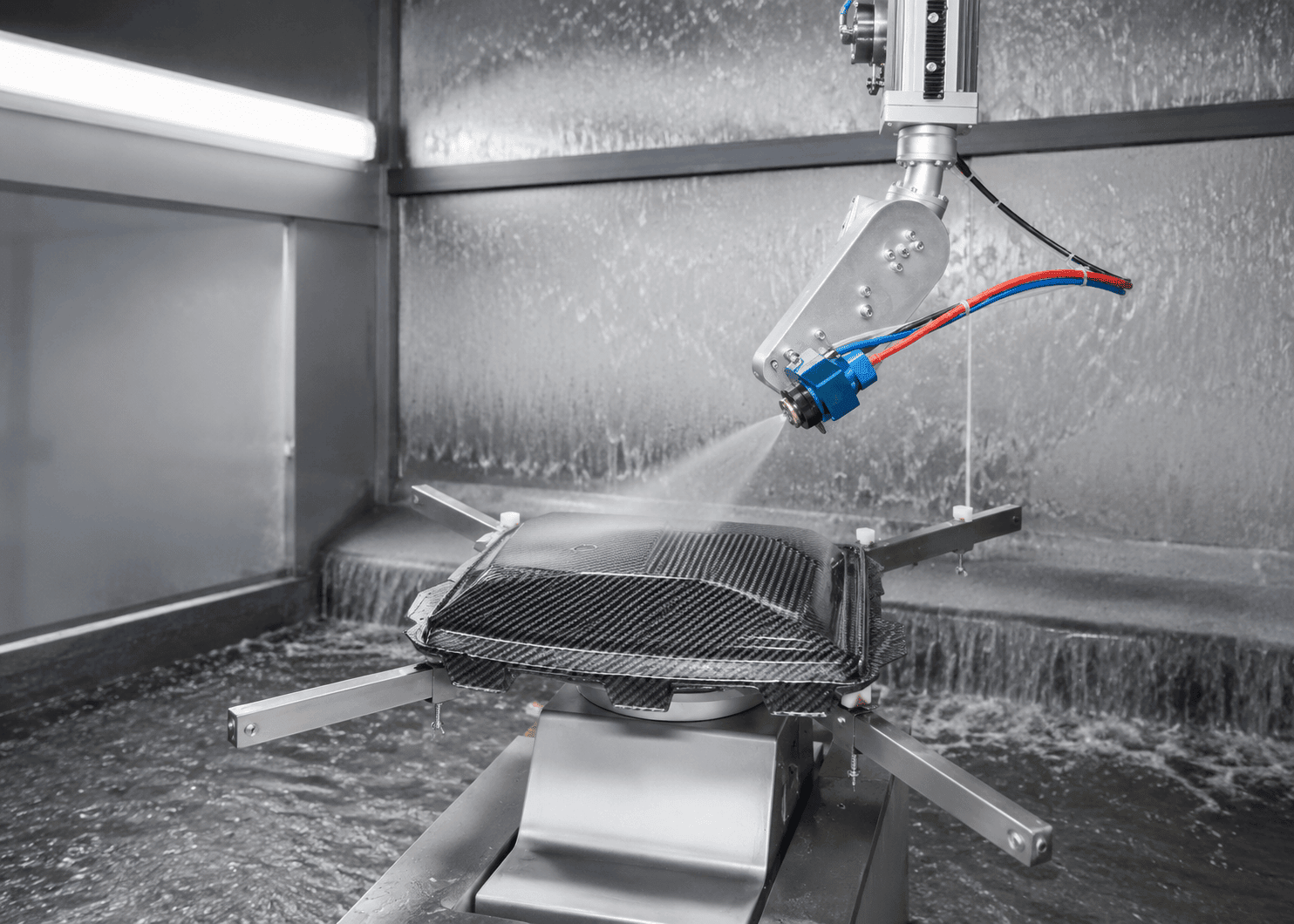
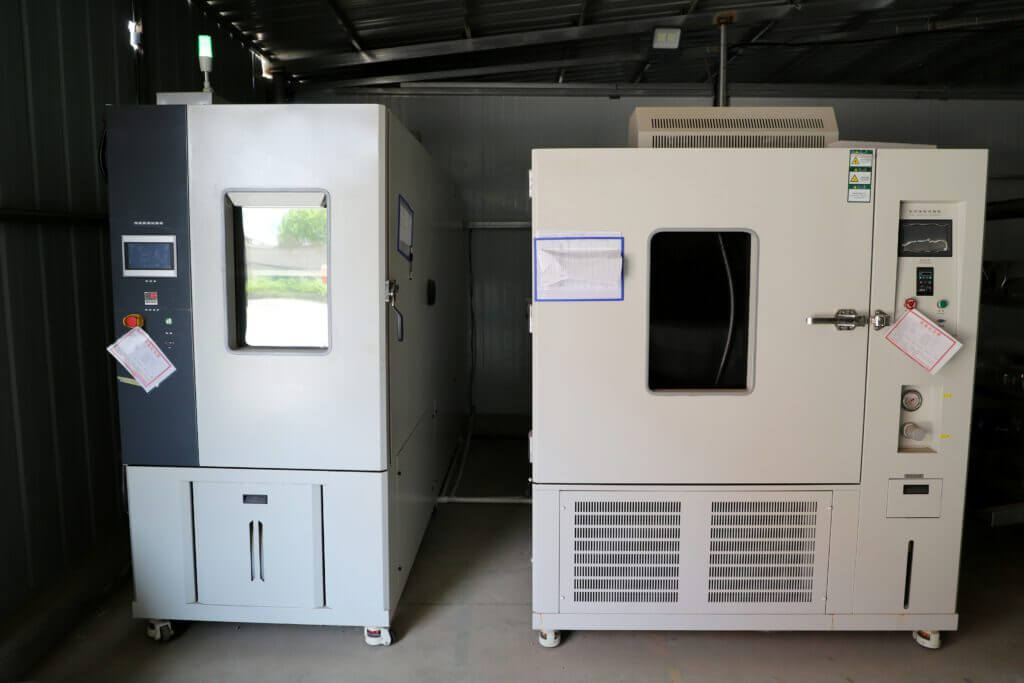
A carbon fiber part has to survive years on a customer’s car, not one pass through a climate-controlled workshop. So testing has to reproduce the environment the product will actually face. The factory’s carbon fiber testing equipment used in manufacturing covers this directly: constant temperature and humidity chambers assess heat, cold, moisture, and aging resistance; xenon-lamp aging equipment simulates sunlight, UV exposure, and thermal stress; and a salt spray chamber validates corrosion resistance for automotive and marine use.
For pressurized components like carbon fiber intakes, a burst test confirms real-world integrity: the part is heated in an oven to 120°C, then pressure-tested in an explosion-proof chamber to 0.7 MPa (7 bar) — passing only with no leakage and no damage. Durability here is a recorded result, not a line in a brochure.
Pre-Shipment Inspection and Packaging Verification
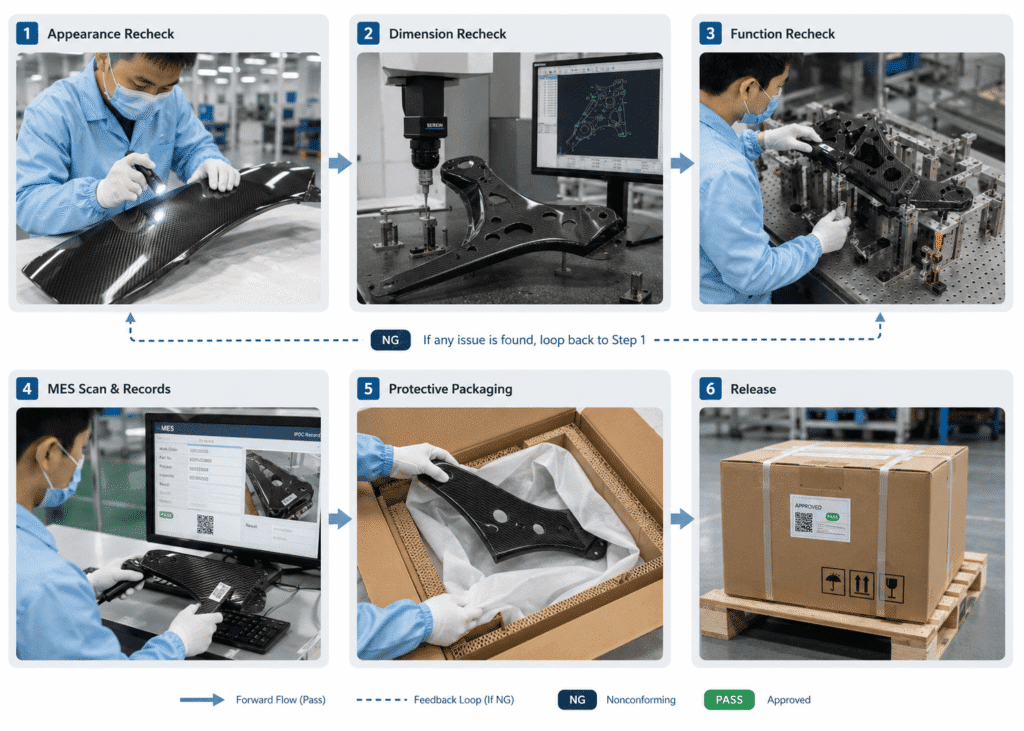
The last gate is carbon fiber pre-shipment inspection, and it’s where transit damage and batch inconsistency get stopped before they become your problem. This is not “one more look.” A real carbon fiber product inspection before delivery re-checks appearance, dimensions, and function, then binds each part to its production record.
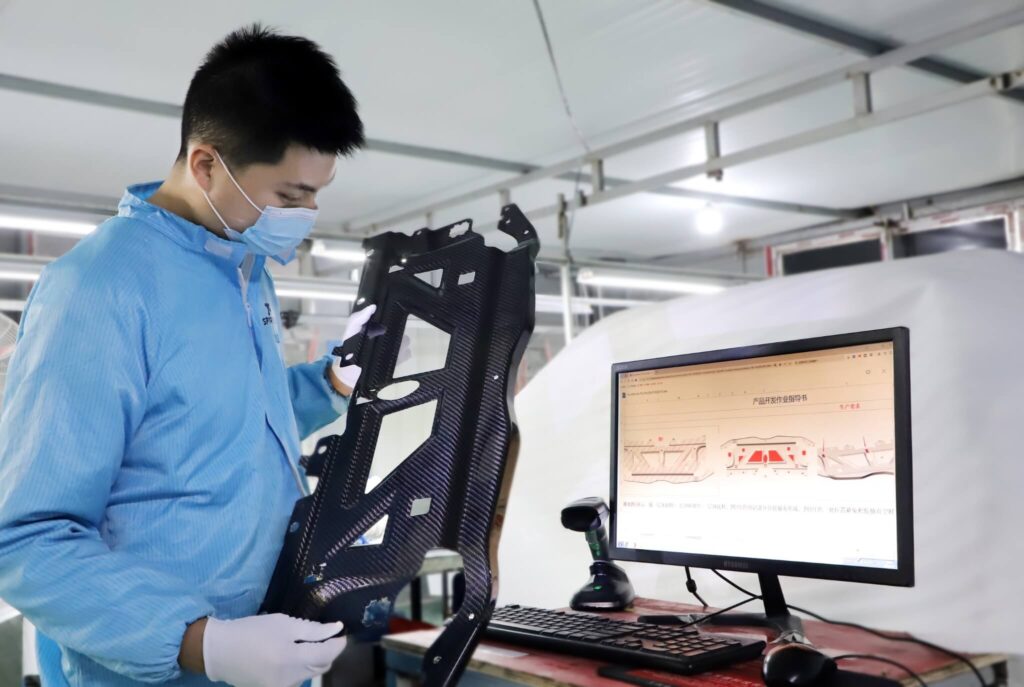
That traceability is the differentiator. Through MES scanning, every part is tied back to its SOP and IPQC process data, so batch-to-batch consistency is verifiable rather than hoped for — the backbone of our carbon fiber mass production capability. Knowing how to inspect carbon fiber products before shipping also means controlling the physical risk: parts ship in non-woven inner bags and honeycomb cartons to prevent the deformation, cracking, and edge damage buyers fear most. For large, irregular parts produced under 200 units on non-metallic molds, mold-deformation is monitored across the run to keep dimensions stable. Effective carbon fiber testing before shipment releases a part only after it’s matched to its own data — that’s the entire point of the gate.
No record, no release: Every shipped part carries a traceable line back to its SOP and IPQC data. If a batch drifts, we know which one and why — before it lands on your dock.
The Bottom Line for Buyers
Every gate above shares one trait: the result is checkable, traceable, and improvable. That is the whole argument for systematic carbon fiber quality testing over a final glance — and it’s a standard you can hold any supplier to.
JCSPORTLINE’s difference is not a lower price. It’s the stack of four things working at once: manufacturing capability, real carbon fiber testing equipment, custom-project experience, and a genuine understanding of how the part is used, installed, and judged by your end customer. A cheaper supplier that only delivers finished goods can’t replicate that stack. So when you weigh suppliers, the cleanest way to judge how to evaluate a carbon fiber supplier’s quality control capability is to ask for the inspection flow and the data behind a shipped part. A partner with real carbon fiber inspection systems shows you both without hesitation. Send us your drawing or project brief, and our engineers will review it and outline exactly which carbon fiber testing steps your product needs.
Frequently Asked Questions
What tests are actually performed before carbon fiber products are shipped?
Surface and gloss inspection, dimensional and assembly-fit checks via vision systems and CMM, structural and fatigue testing backed by FEA, environmental and aging tests (humidity, xenon UV, salt spray, burst), and a final pre-shipment check that ties each part to its production record.
How can I tell if a supplier has real quality control or just does visual inspection?
Ask them to walk through their inspection process and show the recorded data behind one shipped part. Systematic suppliers produce equipment lists, SOPs, and batch traceability on request; visual-only suppliers can only show finished photos.
Do custom carbon fiber products get a different inspection process?
Yes. Custom parts need checking fixtures built around your specific mounting points and application, with tolerance standards set to your assembly — not a generic template applied to everyone.
What testing equipment is used for carbon fiber parts?
Vision measurement systems, CMM, tensile and universal strength machines, fatigue testing machines, constant temperature and humidity chambers, xenon-lamp aging equipment, salt spray chambers, gloss meters, and cross-hatch testers, among others.
Why do gap and fitment issues happen, and how does inspection prevent them?
They come mainly from resin shrinkage during curing and uncontrolled hole positioning. Inspecting dimensions against the CAD model — not the mold — catches deviation before parts ship and keeps critical gaps within tolerance.