
In endurance racing, the chassis is not a passive structure. It is the variable that determines whether every other engineering decision on the car—powertrain, suspension, aerodynamics—actually delivers what it was designed to deliver. For engineers developing Le Mans style racing cars, this is not a philosophical point. It is a specification requirement.
The shift to carbon fiber monocoque chassis construction in prototype and GT-class racing is not driven by aesthetics or brand positioning. It is driven by a structural reality: no other material system simultaneously achieves the weight, rigidity, safety, and aerodynamic precision that 24-hour endurance competition demands. A chassis that compromises on any one of these four parameters does not just underperform—it makes the car unpredictable in ways that accumulate over a race distance.
The Chassis Does More Than You Think
The word “chassis” undersells what a Le Mans style race car chassis actually does. In a monocoque architecture, the outer shell is the structure—it carries all primary loads through the skin itself, rather than routing them through an internal frame. Every major system on the car interfaces with it directly:
- Suspension pickup points define wheel geometry under load
- Drivetrain mounting determines powertrain alignment and vibration isolation
- Roll cage integration governs driver protection in an impact
- Floor and body attachment references dictate aerodynamic surface accuracy
- Access geometry determines how fast the crew can work during a pit stop
A steel spaceframe can address these requirements adequately. A carbon fiber monocoque chassis for racing cars addresses all of them with a structure that weighs 40–55% less—and that weight reduction is not cosmetic. It cascades through every performance metric on the car.

Weight Is the Entry Point, Not the Full Argument
When procurement teams first evaluate lightweight carbon fiber chassis options, the conversation usually starts with mass numbers. That starting point is correct—a composite monocoque for a Le Mans prototype typically targets 65–90 kg versus 130–160 kg for a comparable steel structure—but it is not where the engineering case ends.
Lower chassis mass reduces unsprung and sprung weight simultaneously, producing faster acceleration response, shorter braking distances, reduced thermal cycling on tires and brakes, and measurably lower fuel consumption per stint. In a race scored over 24 hours, those gains compound across hundreds of laps.
A chassis that sheds 40% of its mass while losing torsional rigidity has not improved the car. It has introduced a compliance variable that makes suspension behavior load-dependent and aerodynamic geometry unstable.
lightweight carbon fiber racing chassis earns its place not by being light, but by being light and rigid simultaneously—a combination that steel and aluminum cannot achieve at racing weight targets. By specifying unidirectional plies along primary load paths, woven fabric for interlaminar shear, and local reinforcements at high-stress junction points, composite engineers can produce torsional rigidity values above 20,000 Nm/degree in a structure under 80 kg. No metal construction at equivalent weight reaches that figure.
Rigidity Under Endurance Conditions
A sprint race tests peak performance over a short window. A Le Mans style racing car operating at sustained high speed for 24 hours tests something different: structural integrity under accumulated cyclic load.
Over a full race distance, the chassis absorbs millions of micro-load cycles from road surface inputs, aerodynamic pressure fluctuations, repeated braking events, and thermal expansion cycles as ambient temperature swings between night and day running. In a metal structure, this creates progressive fatigue. Stress concentrations at welded joints, fastener holes, and section transitions are crack initiation sites that weaken incrementally across the race distance.
In a properly specified carbon fiber race car chassis, the failure mechanics work differently. Carbon fiber composites have high fatigue resistance along the fiber axis, and a correctly designed laminate distributes load across surface area rather than concentrating it at geometric features. When the layup schedule is validated against actual race load environments—using finite element analysis correlated to telemetry data—the resulting structure is not just lighter than the metal equivalent. It is more durable under the specific cyclic conditions of endurance competition.
This is not a theoretical claim. It is the reason that FIA-regulated prototype chassis have been built from carbon composite for decades, across programs where structural failure has direct safety consequences.

Aerodynamic Precision Requires Dimensional Stability
Modern Le Mans style racing cars operate in aerodynamic regimes where small geometry changes produce measurable performance deltas. Downforce levels, drag coefficients, and ground effect efficiency all depend on surface shapes that hold their designed geometry under load—at speed, at temperature, and under the aerodynamic forces the body itself generates.
A chassis with torsional compliance, even at low absolute deflection levels, allows body panels, floor sections, and diffuser elements to shift relative to each other under aerodynamic loading. The geometry your aerodynamicist optimized in CFD no longer exists at 250 km/h. What exists is a distorted version, with mismatched gap lines, asymmetric pressure distribution, and handling balance that degrades as speed increases.
A carbon fiber monocoque chassis with validated torsional rigidity eliminates this variable. The aerodynamic surfaces mounted to it perform as designed because the platform they are attached to does not move.
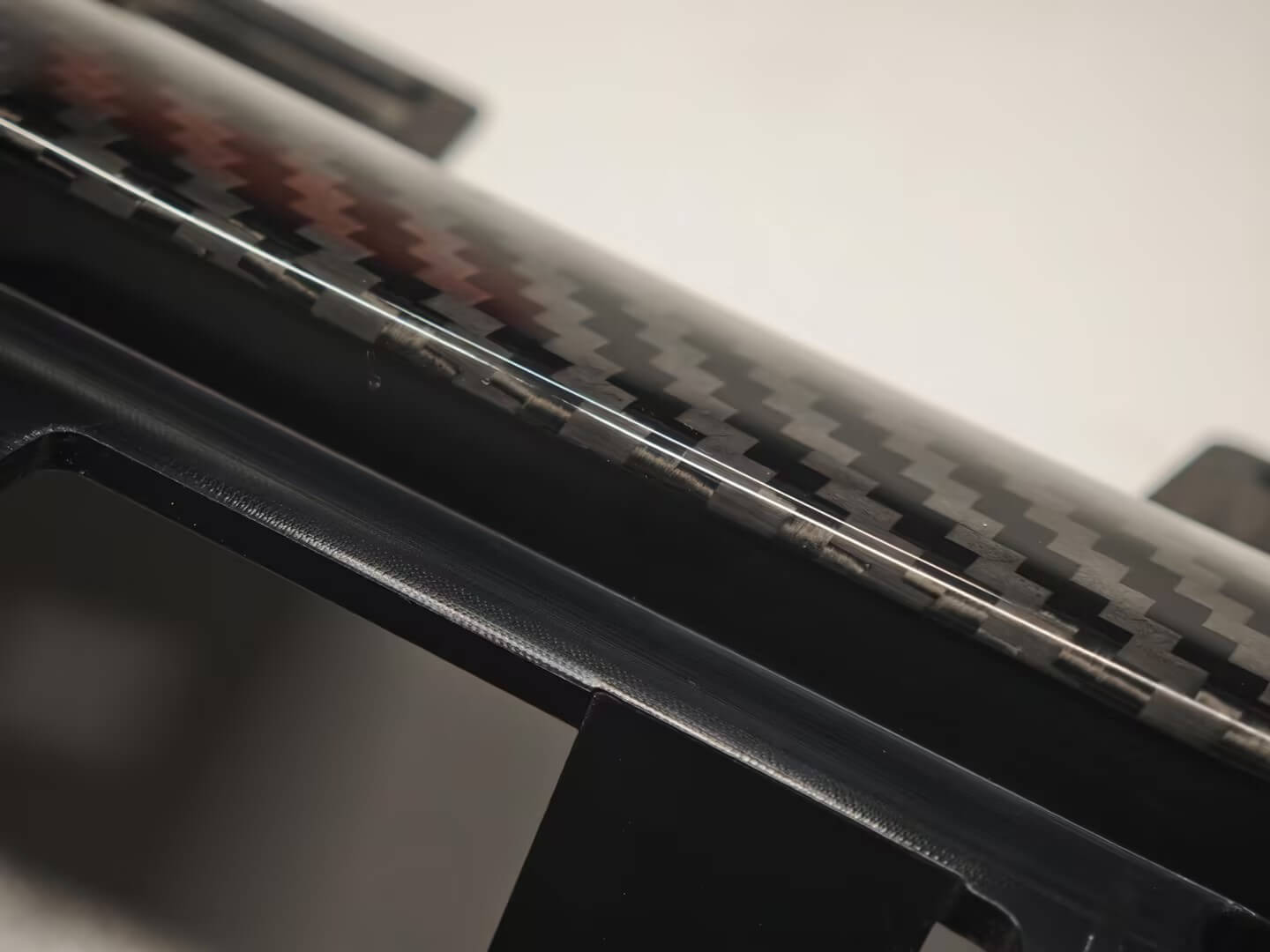
Manufacturing precision is the other half of this equation. Key interface surfaces—suspension pickups, floor attachment references, aerodynamic datum features—must be controlled to tolerances that translate directly to on-car geometry. Through five-axis CNC machining and dedicated composite fixturing, surface profile tolerance is controlled within 0.5mm, with assembly gap tolerance maintained at approximately 0.3mm. At these levels, the geometry defined in CAD is the geometry that exists on the physical car at the start of the race.

Safety Architecture: Why Composite Outperforms Metal Under Impact
The most common technical concern raised by engineers evaluating a carbon fiber race car chassis for the first time centers on impact behavior. Carbon fiber fractures rather than deforming plastically—so is a composite monocoque genuinely safer than a steel structure in a high-speed impact?
The answer is yes, and the mechanism is worth understanding precisely because it is counterintuitive.
Steel structures absorb impact energy through plastic deformation—controlled crumpling in designated zones. This relies on the material’s ductility. Carbon fiber structures absorb energy through progressive laminate fracture—controlled fragmentation that dissipates kinetic energy at high rates while the survival cell remains intact. The critical difference is that composite engineers can design the energy absorption behavior intentionally. Layup density, core material transitions, and structural geometry in designated crash zones can be tuned independently from the primary structure, producing a predictable and repeatable response under impact.
A spaceframe relying on metal ductility offers less predictable protection under off-axis loading conditions—the failure mode depends on impact angle and load magnitude in ways that are harder to engineer in advance.
For Le Mans style racing cars where high-speed impacts are an operational risk category rather than an edge case, engineered crash behavior is a meaningful safety advantage over material ductility alone. Critical zones—particularly the cockpit surround—receive additional laminate reinforcement using high-toughness carbon fiber fabric and impact-resistant stacking sequences. The result is impact absorption performance that exceeds metal equivalents at the same weight.
Modular Design: The Factor That Determines Race Outcomes
In endurance racing, the ability to repair damage quickly is as strategically important as the ability to avoid damage. A lightweight carbon fiber racing chassis designed without modularity in mind forces a binary outcome when the car sustains contact: retire or lose significant time to a major repair.
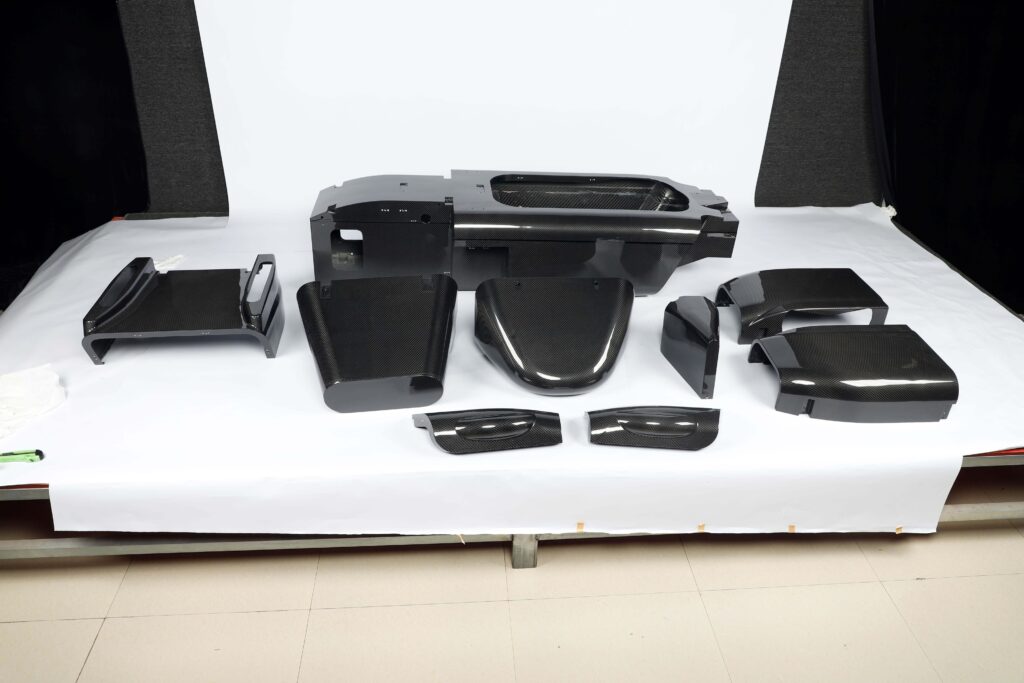
A modular composite chassis architecture separates the primary survival cell from bolt-on crash structures, side pods, and aerodynamic bodywork. These outer elements absorb contact damage independently and can be replaced at race pace without disturbing the core structure.
A team that swaps a damaged front crash section and returns to the race within a pit stop window has converted a potential DNF into a points finish.
Achieving this requires design decisions made before the first part is manufactured: defining structural boundaries between the survival cell and sacrificial zones, engineering bolted interfaces that transfer loads predictably under race conditions, and qualifying repair procedures with the crew before the event. The upfront engineering investment is real. So is the return when those procedures are executed under race conditions.
Evaluating a Carbon Fiber Chassis Supplier: The Right Questions
For sourcing managers and program engineers assessing carbon fiber chassis for Le Mans style racing cars, the evaluation cannot be limited to material specification and unit price. The questions that actually distinguish a capable supplier from one that produces composite parts without composite engineering:
- FEA correlation: Can they show physical test results alongside simulation predictions for the same load cases? Correlation within ±10–15% is a realistic benchmark. Without it, the structural analysis is unvalidated.
- Layup process control: Is fiber angle verified during manufacture? Are cure cycle parameters traced per part? Is void content measured from process coupons? Without documented process control, mechanical properties vary between nominally identical parts.
- Machining capability: Five-axis CNC with composite-specific fixturing is required to hold the dimensional tolerances that aerodynamic and suspension interfaces demand.
- Modular design intent: A supplier that delivers a monolithic structure with no defined repair zones has not solved the endurance racing problem. They have solved the manufacturing problem.
The answers to these questions determine whether you are purchasing a carbon fiber monocoque chassis engineered for endurance competition, or a composite shell optimized for appearance.
Conclusion
A carbon fiber monocoque chassis for Le Mans-style endurance racing solves four engineering problems simultaneously—weight, torsional rigidity, crash safety, and aerodynamic dimensional stability—that no metal chassis architecture resolves at racing weight targets. The material is not the point. The engineering system behind it is: layup design validated against real load environments, autoclave processing for void-free consolidation, five-axis CNC machining for dimensional control, and modular architecture that keeps the car racing when contact happens.
At JCSPORTLINE, structural composite development for Le Mans style racing cars covers the full sequence—from FEA validation and layup design through autoclave cure and precision machining to assembly verification and post-delivery technical support. If your program requires a lightweight carbon fiber racing chassis that performs as engineered across a full race distance, contact our engineering team to review your technical requirements.
FAQ
Q: Is a carbon fiber monocoque chassis customizable to team-specific structural requirements and dimensions?
Yes. Working within Le Mans regulatory frameworks, the chassis architecture can be tailored to team-specific requirements—including split-body structure, mounting hole positioning, and reinforcement rib layout. Custom configurations are validated through a structured engineering review before any tooling is committed.
Q: How durable are the molds, and can they support batch production?
Molds are produced from high-strength industrial-grade composite materials with surface hardening treatment, delivering durability comparable to traditional metal tooling. This makes them viable for medium and small-batch production runs as well as repeated sampling cycles, without the lead time or capital cost of steel tooling.
Q: How does a carbon fiber monocoque chassis perform under race impact conditions?
The layup design uses high-toughness carbon fiber fabric combined with an impact-resistant stacking sequence. Critical zones—particularly the cockpit surround—receive additional laminate reinforcement. Impact absorption performance exceeds metal chassis equivalents at equivalent weight, while the survival cell remains structurally intact for driver protection.
Q: How is dimensional accuracy maintained across all chassis assembly interfaces?
Key mating surfaces are finished through five-axis CNC machining with dedicated composite fixturing. Surface profile tolerance is controlled within 0.5mm, and assembly gap tolerance is maintained at approximately 0.3mm. This ensures consistent gap uniformity across all body and structural interfaces, and keeps aerodynamic geometry performing as designed at race speed.
Q: How straightforward is field maintenance and crash repair during a race event?
The modular design architecture allows individual components to be removed and replaced independently without disturbing the primary structure. Component-level interchangeability means trackside crews can execute partial repairs within a competitive time window. Technical repair guidance and replacement component supply are included in the post-delivery support package.
Q: Can the chassis accommodate future regulation changes and powertrain upgrades?
Yes. Regulatory compatibility is built into the design from the initial engineering phase, with expandable structural interfaces that support powertrain configuration changes. When upgrades require structural adjustments, the engineering team can respond to revised mounting geometry without redesigning the primary chassis architecture.