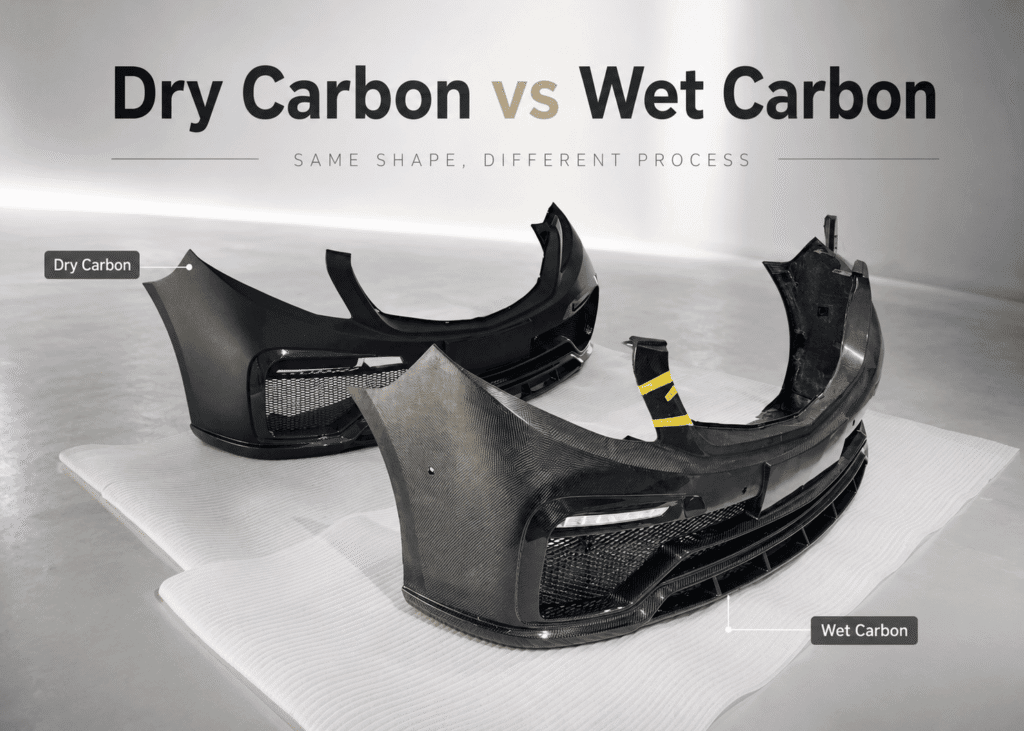
If you source carbon fiber automotive parts, you have probably asked — or wanted to ask — this question: the dry carbon hood and the wet carbon hood are the same shape, so Can Dry Carbon and Wet Carbon Share the Same Mold? On paper, sharing looks like a clean way to cut tooling cost and shorten development.
After two decades of running both processes in volume production, our answer is no — and the reason lives on the mold surface, across hundreds of production cycles, not in a materials textbook. The material-level trade-offs are covered in our dry carbon fiber vs wet carbon fiber comparison. This is a different decision: dry carbon vs wet carbon mold strategy — and getting it wrong shows up later as pinholes, demolding failures, unstable clear-coat adhesion, and batch-to-batch inconsistency that your end customers notice before you do.
A Mold Is Not Just a Shape — It’s a Process Asset
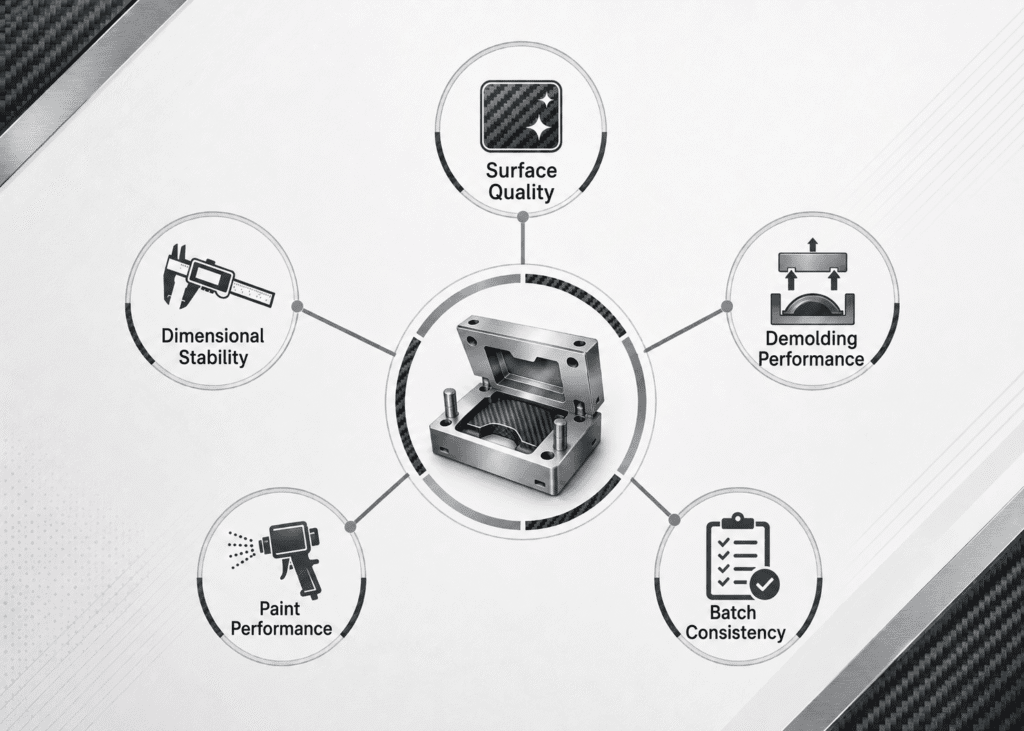
The most expensive misunderstanding in carbon fiber sourcing is treating the mold as a geometry replicator. A mold replicates shape — but in composites it also determines surface quality, dimensional stability, demolding behavior, paint and clear-coat performance, and production repeatability. How Mold Design Affects Carbon Fiber Part Quality is not a tooling-department detail; it is a purchasing decision.
Unlike injection molding, where the material arrives finished and the mold merely forms it, a carbon fiber molding process creates the material and the part simultaneously. The mold surface is in direct contact with the resin as it cures, so every property of that surface — cleanliness, flatness, temperature behavior, release condition — transfers into the part. This is the root logic behind a principle we apply to every project: carbon fiber tooling must match the production process, not just the part geometry. Two parts with identical CAD files, built through different processes, are two different tooling projects.
Dry Carbon vs Wet Carbon: Two Different Sets of Tooling Demands
Why Carbon Fiber Tooling Must Match the Production Process becomes obvious once you put the two processes side by side — not as chemistry, but as demands placed on the mold.
Wet lay-up carbon fiber uses liquid resin applied to fabric in the mold, curing at low temperature and low or ambient pressure. A prepreg carbon fiber mold must survive a fundamentally harsher duty cycle. In our own autoclave production, a typical prepreg curing cycle runs at 150°C for 150 minutes under 6 bar of pressure, with demolding controlled below 80°C to prevent thermal distortion. A mold that performs acceptably in room-temperature wet lay-up loses flatness, surface accuracy, or release stability under repeated cycles like that — the only question is how quickly.
| Tooling Requirement | Wet Carbon (Wet Lay-up) | Dry Carbon (Prepreg / Autoclave) |
| Process temperature | Low / ambient cure | High-temperature cure (e.g., 150°C cycles) |
| Pressure | Low or ambient | High (e.g., 6 bar autoclave) |
| Resin system | Liquid resin, applied in-mold | Pre-impregnated, controlled resin content |
| Surface sensitivity | Tolerant of minor residue | Highly sensitive to contamination and unevenness |
| Release system | Wax / liquid release agents, frequent reapplication | Stable, heat-rated release system matched to prepreg |
| Maintenance logic | Clean-and-reuse between lay-ups | Controlled surface condition tracked over mold life |
These are the practical Dry Carbon vs Wet Carbon Tooling Differences. Note where most shared-mold plans fail: the last two rows. Temperature ratings can be checked on a datasheet. Surface condition cannot.
The Hidden Killer: Mold Contamination and Release System Mismatch
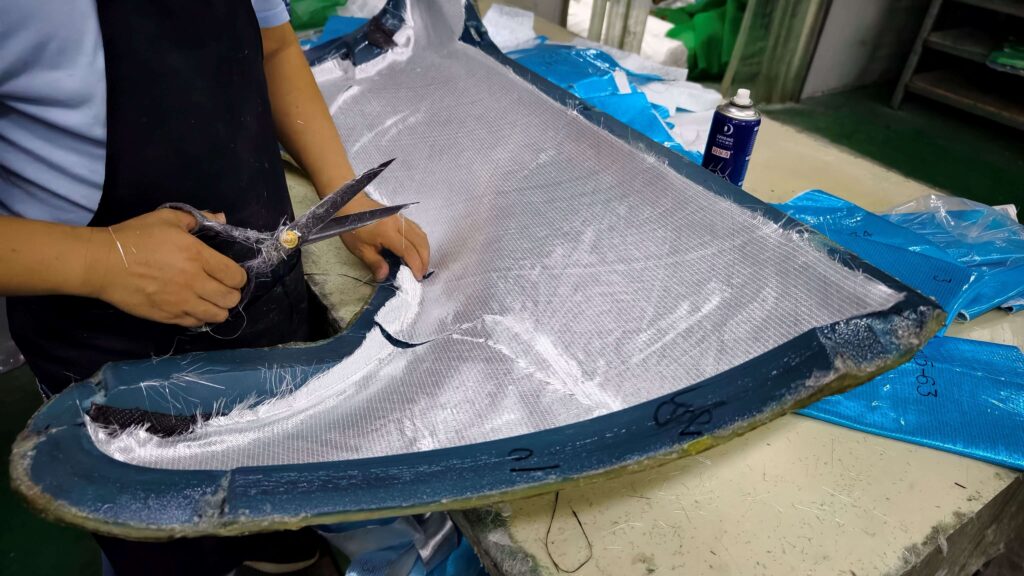
Mold contamination in carbon fiber production is cumulative — and it is the part of the dry carbon vs wet carbon mold question that only becomes visible in production.
Every wet lay-up cycle leaves traces on the mold: cured resin residue, flash along the edges, layers of release wax, build-up from the mold release agent for carbon fiber, and sanding dust from part finishing. Wet carbon production tolerates this — the next application of liquid resin is forgiving. Prepreg is not. Dry carbon places far higher demands on mold surface cleanliness, flatness, release-agent stability, and heat resistance. Run prepreg on a contaminated surface and the defects map directly to the residue: in cases we have diagnosed for clients, this is the real answer to why carbon fiber parts have pinholes and white spots — along with surface print marks, difficult demolding, and clear coat that will not adhere consistently.
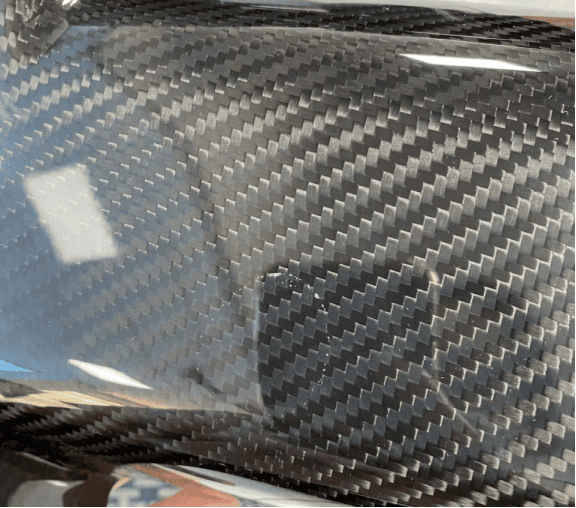
A cleaned wet carbon mold is not a dry-carbon-ready mold. Contamination builds over the mold’s service life, and no single cleaning cycle resets it to zero. This is Why Prepreg Carbon Fiber Needs a Different Mold — not a different shape, a different surface history.
What “Saving One Mold” Actually Costs You
We understand the suspicion: when a supplier says you need separate tooling, it can sound like the problem is being made complicated to justify a bigger quote. So put the argument in purchasing terms, not engineering terms.
A shared mold saves one tooling invoice. What it puts at risk is everything downstream of that invoice: rework and rejection rates on cosmetic surfaces, demolding failures that stop the line, clear-coat adhesion problems that surface as warranty claims months after delivery, and batch inconsistency that erodes the premium positioning that made you choose dry carbon in the first place. “Mixing temporarily” carries the same risk profile — the first few parts pass inspection, and the failure mode arrives during volume production, when it is most expensive.
The tooling decision is a risk allocation decision. Separate molds move cost to the beginning of the project, where it is visible and controllable. A shared mold moves cost to mass production and after-sales, where it is neither.
Disciplined carbon fiber mold maintenance — matched to the process the mold actually serves — is what protects that allocation. It is a core part of the carbon fiber solutions we quote, not an optional add-on.
How to Choose the Right Tooling Strategy for Your OEM Project
For sourcing managers and product developers, how to choose carbon fiber mold for OEM parts comes down to four questions worth asking before you compare prices:
- Do you maintain separate molds for dry carbon and wet carbon production — and can you show the tooling records?
- How is mold surface condition maintained and tracked over the mold’s service life?
- Is your release system rated and validated for prepreg processing?
- Do you have a documented tooling management standard, or is mold care left to operator habit?
A supplier who answers these specifically is selling you process judgment. A supplier who answers vaguely is selling you a mold.
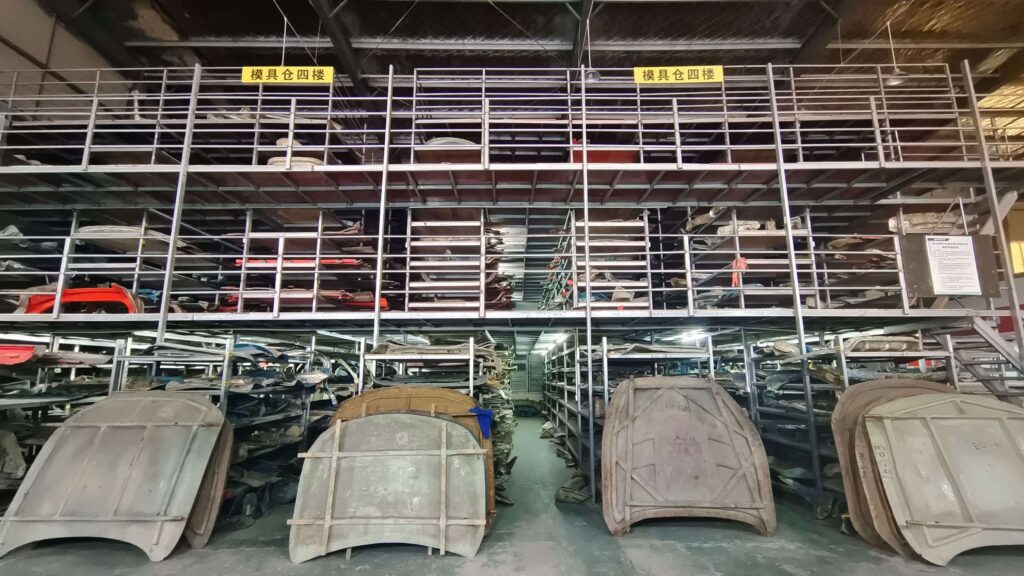
At JCSPORTLINE, that judgment starts before tooling is quoted. Our engineering team at the 1,400 m² Shenzhen R&D center returns a free technical feasibility report within 24 hours: it defines the process boundary first — dry carbon or wet carbon, based on the product’s positioning, surface requirements, and structural role — and only then defines the carbon fiber mold design to match. Tooling strategy also scales with volume: for large, complex-geometry parts under roughly 200 units, we often recommend non-metal tooling to reduce upfront cost, with deformation control measures built into the production plan. Matching tooling to the project is sometimes the cheaper option and sometimes the more robust one — but it is never a guess. The sequence is fixed: process boundary first, mold second, quote third.
Frequently Asked Questions
Can dry carbon and wet carbon share the same mold if the wet mold is thoroughly cleaned?
No. Cleaning removes surface residue, but a wet carbon mold’s release system, surface history, and often its temperature rating remain mismatched to prepreg processing. The risk of pinholes, print marks, and adhesion problems stays.
What happens if we mix processes on one mold “just once”?
The first parts may look acceptable. The risk is not the single run — it is that contamination and release-system mismatch produce defects unpredictably, and an OEM program cannot qualify a process that passes unpredictably.
Does separate tooling significantly increase budget and lead time?
It increases upfront tooling cost, yes. Measured across a production program, it costs less than the rework, rejection, and after-sales exposure a shared mold introduces. Tooling type can also be matched to volume to control that upfront cost.
How do I verify a supplier actually separates dry and wet carbon tooling?
Ask for tooling management documentation: mold registers, surface maintenance records, and release-system specifications by process. Suppliers who run both processes at scale have these; suppliers who improvise do not.
How do I know whether my project should be dry carbon in the first place?
That is a product-positioning question — cosmetic vs. structural, premium vs. cost-driven — and it is exactly what a feasibility review resolves before tooling is committed.
Conclusion
The dry carbon vs wet carbon mold question is really a question about what a mold is. Treat it as a shape, and sharing one looks like savings. Treat it as a process asset — which is what it behaves like across a production program — and separate, process-matched tooling is the lower-risk, lower-total-cost decision for any project where surface quality and batch consistency carry your brand.
If you are weighing tooling strategy for a carbon fiber program, send us the part. Our engineering team will return a technical feasibility assessment — process boundary, tooling recommendation, and the reasoning behind both — within 24 hours.