You found the car everyone will be talking about next season. You want the widebody rendered, the samples shot, the pre-sale live — fast. Then your supplier quotes a custom carbon fiber development timeline measured in weeks, not days, and the obvious question lands: why so long?
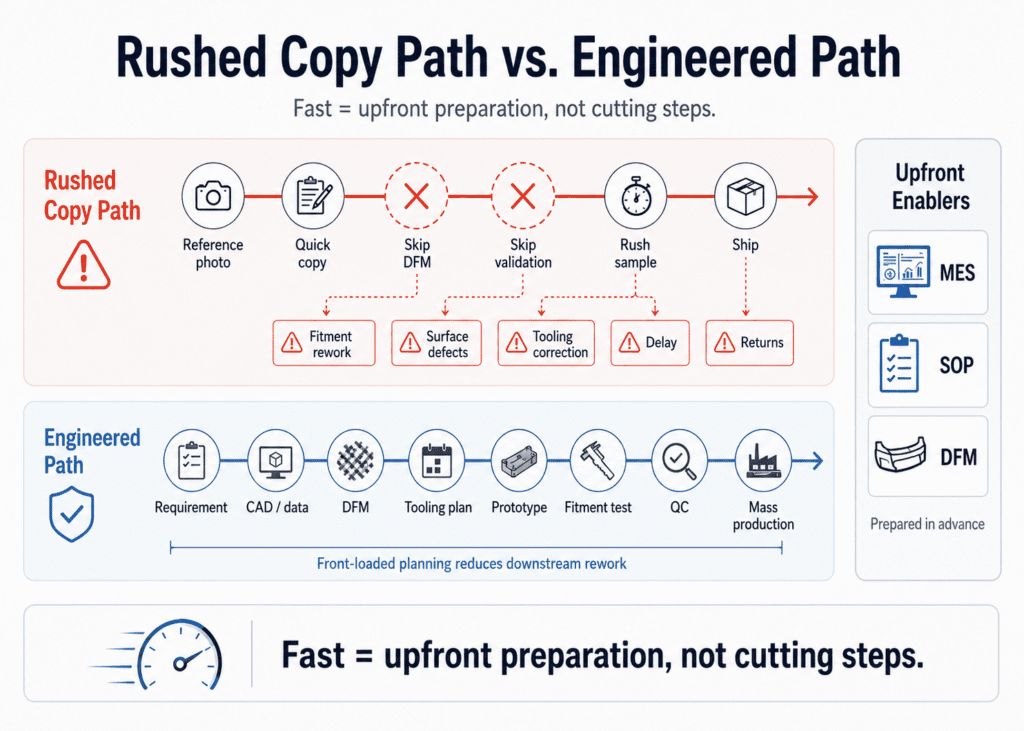
Here is the honest answer, and it is the whole point of this article. A long timeline is not a slow factory. It is the difference between copying a shell and engineering a part that fits, sells, and reorders. The real reason why custom carbon fiber products take longer to develop is that a large-format aero part is decided by everything you don’t see on the front face — the back structure, the mounting points, the tolerances, the molding process. Compress those and you don’t save time; you push the cost downstream into misfit, warped edges, and batch rework that lands on the brand, not the supplier.
What a Development Timeline Actually Includes (Not “Just a Mold + a Sample”)
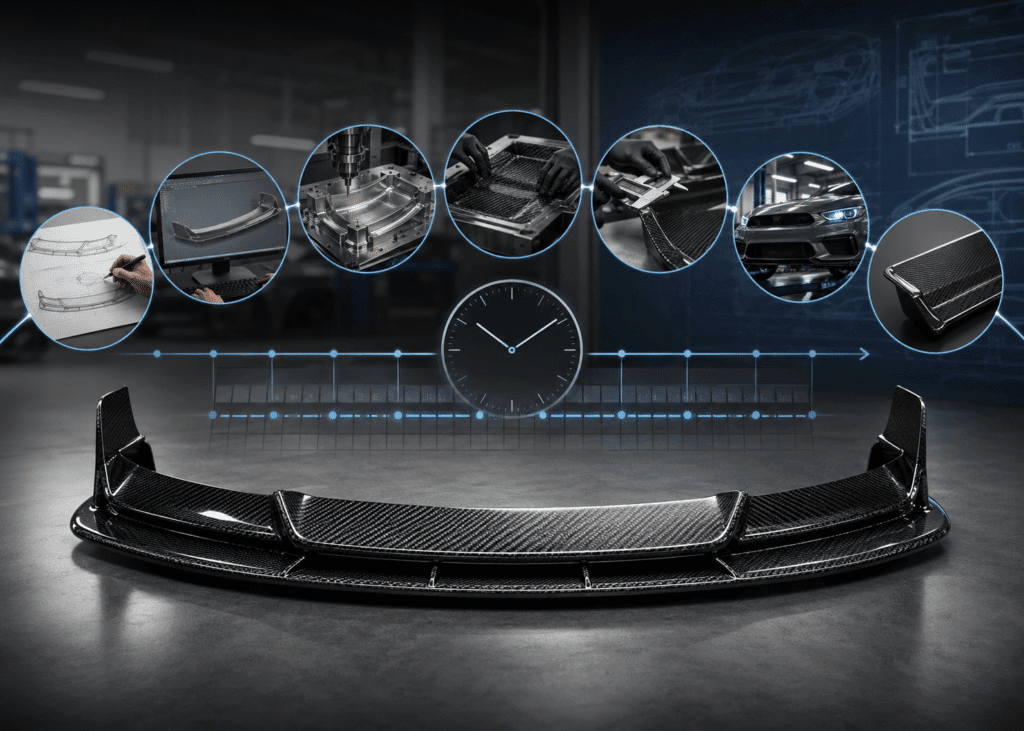
Most buyers estimate a project as “make one mold, produce one sample.” That mental model is the single biggest reason carbon fiber production lead time gets underestimated. A real custom carbon fiber product development process runs through a sequence of dependent stages, and each one exists to kill a specific failure risk before it reaches your customers.
| Stage | What happens | Why it takes the time it takes |
| Data & scanning | Reverse-engineer the vehicle, capture mounting geometry | A body that “looks right” but ignores real hard points never fits |
| Structural & fitment analysis | Reinforce the back structure, confirm clips, edges, hole positions | Prevents flex, warping, and gaps in mass production |
| Prototype (hand-board) | Build the first physical part | The first test-fit almost always exposes adjustments |
| Test-fit & iteration | Mount on the actual car, correct deviations | Catches model-year and tolerance issues early |
| Mold optimization | Refine tooling for demolding, surface, and mold life | A rushed mold locks defects into every unit |
| Process & curing test | Validate the molding and cure for the required finish | Dry-carbon and matte OEM effects need process tuning |
| Mass-production prep | Lock the SOP and quality controls | Turns one good sample into thousands of consistent parts |
Each link depends on the one before it. That is why how long does custom carbon fiber product development take has no one-line answer, and why the honest custom carbon fiber parts design tooling and testing process can’t be shortened by deleting steps — skip a link and the failure simply moves further down the chain, where it costs more to fix. JCSPORTLINE runs this as an integrated flow from concept through custom carbon fiber manufacturing to production, so the hand-off between stages doesn’t leak days.
Why Large Aero Parts Can’t Be Directly Copied From the Original Car
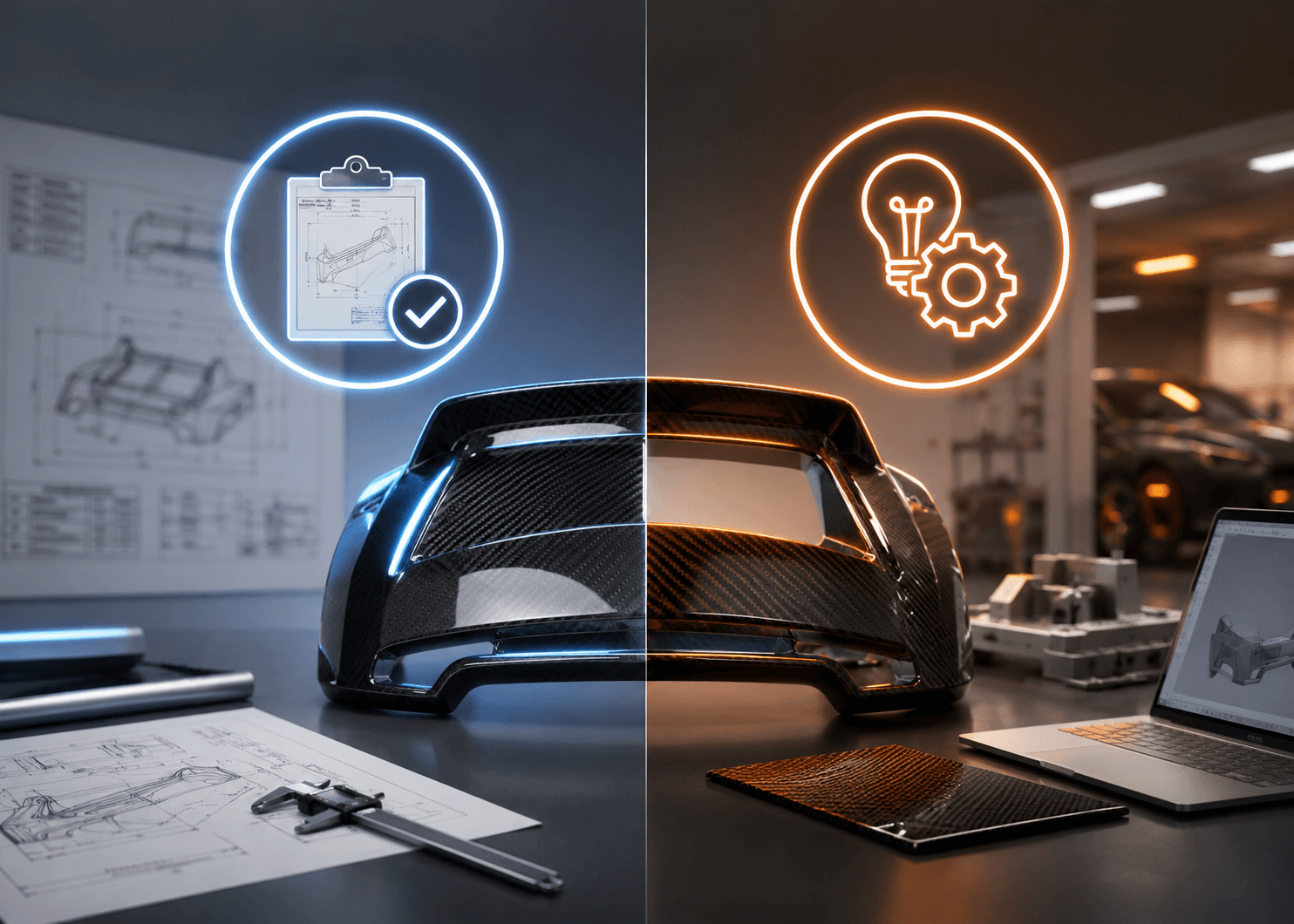
This is where cheap copying and engineering-led manufacturing part ways. Plenty of suppliers treat the job as “you have a sample, we copy it.” That model is exactly why carbon fiber body kits cannot be directly copied with reliable results.
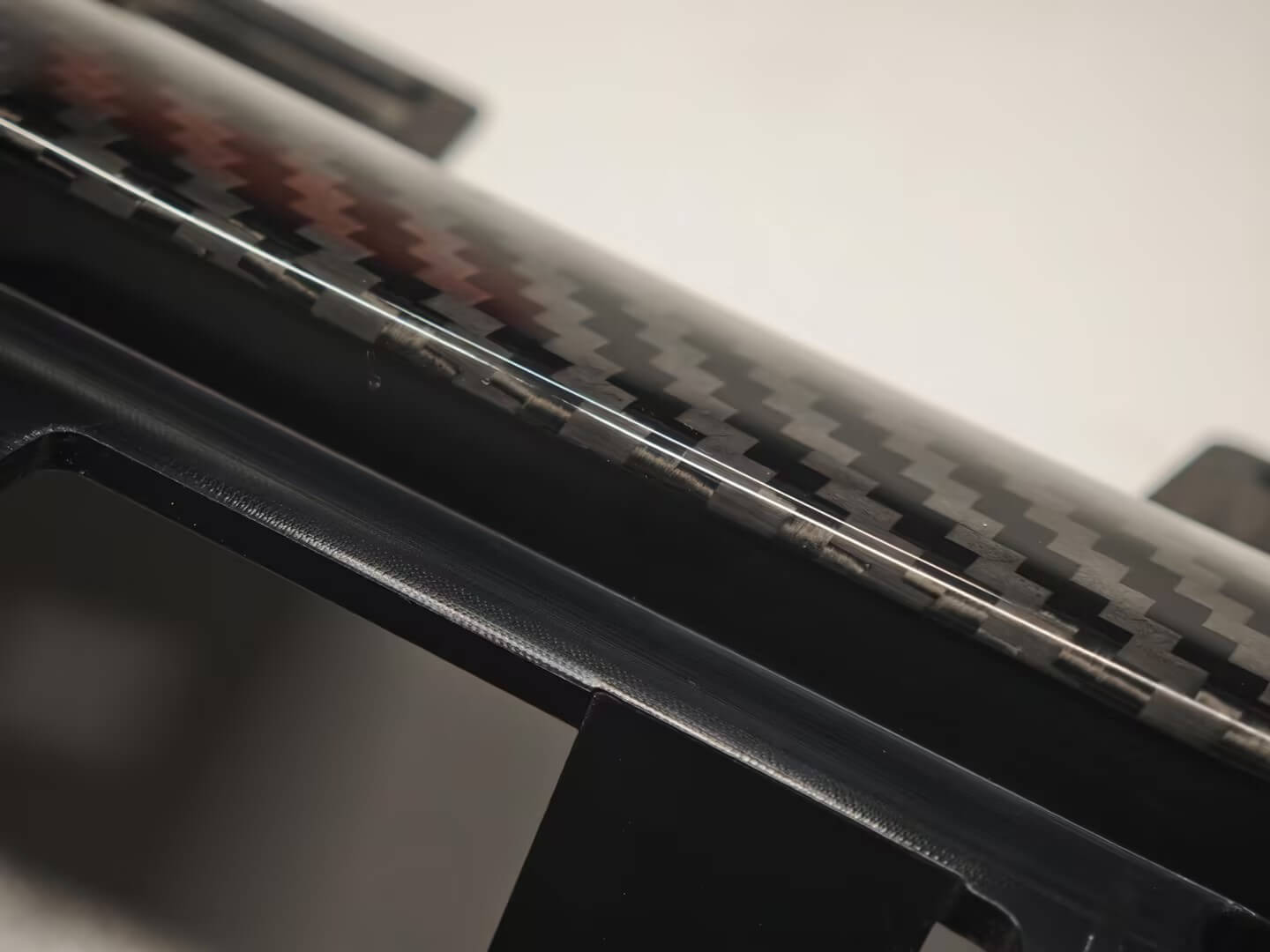
A widebody flare, front bumper, hood, or diffuser looks like a single outer shell. The product is the back: the reinforcement structure, the clip and bracket positions, the boundary treatment, the opening precision, the mounting tolerances. Those decide carbon fiber fitment — whether the part bolts on cleanly, sits flush, and stays flush across a full batch. A surface copy captures none of it. Worse, manufacturers change hard points between model years, so reusing last season’s data quietly builds misfit into the tooling. Serious carbon fiber body kit development re-confirms those details for each variant instead of assuming.
The fit test, not the beauty test. Anyone can reproduce a front face. The questions that decide whether custom carbon fiber parts actually sell are: will it install without modification, will the edges stay true, will unit #500 fit as well as unit #1? For aftermarket brands and overseas distributors, the answer to those questions is the product.
For an aero-kit brand owner or an OEM/ODM program manager, that gap is the difference between a launch and a returns problem — and it is the reason we engineer from the vehicle up, not from the photograph in.

The Engineering Work That Eats Time: Scanning, Structural Analysis & Prototyping
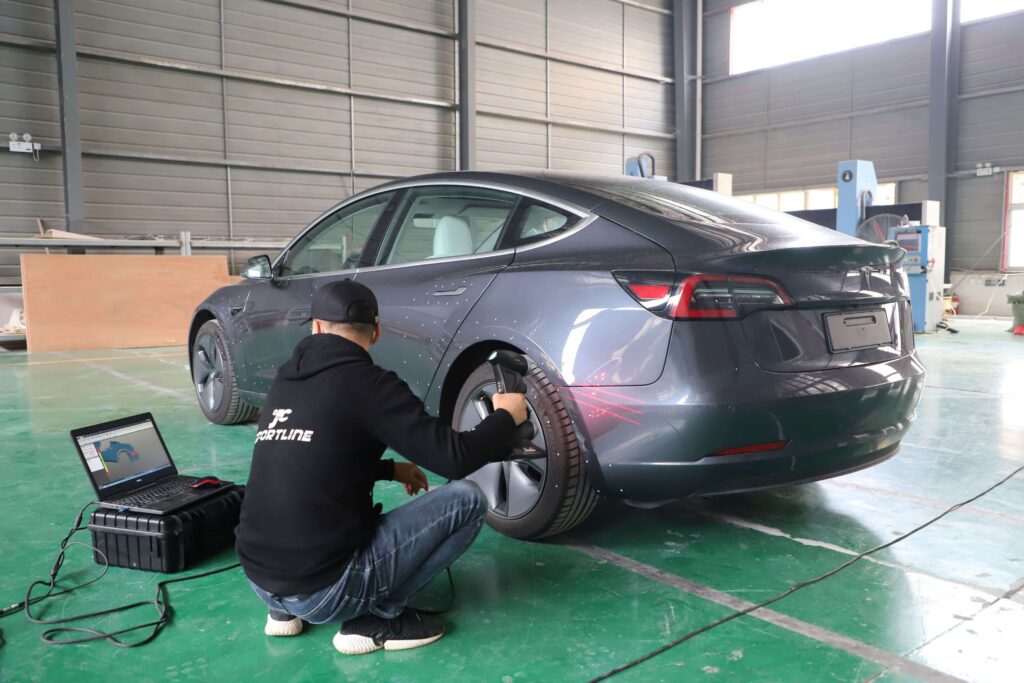
Ask what the extra weeks buy, and the answer is engineering validation. Understanding how 3D scanning and structural analysis affect carbon fiber development time explains most of the schedule that surprises first-time buyers.
Scanning turns the physical vehicle into accurate data. Structural analysis then confirms the part is stiff and stable where it needs to be — not merely attractive. This is where carbon fiber prototype development earns its place: the first hand-board exists to be tested and corrected, not admired. These stages are the core factors that affect custom carbon fiber development timeline, and they are exactly what a “copy the shell” supplier omits.
We validate structure, not just surface. In one JCSPORTLINE engineering study, a structural roof crossbeam was analyzed against its metal counterpart using finite-element analysis across five load cases — free and constrained modal behavior, axial tensile stiffness, bending stiffness, and bending strength. On that project, the composite version cut significant weight while improving stiffness and strength rather than trading one for the other. That is the carbon fiber product development discipline separating an engineered part from a cosmetic clone.
Our design and engineering teams treat this as the front end of every program, which is why the analysis work shows up in the timeline instead of surfacing as a warranty claim later.
Mold Development & Tooling: Where Timelines Are Really Won or Lost
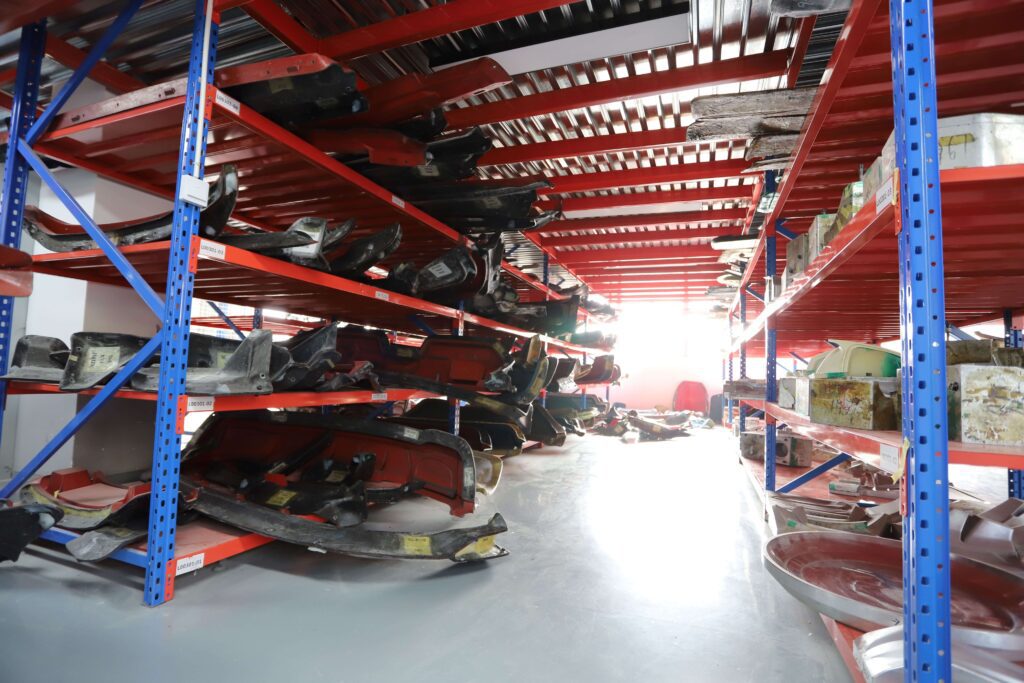
If one stage decides both your schedule and your batch quality, it is tooling. Carbon fiber mold development is never a single step; the carbon fiber tooling process iterates because the mold governs demolding, surface finish, and how many consistent parts it produces before it drifts.
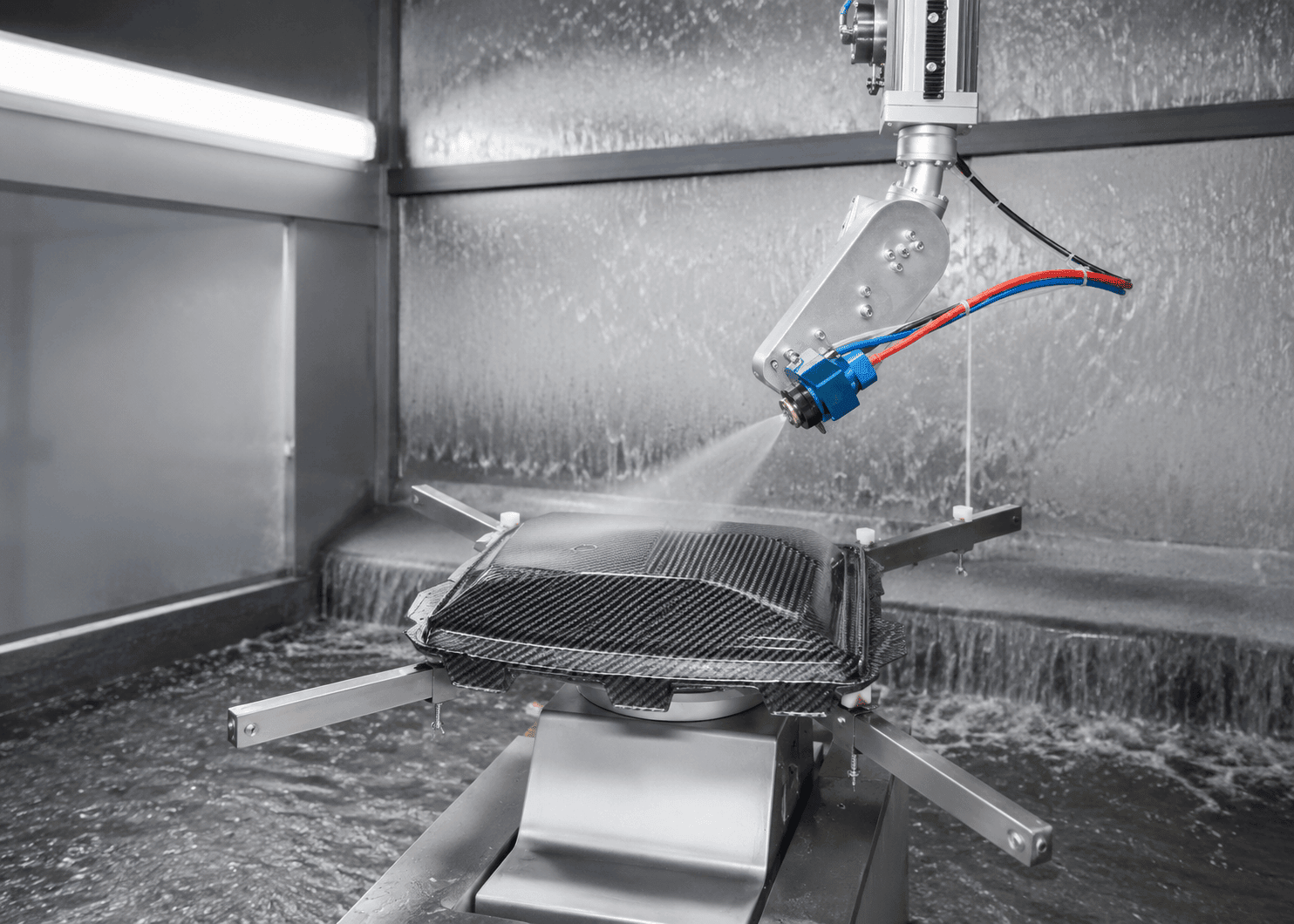
The realistic carbon fiber mold development and prototyping timeline widens with part size and complexity. Large, low-volume, irregular aero parts often call for non-metal tooling, which then demands deformation control to hold surface quality across a run. Curing and process validation add more time still: OEM-grade matte and dry-carbon visual effects are earned through process testing, not a default setting. This is much of why OEM carbon fiber projects need longer lead times — OEM carbon fiber manufacturing is judged on the thousandth part, not the first.
Mold life is a quality decision. A mold optimized only for speed can produce a flawless first sample and then degrade. For sourcing and procurement managers planning a product line, tooling built for repeatable output is what protects surface consistency and reorder economics.
How to Shorten the Timeline Without Cutting Corners
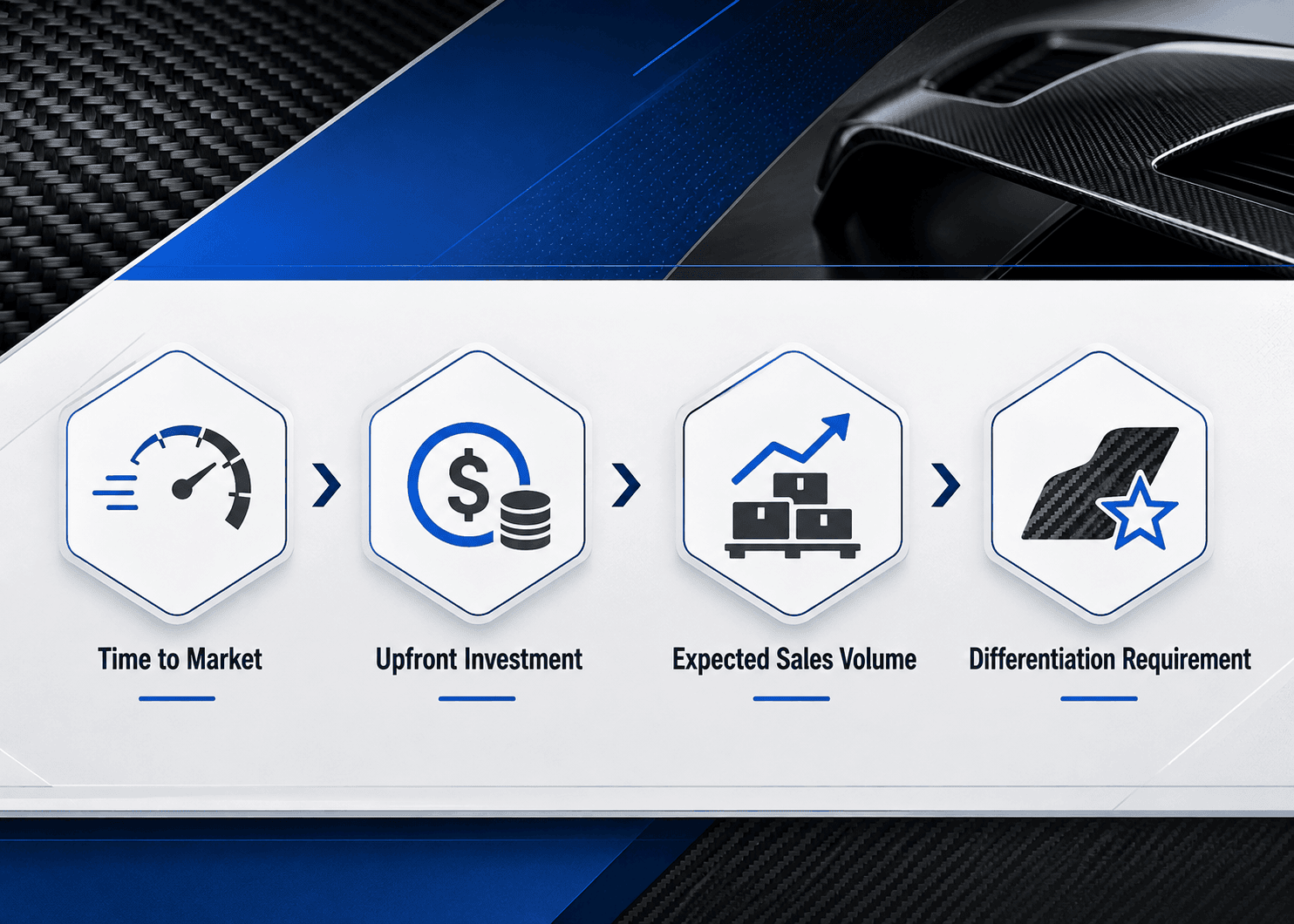
Accepting a credible timeline is not the same as accepting a slow one. The real question — how to shorten custom carbon fiber development lead time — has a specific answer: systematize the engineering, don’t delete it.
That is how a documented, engineering-driven workflow moves a project from carbon fiber prototype to mass production on a predictable schedule. A structured JCSPORTLINE development flow typically runs on the order of weeks with documented on-time delivery performance — not because stages are skipped, but because feasibility review, DFM, concurrent engineering, and MES-tracked SOPs are prepared in advance. Speed is a byproduct of preparation. When a supplier offers to skip scanning, structural checks, or test-fitting to hit an unrealistic date, they are not compressing the custom carbon fiber development timeline — they are transferring the risk to your brand.
Conclusion
A development timeline is not a delay to endure; it is risk control you can audit. The weeks spent scanning, validating structure, iterating prototypes, and optimizing tooling are the weeks that keep parts fitting, edges true, and batches consistent. Fast is possible — but only when the engineering is systematized, never when it is cut. For any brand building a product line rather than chasing a single sample, that distinction is the whole game.
Planning a new carbon fiber program? Bring JCSPORTLINE your vehicle, sketch, or CAD, and our engineering team will map the realistic development path — feasibility, tooling, testing, and mass production — so your launch rests on a timeline that protects your quality and your margins.
Frequently Asked Questions
How long does custom carbon fiber product development actually take?
It depends on part size, complexity, and finish. A small cosmetic part moves quickly; a large aero component with structural requirements needs more time for scanning, structural analysis, tooling, and test-fitting. A credible quote reflects those stages instead of hiding them.
Why can some suppliers deliver samples so fast — and should I trust it?
A fast surface copy is easy; a validated, mass-production-ready part is not. If a quote skips structural checks or test-fitting, ask what happens at unit #500. Speed with no engineering is a batch-quality problem waiting to surface.
Why does a different model year of the same car need re-development?
Manufacturers change mounting points, panel geometry, and hard points between years. Reusing old data risks misfit, so serious development re-confirms the details for each variant.
Can I skip prototyping or test-fitting to save time?
You can, but it moves the cost downstream. Those stages catch fitment and tolerance issues before tooling is finalized — far cheaper to fix there than after mass production.
Does a longer development timeline mean higher cost?
Not necessarily. Timeline is driven mainly by structure, tooling, and process validation — not raw material cost. Proper upfront engineering usually lowers total cost by preventing rework, rejects, and returns.