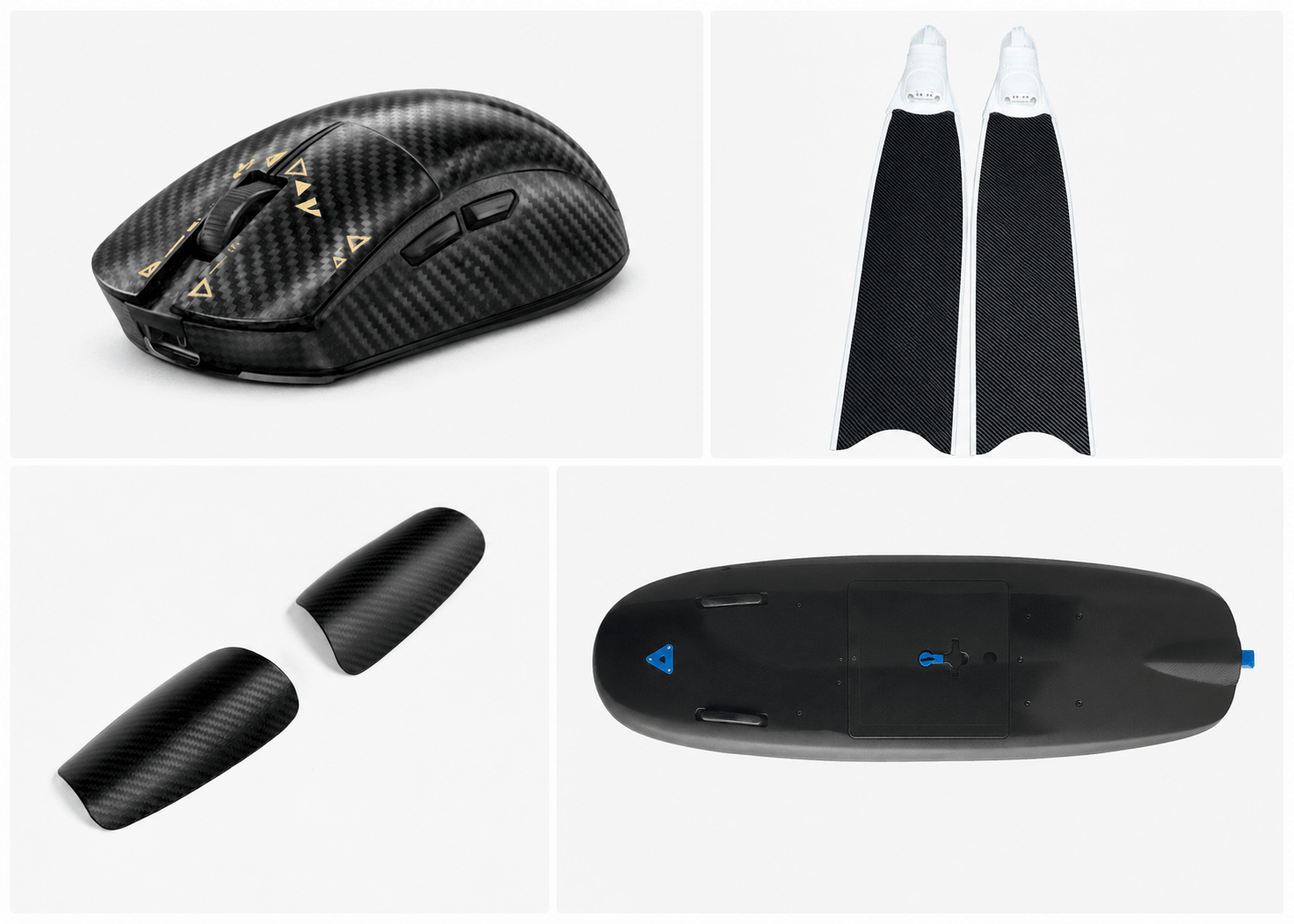
Carbon fiber applications extend far beyond automotive body parts. Marine brands, sports-equipment companies, medical-product developers, electronics manufacturers, and premium consumer brands choose carbon fiber because it can combine lightweight construction, structural stiffness, fatigue resistance, corrosion-resistant design potential, and a distinctive high-end appearance.
However, carbon fiber is not automatically the right material for every non-automotive product. A successful project requires the manufacturer to evaluate the complete application: how the product is loaded, where it will be used, whether it will contact water or chemicals, how it will be assembled, what it should weigh, and how many units must eventually be produced.
For B2B buyers, the real question is not simply, “Can this product be made from carbon fiber?” The better question is:
Can carbon fiber provide enough technical, commercial, and brand value to justify the development process?
A professional composite manufacturer should help answer that question through application analysis, material selection, structural design, process planning, prototype validation, and production-readiness review.
Why Brands Outside Automotive Choose Carbon Fiber
The value of carbon fiber in non-automotive products is not limited to weight reduction. In many projects, it performs both a structural and visual role.
Marine and Water-Sports Products
Surfboards, hydrofoil boards, electric surfboards, marine covers, and other water-sports products may benefit from carbon fiber because of its stiffness-to-weight potential and resistance to fatigue under repeated loading.
Potential advantages include:
- lower product weight;
- stronger structural support;
- reduced deformation;
- easier transport and handling;
- premium surface appearance;
- stronger product differentiation;
- corrosion-resistant composite structures when properly engineered.
Still, carbon fiber alone does not make a marine product waterproof or corrosion-proof. Resin, coatings, seals, adhesives, inserts, fasteners, and manufacturing quality all influence long-term performance.
Sports Equipment
Carbon fiber is widely considered for sports products where weight, stiffness, response, and repeated-load behavior matter.
Possible carbon fiber applications in sports equipment include:
- cycling components;
- protective braces;
- paddles;
- rackets;
- shafts;
- performance footwear components;
- mobility products;
- sports-equipment frames and shells.
The structure can be customized through fiber orientation, layup thickness, local reinforcement, core materials, and hybrid fibers. This allows designers to develop different stiffness or flex characteristics for specific use cases.
Consumer Electronics and Lifestyle Products
Carbon fiber can also be used in premium electronics, luggage, backpacks, speakers, furniture, and lifestyle accessories.
In these products, buyers may prioritize:
- thin structural shells;
- lower weight;
- premium visual identity;
- protection for internal components;
- custom surface effects;
- brand differentiation.
For consumer products, surface consistency and manufacturing repeatability may be just as important as mechanical performance.
Medical and Mobility Applications
Medical-device and mobility-product developers may consider carbon fiber when they need lightweight handling, structural support, corrosion resistance, and custom geometry.
Examples may include wheelchair components, braces, rehabilitation devices, and lightweight support structures. These applications require careful validation because strength, comfort, cleaning, compliance, and user safety may all affect the final design.
Is Carbon Fiber the Right Material for the Product?
Carbon fiber should be compared with realistic alternatives rather than selected only because it looks premium.
Possible alternatives include:
- aluminum;
- stainless steel;
- fiberglass;
- engineering plastics;
- wood;
- hybrid composites.
The final decision should consider:
- required weight;
- stiffness and strength;
- impact behavior;
- fatigue life;
- corrosion environment;
- repairability;
- production volume;
- tooling cost;
- compliance requirements;
- retail price;
- total project cost.
For example, aluminum may be easier to machine and repair. Fiberglass may provide a more economical solution for some larger structures. Engineering plastics may be better for high-volume molded housings. Carbon fiber becomes most valuable when its combined structural, weight, appearance, and branding benefits support the product’s market position.
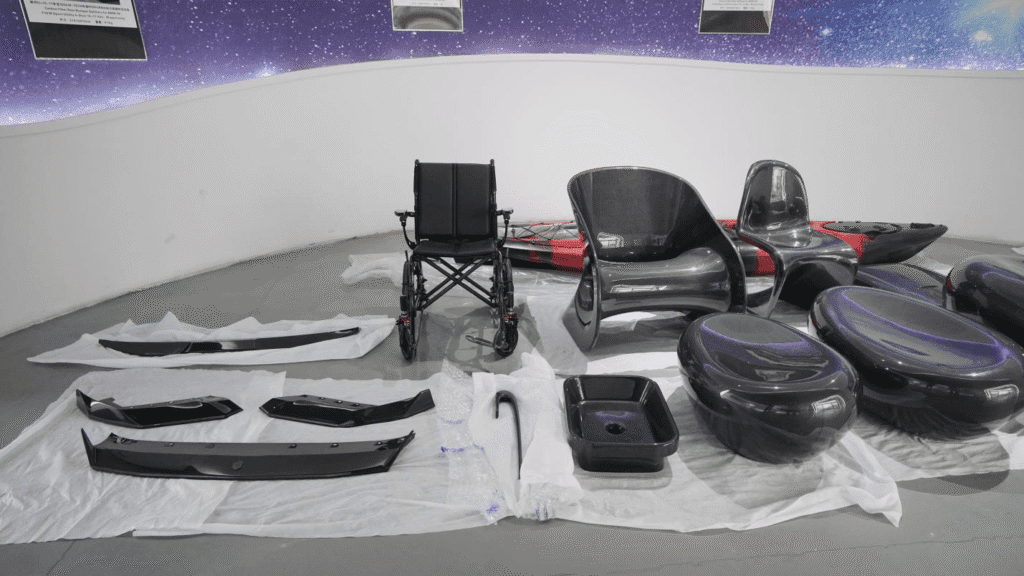
Process Selection for Marine, Sports and Consumer Products
Different carbon fiber composite applications require different manufacturing routes. Autoclave curing, hot-press forming, compression molding, vacuum infusion, and forged carbon each have suitable use cases.
| Process | Suitable Products | Surface Potential | Repeatability | Tooling Needs | Relative Cost | Main Limitation |
| Prepreg autoclave | Premium lightweight and structural parts | High | High when controlled | Medium to high | High | Equipment and material cost |
| Controlled oven cure | Selected dry carbon products | Good to high | Good | Medium | Medium to high | Lower pressure than autoclave |
| Hot-press forming | Visible shells and selected lightweight parts | High | Good | Medium to high | Medium to high | Geometry and tooling constraints |
| Compression molding | Repeatable structural or semi-structural products | Good | High | High initial investment | Cost-effective at volume | Less suitable for frequent changes |
| Vacuum infusion | Large or lower-volume composite structures | Moderate to good | Moderate | Low to medium | Medium | Resin and surface variation require control |
| Forged carbon molding | Complex small parts and premium accessories | Distinctive | Good with stable tooling | Medium to high | Medium to high | Random visual pattern |
| Hybrid process | Products with mixed requirements | Project-specific | Project-specific | Varies | Varies | Requires stronger engineering integration |
Prepreg and Hot-Press Processes
Prepreg materials provide controlled resin content before layup. They may be appropriate for products requiring lower weight, visible carbon surfaces, and more stable laminate quality.
Hot-press forming can support cleaner surface control and a more consistent carbon appearance in suitable geometries. It may be useful for premium shells or sports products where visual quality is a major part of the brand value.
Compression Molding
Compression molding can be suitable for products with predictable demand and a strong need for batch consistency.
Once the tooling and process are established, it can support:
- repeatable dimensions;
- stable structural performance;
- faster production cycles;
- better cost control at volume.
However, tooling investment can be higher, and design changes may be expensive after the mold is completed.
Vacuum Infusion
Vacuum infusion may be appropriate for larger structures, lower-volume products, and early-stage development where cost and geometry make autoclave production less practical.
A well-managed infusion process can produce reliable parts, but resin distribution, vacuum integrity, operator control, and surface finishing must be carefully managed.
Forged Carbon
Forged carbon uses chopped fibers or carbon molding compounds rather than continuous woven fabric. It is useful for complex small parts where woven alignment would be difficult.
It can also provide a distinctive appearance for premium consumer accessories. Actual performance still depends on fiber distribution, resin, pressure, geometry, and thickness.
No process is universally superior. The correct route depends on the product’s structure, dimensions, appearance, quantity, budget, and production goals.
Marine Product Design: Structure, Water Resistance and Corrosion
Marine products require more than a lightweight carbon shell.
The development team must evaluate:
- one-piece or multi-piece construction;
- local reinforcement;
- mounting loads;
- impact conditions;
- repeated fatigue;
- waterproof sealing;
- core materials;
- leak or pressure testing;
- metal inserts;
- fastener selection;
- saltwater exposure;
- repair and maintenance.
Water Resistance
Carbon fiber reinforcement does not absorb water like some traditional materials, but the final composite structure can still fail if the resin, bonding, sealing, or assembly system is unsuitable.
Water may enter through:
- seams;
- inserts;
- mounting points;
- damaged coatings;
- poorly bonded joints;
- cable or hardware openings.
Water resistance must therefore be designed into the complete product.
Corrosion and Metal Hardware
Carbon fiber itself does not rust. However, marine-product corrosion resistance depends on the full material system.
Special attention is needed where carbon fiber contacts metals because galvanic interaction may occur under certain conditions. Suitable isolation layers, coatings, adhesives, or hardware materials may be required.
Titanium-alloy hardware can be considered for selected premium marine projects because of its corrosion resistance, structural properties, and high-end positioning. It is not automatically required for every product. Stainless steel, coated aluminum, or other materials may also be suitable depending on load, environment, cost, and isolation design.
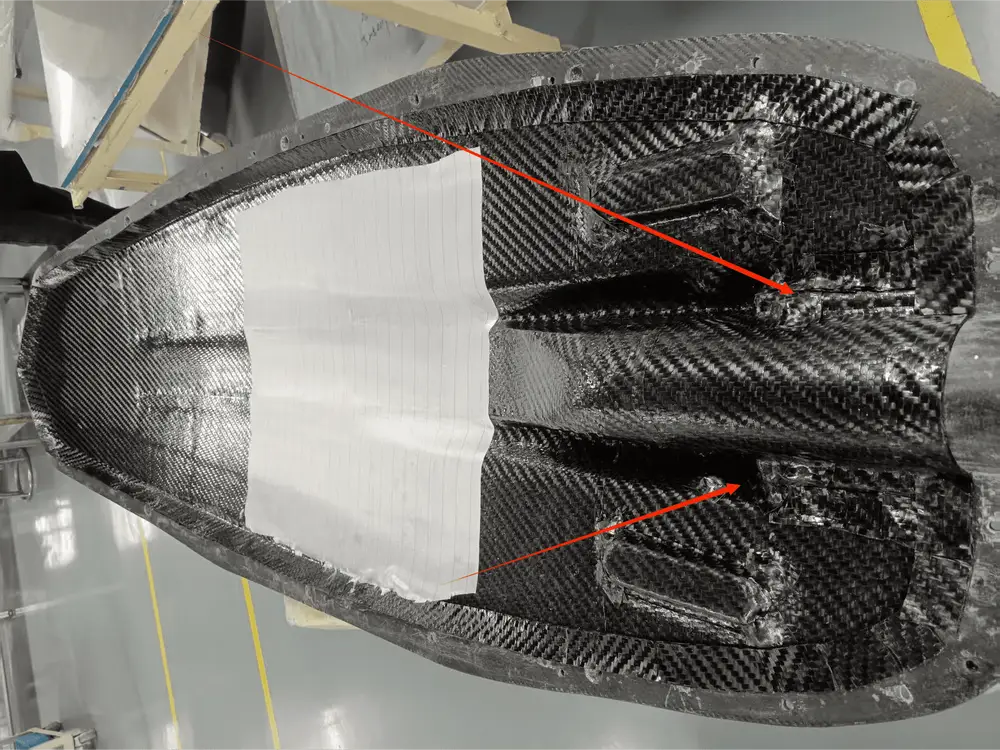
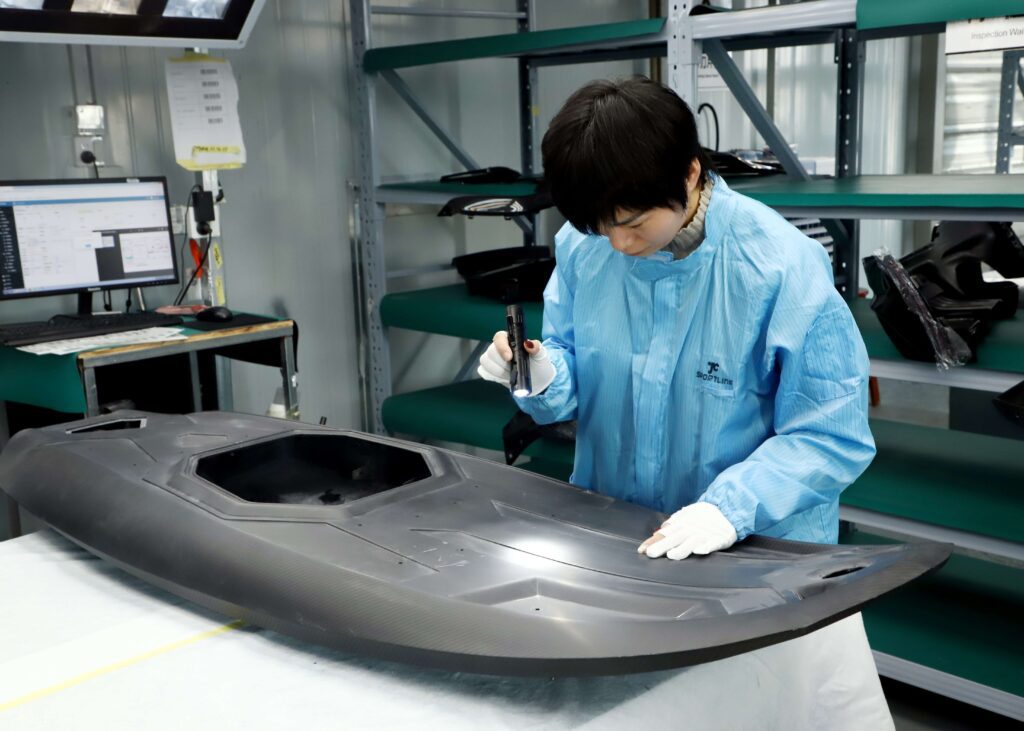
Case: From a 10-Year Surfboard Delay to Production Readiness
A composite surfboard brand had worked with an overseas marine company to develop and promote a new board project. However, the project remained unable to enter stable production for approximately ten years.
The customer originally specialized in marketing, not composite manufacturing. During the long development period, repeated supplier failures forced the customer to study materials, molds, forming methods, hardware, and production details personally.
The customer had tried working with more than ten smaller or low-cost suppliers. Although individual samples could sometimes be produced, the suppliers could not consistently meet the required structural, surface, production, and brand standards.
The project was not being delayed by one isolated defect. It faced a complete system problem.
Main Project Challenges
The project involved:
- an unsuitable initial manufacturing route;
- a complicated multi-piece mold structure;
- difficult assembly;
- inconsistent surfaces;
- unsuitable metal hardware;
- weight-control problems;
- unstable production yield;
- insufficient capacity;
- no reliable route from prototype to repeat production.
This is a common problem in new custom carbon fiber applications. Different suppliers may each solve one stage, but no one takes responsibility for the complete product system.
Process Upgrade
The customer’s original route relied on vacuum-infusion wet carbon. JC SPORTLINE reviewed the project and introduced two different process directions.
Hot-press forming was used where stronger appearance and surface control were priorities. Compression molding was introduced for areas requiring repeatability, structural consistency, production efficiency, and cost balance.
The objective was not to declare one process universally better. It was to match the process to each part’s technical and commercial role.
Structural and Tooling Upgrade
The original product used a complicated multi-piece molding method. The design was reviewed to determine where a more integrated one-piece structure could reduce assembly operations, sealing points, and dimensional variation.
A one-piece structure was adopted where it was technically and commercially suitable. This simplified some assembly risks and supported a cleaner product design.
Hardware Upgrade
Selected stainless-steel parts were replaced with titanium-alloy hardware. The purpose was to improve corrosion resistance, structural performance, and premium brand positioning for the project.
This decision was based on the product’s marine environment and target market, not on a rule that all water-sports products require titanium.
Weight and Capacity Planning
The project’s target weight was controlled at approximately 8 kg. The actual result depended on board size, laminate structure, reinforcement, internal components, and hardware.
An additional production line was also arranged to support expected order growth. Dedicated operators became more familiar with the product, helping create a more predictable production rhythm and stronger quality consistency.
According to the project record, the product reached hand-sample testing and production-readiness conditions within approximately six months. Planned capacity reached around 1,000 sets per month, and the upgraded product attracted orders at major exhibitions.
These were project-specific results. Similar timelines, weights, or production volumes cannot be guaranteed for every surfboard or hydrofoil project.
For more information about this application, buyers can review JC SPORTLINE’s carbon fiber hydrofoil surfboard OEM manufacturing capabilities and electric surfboard product.
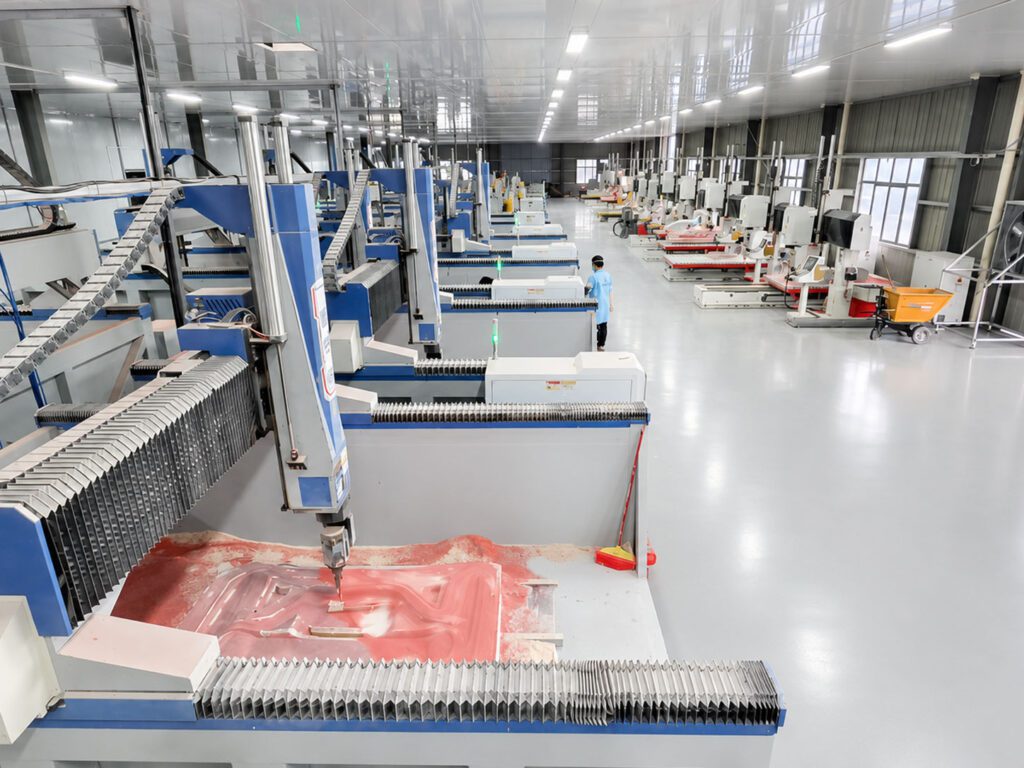
One-Piece vs Multi-Piece Carbon Fiber Structures
Both one-piece and multi-piece structures can be appropriate.
Potential Advantages of One-Piece Molding
- fewer bonded joints;
- fewer sealing points;
- cleaner appearance;
- improved structural continuity;
- fewer assembly components;
- stronger integrated design.
Potential Limitations of One-Piece Molding
- more complex tooling;
- difficult demolding;
- higher mold investment;
- limited access to internal structures;
- more challenging repair;
- larger equipment requirements.
Potential Advantages of Multi-Piece Construction
- simpler individual molds;
- easier internal access;
- more flexible assembly;
- replacement of separate sections;
- easier integration of internal components.
Potential Limitations of Multi-Piece Construction
- more bonding operations;
- more possible leakage points;
- dimensional accumulation;
- alignment risk;
- increased hardware;
- more inspection requirements.
The correct structure depends on load paths, reinforcement, sealing, maintenance, tooling, assembly, and production volume.
From Prototype to Scalable Production
One successful prototype does not prove that a product is ready for mass production.
Production readiness requires:
- an approved master sample;
- finalized CAD and mold data;
- material specifications;
- layup or charge-placement standards;
- reinforcement instructions;
- curing parameters;
- trimming and drilling fixtures;
- sealing procedures;
- hardware specifications;
- dimensional inspection;
- water-resistance testing where required;
- appearance standards;
- packaging standards;
- capacity planning;
- batch QC;
- traceability.
For suitable high-volume products, a dedicated production line may improve operator familiarity, workflow consistency, and capacity planning. It is not required for every project, but it may be valuable when demand is stable and the process is sufficiently mature.
Buyers evaluating scale-up can review JC SPORTLINE’s carbon fiber mass production capability.
What Non-Automotive Buyers Should Prepare
Before starting a project, buyers should prepare as much application information as possible.
Useful inputs include:
- product concept;
- sketches or reference images;
- 3D data;
- physical samples;
- dimensions;
- use environment;
- load direction;
- maximum load;
- fatigue conditions;
- impact requirements;
- target weight;
- stiffness target;
- temperature exposure;
- water or saltwater exposure;
- waterproof requirements;
- corrosion requirements;
- surface appearance;
- weave or forged-carbon preference;
- finish requirements;
- metal inserts and hardware;
- assembly method;
- prototype quantity;
- expected annual volume;
- target price;
- tooling budget;
- launch date;
- testing requirements.
Buyers do not need to provide every engineering answer at the beginning. The manufacturer should help identify missing information. However, clearer application and market data makes feasibility review, process selection, cost estimation, and production planning more accurate.
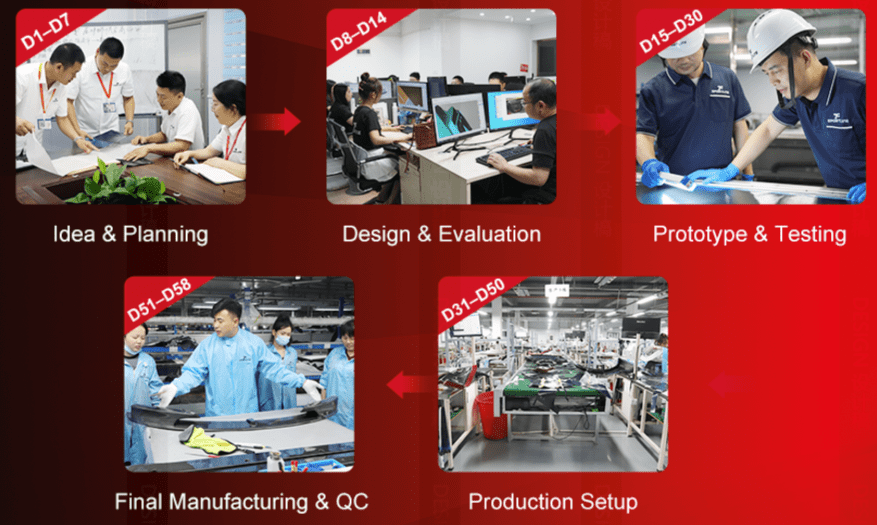
How JC SPORTLINE Evaluates New Composite Applications
JC SPORTLINE evaluates new composite products through several connected reviews.
Application Review
The team first studies how the product will be used, who will use it, what loads it will face, and how the brand intends to position it.
Material Review
Carbon fiber type, resin system, core material, hybrid reinforcement, inserts, and hardware are evaluated according to the environment and performance targets.
Structural Review
The engineering team considers load paths, local reinforcement, joining, sealing, one-piece versus multi-piece construction, and dimensional requirements.
Process Review
Autoclave, oven cure, hot press, compression molding, vacuum infusion, forged carbon, and hybrid routes are compared.
Prototype and Testing Plan
The first sample should have defined validation goals, such as:
- weight;
- fitment;
- appearance;
- water sealing;
- impact performance;
- fatigue behavior;
- assembly;
- structural response.
Production-Readiness Review
Before scaling, the manufacturer evaluates mold quantity, production cycle, worker training, yield, quality inspection, packaging, and monthly capacity.
The objective is not simply to make one sample. It is to determine whether the product can be manufactured consistently and supplied as demand grows.
Conclusion: Evaluate the Complete Product System
The most valuable carbon fiber applications outside automotive are not created by simply replacing an existing material with carbon fiber.
Successful surfboards, marine structures, sports products, electronics, medical products, and lifestyle goods require coordinated decisions about materials, structure, molds, reinforcement, hardware, sealing, appearance, testing, and production capacity.
The ten-year surfboard case shows that a low quotation or successful prototype does not automatically create a manufacturable product. Long-term value comes from solving the full product system and building a realistic path to repeat production.
If your company is developing a marine, sports, consumer, medical, or industrial composite product, contact an experienced carbon fiber manufacturer to review application feasibility, material selection, structural design, process options, prototype validation, and scalable production.
FAQ
Which industries can JC SPORTLINE support?
JC SPORTLINE supports projects in automotive, motorsport, marine products, sports equipment, medical devices, aerospace and drone structures, consumer electronics, home and lifestyle products, and other custom composite applications.
Do you use real carbon fiber for non-automotive products?
Yes. Products use genuine carbon fiber reinforcement rather than printed films, hydro-dipped plastics, or imitation carbon patterns. The exact fiber, resin, weave, and process depend on the project.
Which carbon fiber manufacturing processes are available?
Available routes include prepreg autoclave curing, oven curing, vacuum infusion, hot-press forming, compression molding, forged carbon molding, and project-specific hybrid processes.
Which dry carbon processes can be used for hydrofoil surfboards?
Compression molding may support structural consistency and repeatable production. Hot-press forming may provide cleaner visible carbon surfaces and stronger appearance control. The final choice depends on structure, volume, weight, finish, and budget.
Can hydrofoil surfboards use one-piece or multi-piece structures?
Yes. Both structures are possible. The correct choice depends on engineering design, reinforcement, mounting systems, tooling, sealing, assembly, repair requirements, and production volume.
How do buyers know whether a non-automotive product is suitable for carbon fiber?
Buyers should compare carbon fiber with alternative materials based on weight, stiffness, impact, fatigue, corrosion environment, appearance, tooling, volume, and target price. A feasibility review can determine whether carbon fiber creates enough technical and commercial value.