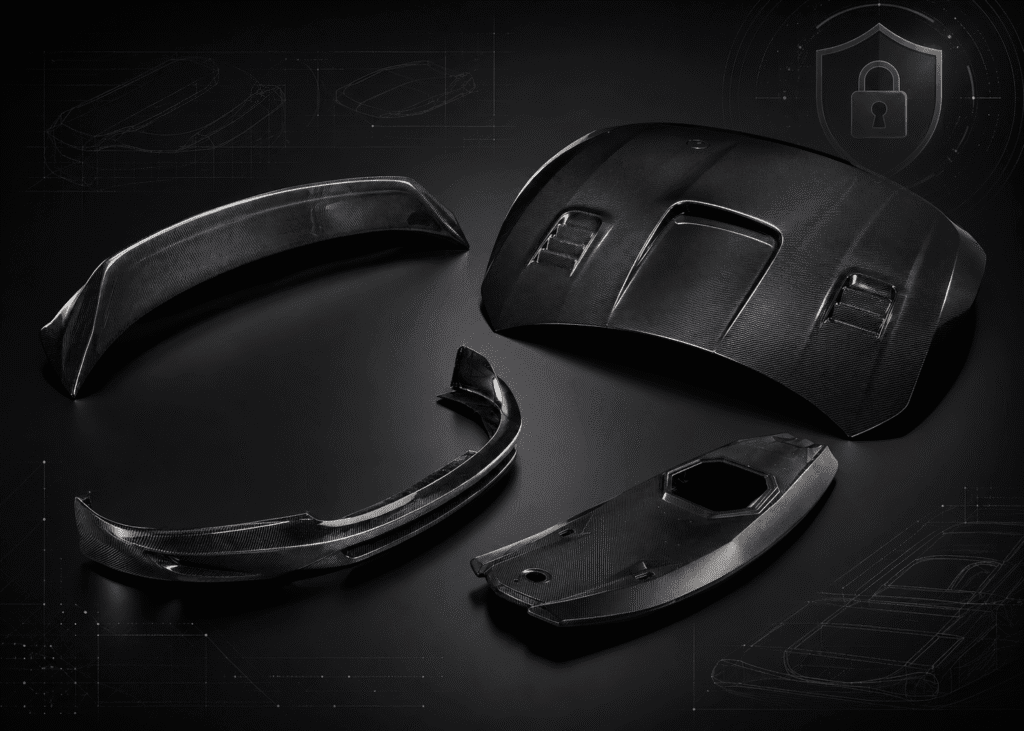
You paid for a custom design. Months later, you find the exact part on a public marketplace—or on a local competitor’s car. The supplier reused your tooling, sold your geometry, and your “exclusive” advantage is gone. If you source carbon parts overseas, this is the risk that should keep you up at night—not the unit price.
So here is the position this article takes: private label carbon fiber manufacturing is not printing your logo on a generic part. Done properly, it is a protection system spanning design, tooling, production, brand presentation, and market segmentation. IP protection is engineered in from the first disclosure, not bolted on after a problem appears. For serious private label carbon fiber manufacturing for B2B brands, the contract, the mold, the finish, and the packaging all have to work together.
What Private Label Carbon Fiber Manufacturing Should Actually Mean
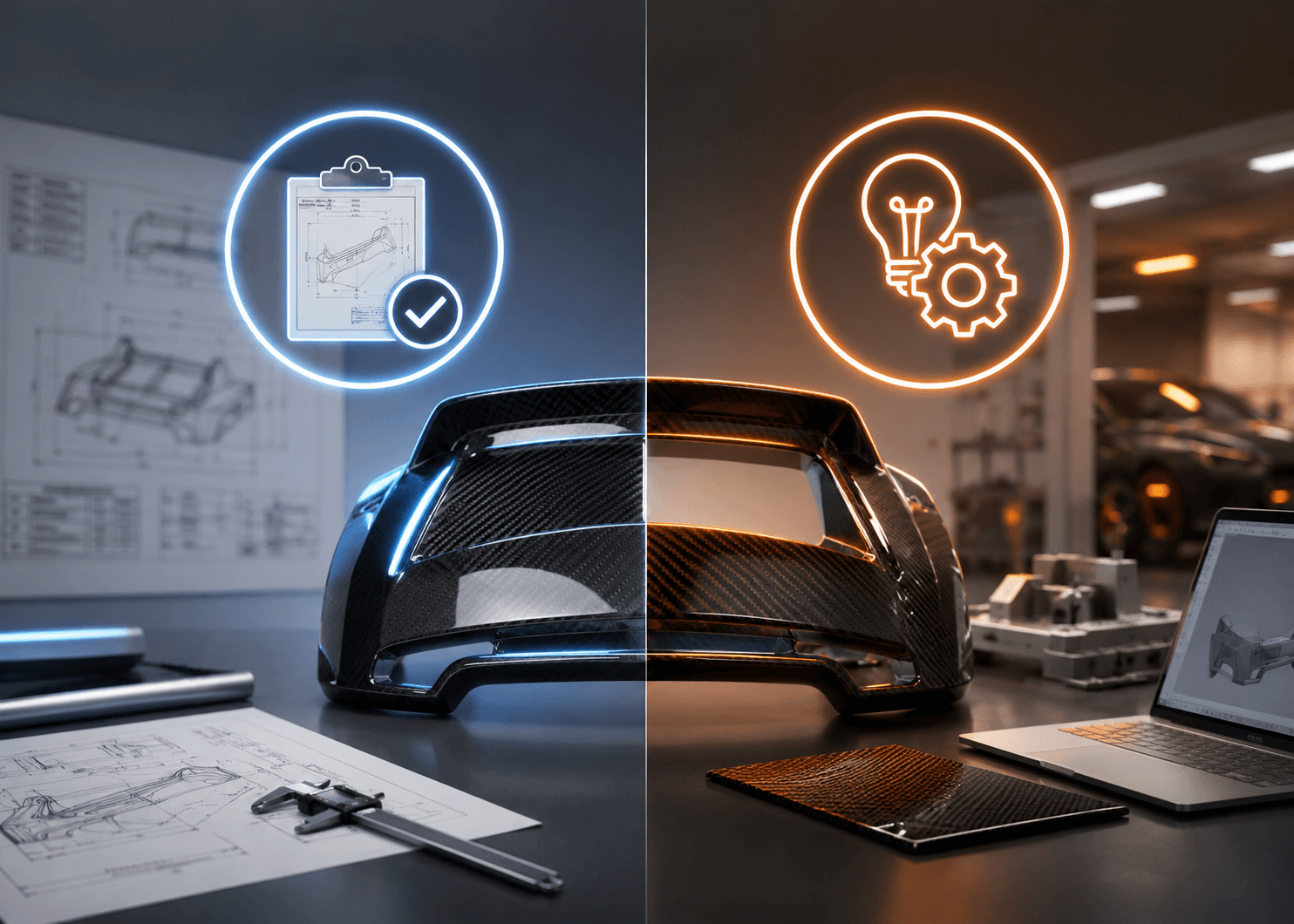
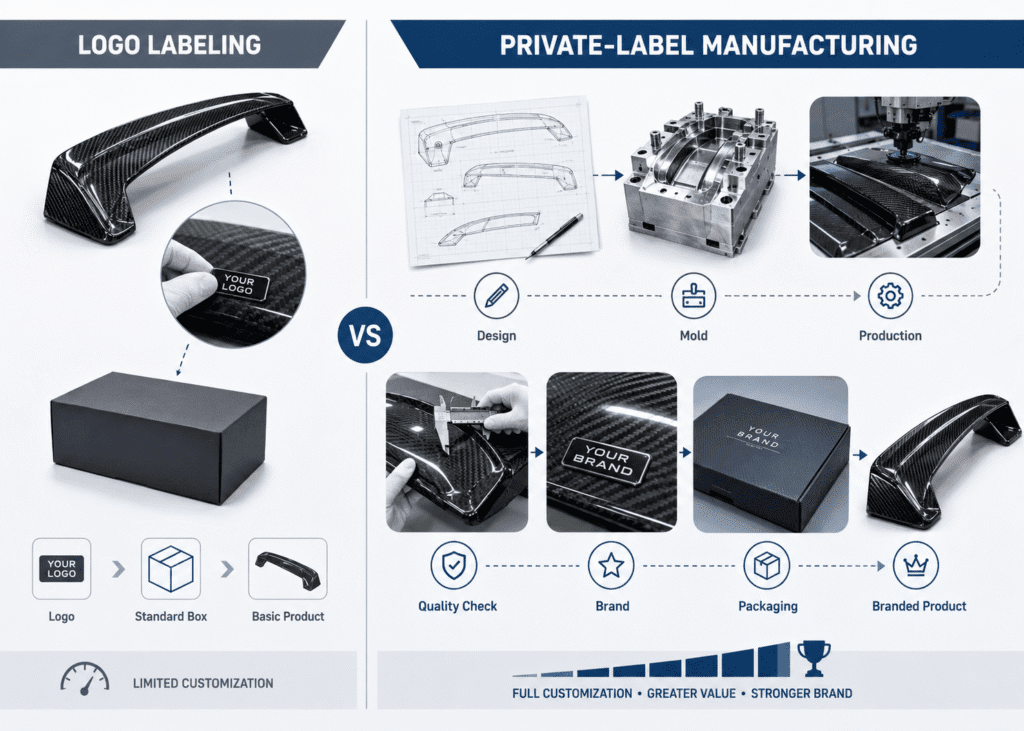
Most suppliers treat private label as a labeling station: same mold, same part, your sticker. That model gives you nothing defensible. Real carbon fiber private labeling controls the whole chain—who can produce the part, who owns the geometry, how the surface looks, and who else in your market can buy something similar.
Labeling vs. private-label manufacturing: Anyone can apply a logo. Only a real manufacturing partner controls the mold, the lay-up, and the right to reproduce your part.
A capable OEM carbon fiber manufacturing partner builds your part to spec; a true ODM carbon fiber manufacturing partner co-develops the design itself. Either way, custom branded carbon fiber parts only protect your brand differentiation if the agreements behind them are real. The rest of this guide is the checklist most buyers wish they’d had before shipping their CAD files.
The NDA Is Your Starting Point — Not a Guarantee
A carbon fiber NDA agreement is the right first move before you disclose a single drawing. It is also routinely misunderstood. An NDA is not a magic shield that automatically wins a lawsuit; it is a written boundary defining what is confidential, who is bound, and what evidence exists if something goes wrong. Treat any supplier who waves it off as “just a formality” as a warning sign.
If you are working out how to protect carbon fiber product designs in China, judge the NDA against these dimensions—not its length.
| Check | What to confirm |
| Confidential scope | CAD, 3D scans, samples, concepts—defined explicitly, not “general business information” |
| Bound parties | Manufacturer plus affiliated factories, mold suppliers, and subcontractors |
| Production limits | No third-party production, no public display, no sample showcasing of your part |
| Derivative designs | Lightly modified versions of your geometry explicitly prohibited |
| Evidence & disputes | File-access logs, retained records, and a defined dispute path |
This is also the honest answer to how to stop a supplier from copying your carbon fiber design: a tightly scoped NDA backed by record-keeping, not a verbal promise. We have worked with brand-protection clients whose previous supplier was selling their custom parts online and copying tooling to competitors. In those cases we arranged for the client to sign IP agreements with counsel, helped assemble supporting evidence, and supported them in pursuing enforcement locally. Strong carbon fiber IP protection comes from that combination—written boundary, evidence chain, and a manufacturer willing to cooperate—not from the document alone.
When Contracts Should Pair With IP Registration
For genuinely original products, a contract works best alongside the right registration—trademark, design rights, or other applicable protection—with professional counsel involved early. Whether to register depends on the product’s originality, your target market, and its commercial value; it is not automatic for every part, and no one should hand you a guaranteed legal outcome before reviewing your jurisdiction and contract. Choosing a China carbon fiber manufacturer with IP protection means choosing one that can support that process with documentation and local coordination—the kind of upfront carbon fiber consulting that decides protection before tooling is cut, not one that leaves you to handle infringement alone.
Who Owns the Mold? Ownership vs. Usage Rights
This is where most disputes start. Paying the tooling fee does not automatically mean you own the tool. The question who owns the mold in carbon fiber manufacturing has three separate answers that must be written down: ownership, usage rights, and custody.
Carbon fiber mold ownership should be defined before development begins—not negotiated after a falling-out. Without it, a factory can argue it may use “its” tool to produce spares, display samples, or fill third-party orders. The follow-up, who owns carbon fiber tooling after a project ends, matters just as much: a tool can be transferred, sealed, or destroyed, and you should decide which—on paper—on day one.
| Tooling clause | Must specify |
| Owner | Named owner of the physical mold and the geometry |
| Authorized use | Permitted only for the client’s orders—no third-party runs |
| Custody | Who stores it, where, and under what access control |
| Reproduction | No duplicate molds without written authorization |
| End-of-project | Transfer, sealing, or destruction—defined in advance |
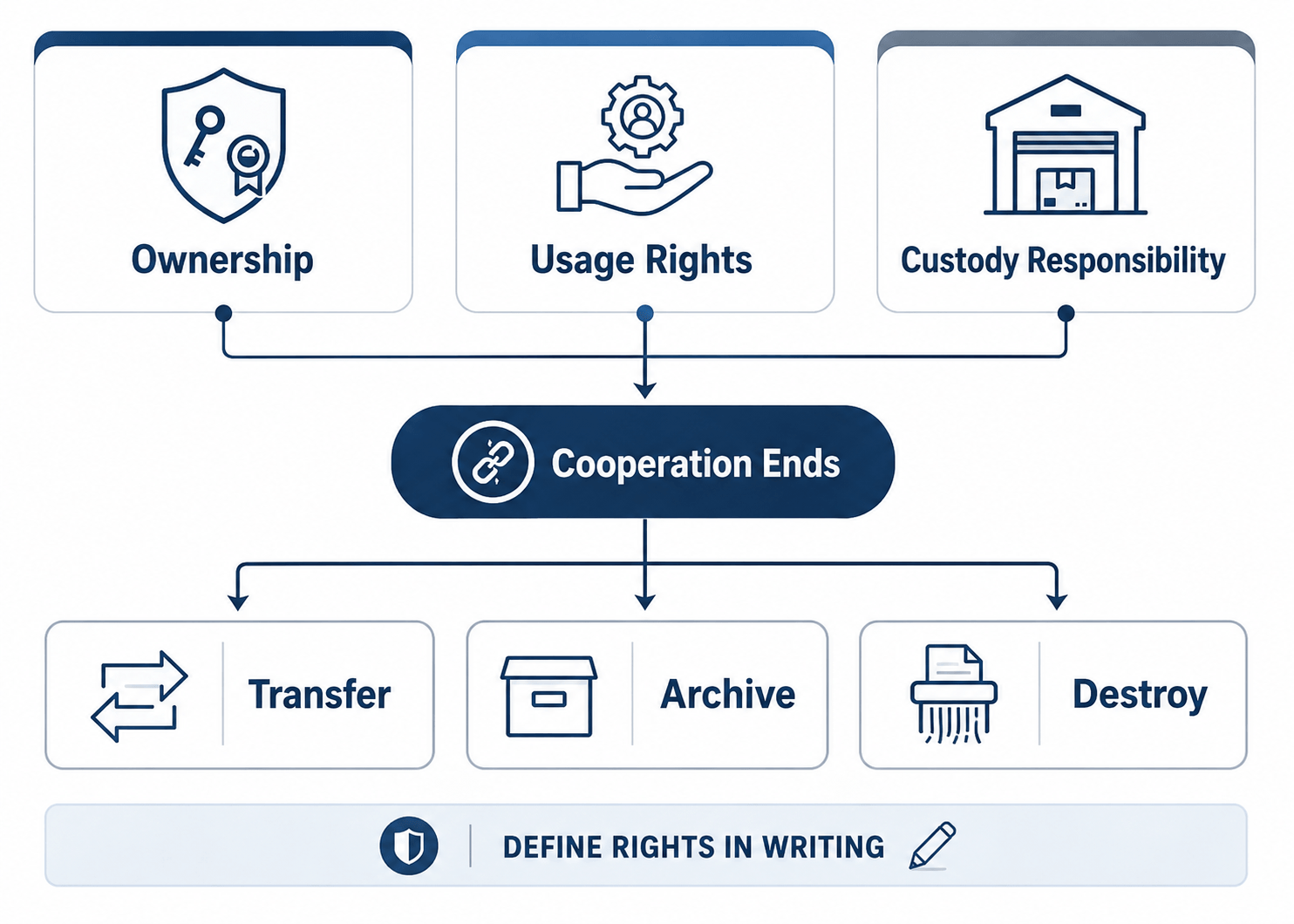
Ownership, usage, and custody must be confirmed in writing. No manufacturer should define those terms unilaterally, and any partner who resists putting them in the contract is telling you something.
Recognizing the Risk Signals Before They Cost You
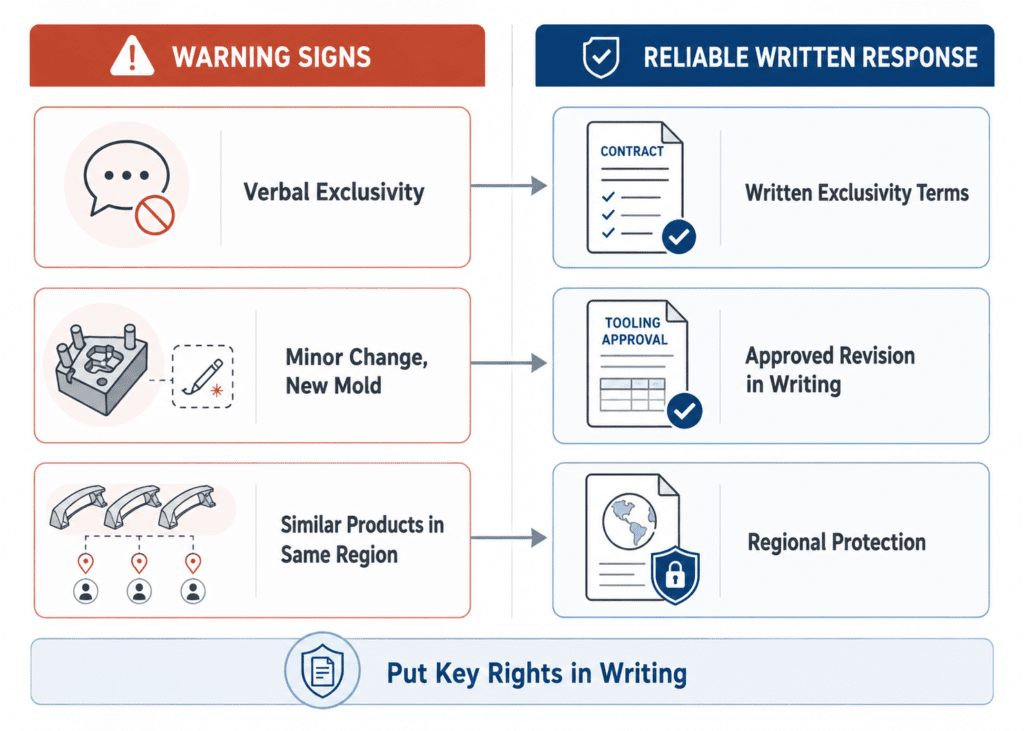
Buyers rarely get burned by an obvious scam—they get burned by soft promises. Watch for these: exclusivity offered verbally with no written scope; a willingness to “slightly change the look” and re-cut a mold to dodge a commitment; and one factory quietly serving several brands in the same region until everyone’s catalog looks identical.
That last point is a fair question to ask any China carbon fiber manufacturer: if you serve many brands, how do you keep our products from overlapping? The defensible answer is not “we’d never do that.” It is a method—separating clients through product mix, custom detailing, finish, project confidentiality, and positioning, deliberately not copying one playbook across every market. A manufacturer focused on long-term partnerships protects each client’s space instead of reselling the same strategy to their competitors. That is the foundation of durable brand differentiation and credible carbon fiber private labeling.
Differentiation That Outlasts a Legal Document
Legal documents set boundaries; they don’t build a moat. The most durable protection is a product competitors can’t easily reproduce—and that is built on the manufacturing floor.
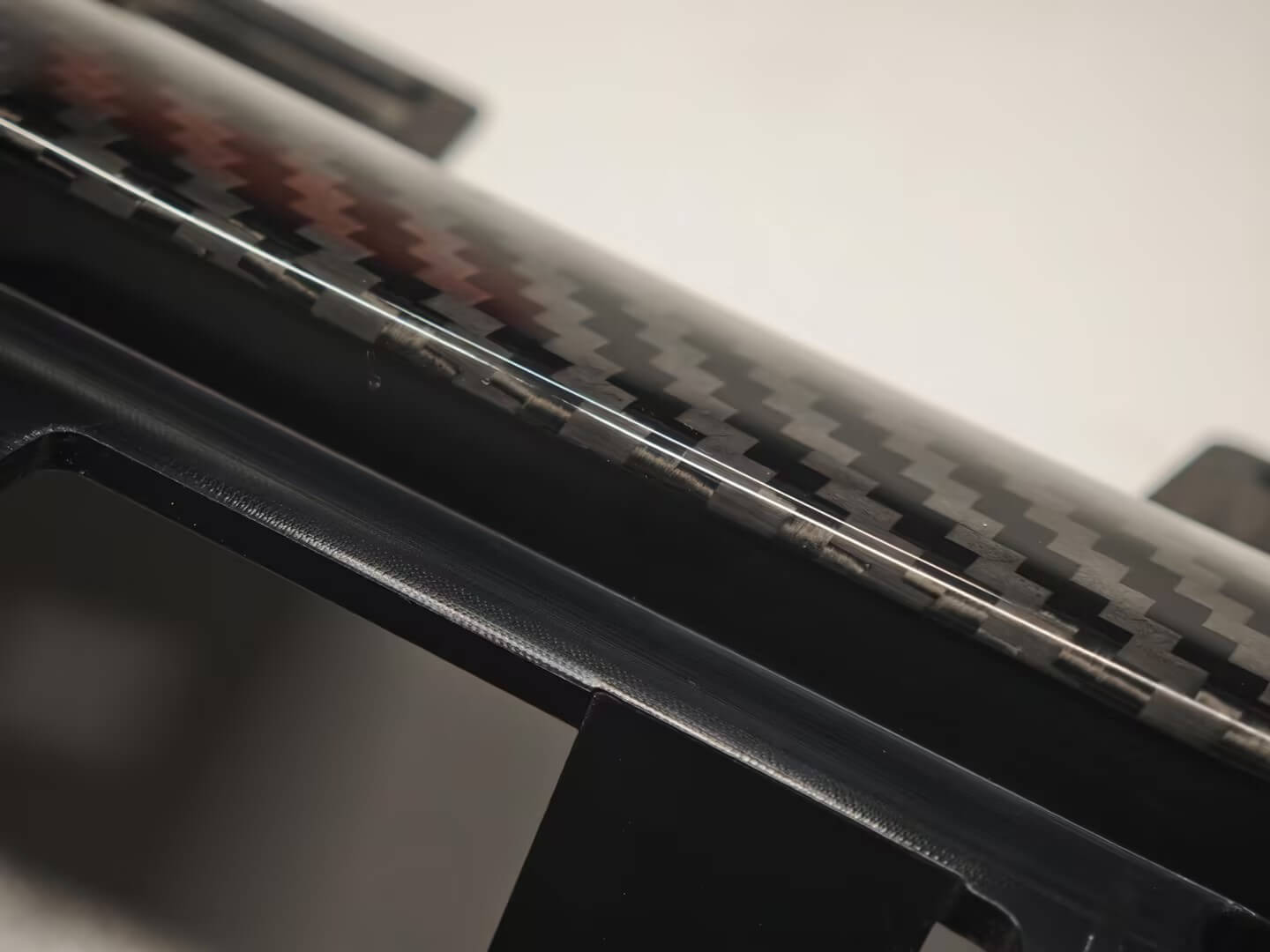
A logo can be copied overnight. A deliberately engineered weave-and-structure signature is far harder to reproduce.
This is where exclusive carbon fiber product development earns its name. Subtle profile adjustments, carbon fiber weave customization, surface treatment, and structural detailing give a part an identity that survives the moment a rival tries to clone it. We’ve taken a cross-border seller who only resold generic Tesla parts and built a defensible line by refining the existing product, providing 3D rendering and reverse engineering, and using a distinct carbon weave to anchor their brand identity—turning a follower into a deeply integrated partner.
The reason this works is end-to-end capability: concept evaluation, 3D design and reverse engineering, engineering optimization, mold development, sample validation, and mass production under one roof, so a differentiated design actually reaches consistent volume. When an ex-racing driver developing an all-carbon steering wheel with a premium marque came to us after several factories failed on fit and hole-position accuracy, we improved the structure and process without altering the exterior—and the program grew from four parts to six and moved into series production. The client accepted a higher price because the capability was real. Custom branded carbon fiber parts mean little without that engineering depth behind them.
Logo and Packaging: The Complete Private-Label Experience
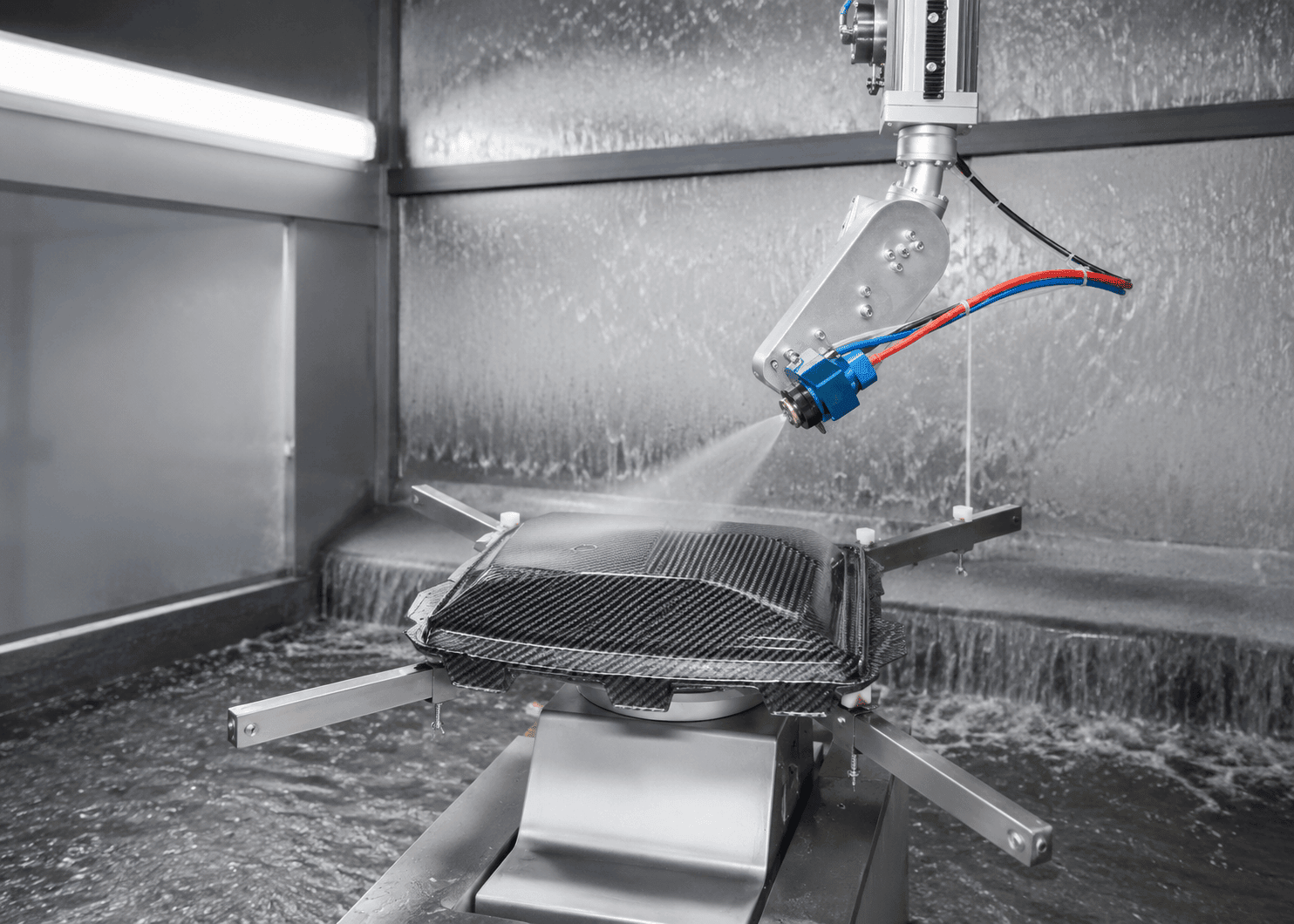
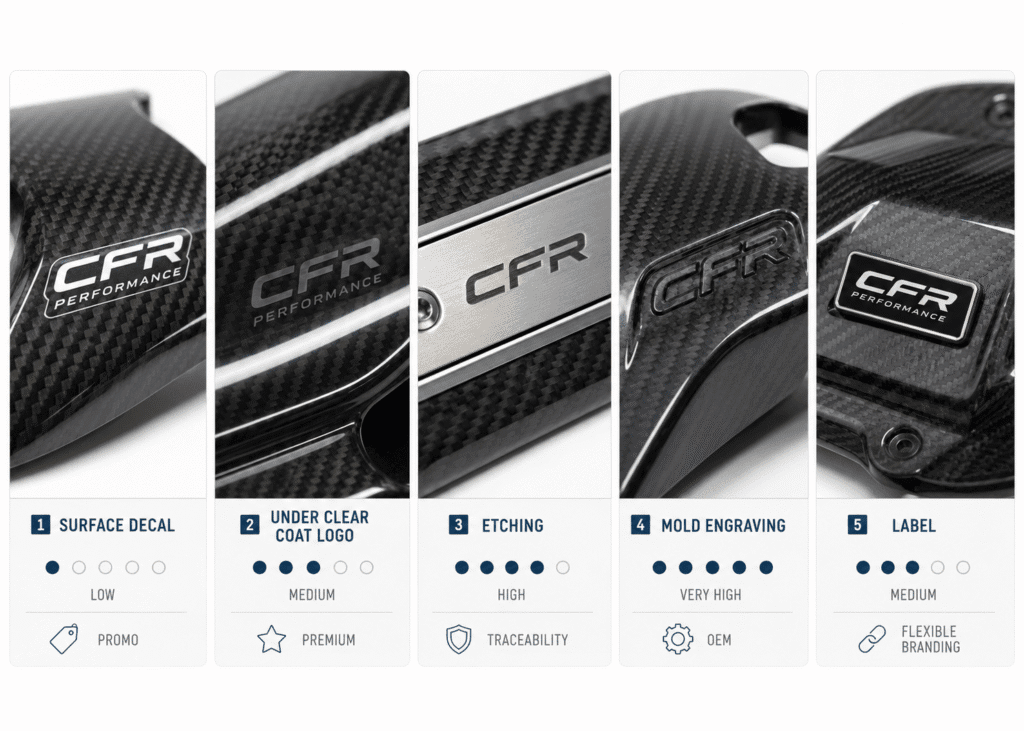
The last mile of private label is where many programs quietly fall short. Carbon fiber logo customization is not a sticker applied at the end of the line. The method—surface decal, under-clear-coat logo, engraving, mold marking, or label—has to be chosen for durability, position consistency, and repeatability at volume, which means the logo belongs in the engineering and consistency review, not in a last-minute finishing step.
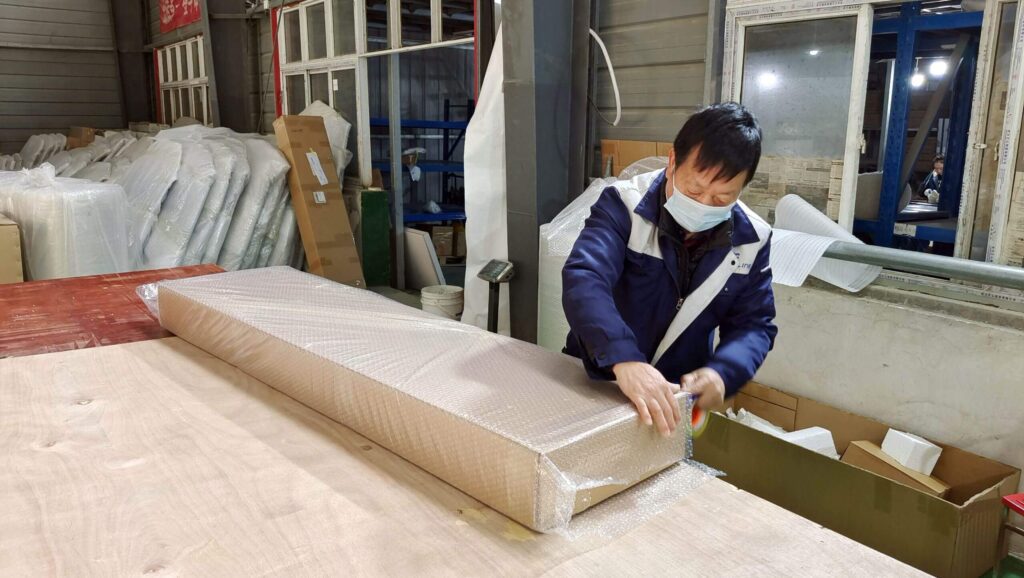
Carbon fiber packaging customization completes the experience. Outer cartons, inner protection, labels, documentation, and SKU identification can all be planned around your brand so the unboxing matches the product. This is what OEM carbon fiber parts with custom logo and packaging should deliver: not a factory-default box, but a coherent branded handover—one of the value-added services that separates a parts vendor from a brand partner. For brands moving from high-end aftermarket reselling to their own identity, that has meant dry-carbon autoclave kits, exclusively developed signature designs, an NDA protecting that work, and brand assets to support the launch.
From Cheap Parts Supplier to Brand-Asset Partner
If you take one thing from this: stop sourcing for the lowest unit price and start selecting for protected brand value. When you evaluate how to choose a private label carbon fiber manufacturer in China, put these questions in your inquiry:
- Will you sign a scoped NDA before I disclose designs, and who else is bound?
- In writing—who owns the mold, and what happens to it when we stop working together?
- How do you keep my products distinct from your other clients in my region?
- Can the logo and packaging be engineered in, not added on?
A partner who answers these clearly is doing private label carbon fiber manufacturing the way it should be done. JCSPORTLINE’s role is exactly that dual position—a manufacturing partner and a brand-protection supporter—producing the parts while supporting NDAs, mold management, design and IP documentation, local legal coordination, differentiated development, and finished logo and packaging. That is what makes a China carbon fiber manufacturer with IP protection worth a long-term relationship.
Frequently Asked Questions
Can you customize carbon fiber products for B2B projects?
Yes. We support custom development based on your design concept, sample, 3D data, performance target, brand positioning, and production requirements. Customization can cover structure, material, weave, finish, logo, packaging, and manufacturing process.
Do you support OEM and ODM services?
Yes. We support OEM and ODM carbon fiber manufacturing for global brands, distributors, and product developers—including private-label production, exclusive design development, custom packaging, logo solutions, and project-based engineering support.
How do you protect a client’s original design?
For original custom projects, we can sign a carbon fiber NDA agreement and define project ownership, tooling use, and confidentiality requirements. Where needed, we can support clients with China-based IP protection resources to help reduce the risk of copying through other suppliers.
Can you help with logo and private-label branding?
Yes. We support carbon fiber logo customization through surface decals, under-clear-coat logos, engraving, mold marking, and labels, plus custom packaging. The best solution depends on finish requirements, durability, MOQ, and production process.
Do you charge customs fees for international orders?
Customs duties, taxes, and import fees depend on the destination country, shipping terms, and local regulations. We can agree on terms such as EXW, FOB, or DDP before shipment so cost responsibility is clear.