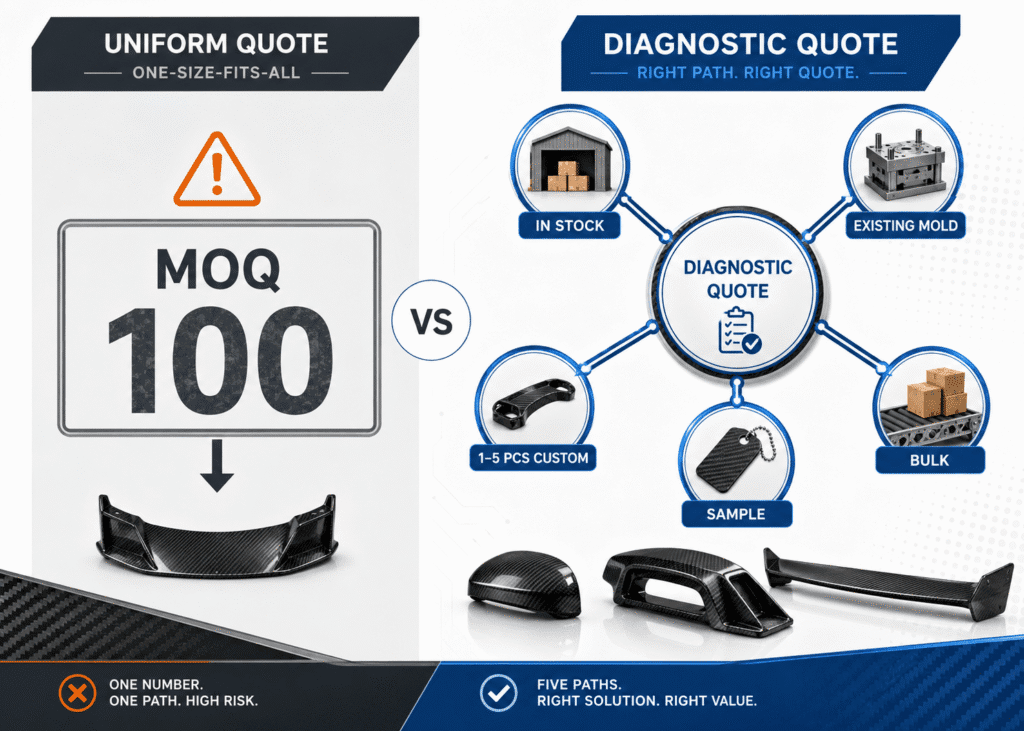
If you have ever asked a supplier “what is your carbon fiber MOQ?” and received a single number with no follow-up questions, treat that answer as a warning sign, not a convenience. The same applies to carbon fiber lead time. A factory that quotes one universal figure—before knowing whether your part is in stock, already tooled, or a brand-new custom design—is either guessing or setting you up for a delay.
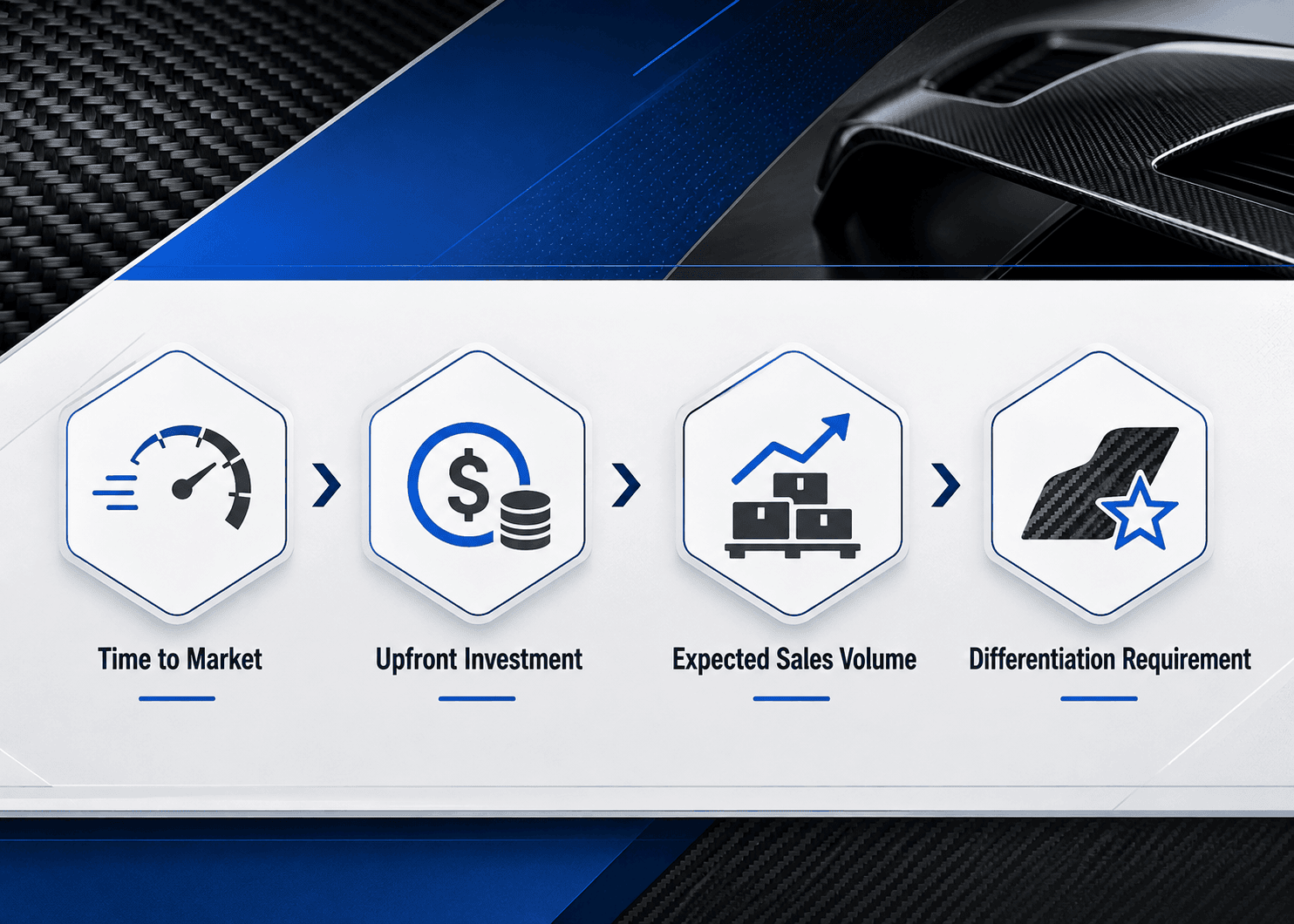
The cost of that guess lands on you. A dealer who misses the spring tuning season loses the ad budget already spent. An e-commerce seller whose listing goes out of stock watches the ranking collapse. A brand that planned a launch around a verbal promise ships nothing. For procurement managers, distributors, and product development teams, the real question is never “what is the carbon fiber minimum order quantity”—it is “which production path does my project belong to, and what does that path actually require?”
This article breaks down the five product states that determine MOQ and lead time, what 1–5 piece development really involves, how bulk capacity should be verified, and exactly what to send a supplier to get a quote you can plan a business around.
Why There Is No Single Answer to Carbon Fiber MOQ
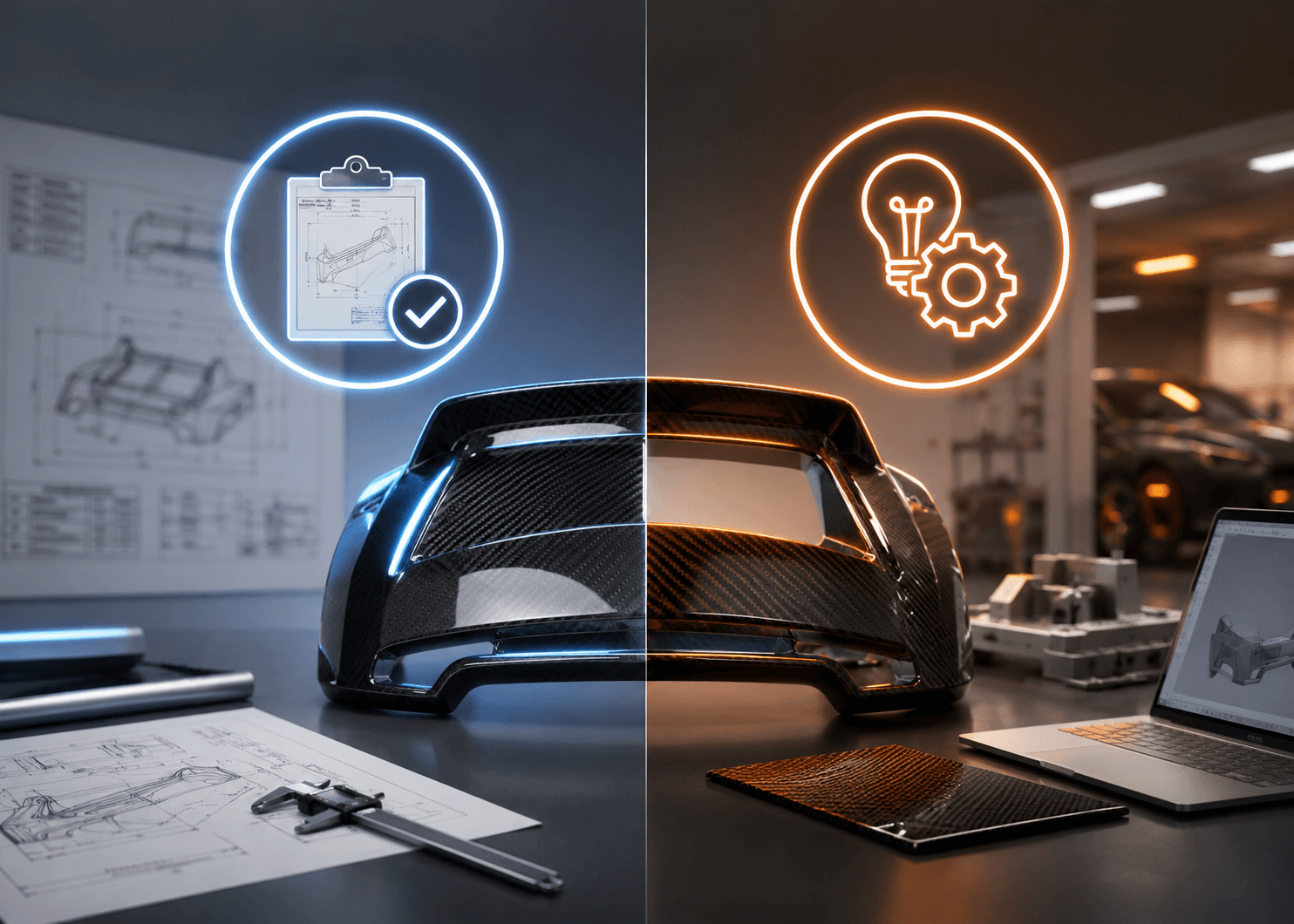
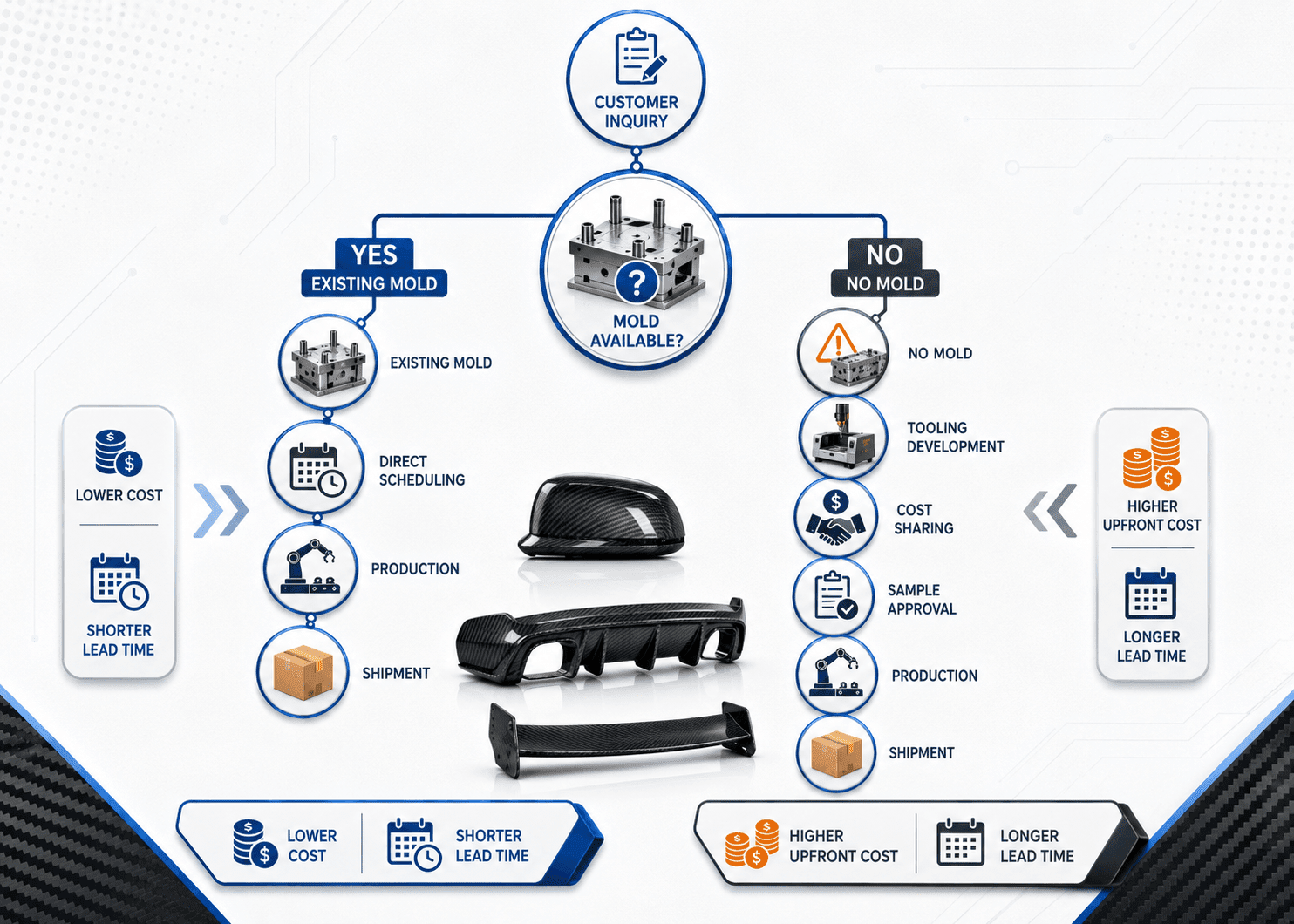
The dividing line in every carbon fiber MOQ discussion is the mold. Once tooling exists, your order follows marginal-cost logic: material, lay-up labor, curing, finishing, QC. Before tooling exists, your order follows development-cost logic: engineering, carbon fiber tooling cost, fitting validation, and process setup must be absorbed somewhere—either in a higher unit price or a separate development fee. A supplier who quotes a custom carbon fiber parts MOQ without first asking about mold status has skipped the only question that matters.
Every inquiry falls into one of five product states across the full range of carbon fiber solutions:
| Product State | MOQ Logic | Lead Time Logic | Typical Buyer |
| Website product, in stock | From 1 piece | Ship from warehouse after stock confirmation | Dealers, e-commerce sellers |
| Website product, made to order | Low — mold already exists | Production slot + standard process cycle, confirmed per mold status | Repeat-order dealers |
| 1–5 piece new custom development | Reviewed case by case | Development phases drive the schedule, not quantity | Custom brands, show-car builders |
| Sample / validation build | 1–2 pieces | Depends on tooling route and material readiness | OEM/ODM development teams |
| Bulk production (100+ pieces) | Volume-based pricing | Determined by mold count, capacity, and season — not promises | Distributors, brand owners |
One point worth stating plainly: a product page on a website is not a stock guarantee. Some popular items sit in overseas or China warehouses as carbon fiber parts in stock; others exist as proven molds awaiting a production order. The two have completely different lead times, and you are entitled to ask which one you are buying.
In-Stock Parts and Repeat Orders: The Fastest Path
For dealers and distributors, the fastest path runs through products that are either physically stocked or already tooled. The correct question is not “is this available?” but “how many sellable units are in which warehouse right now, and if I exceed that, what is the carbon fiber supply lead time for the next production run?” A serious supplier answers both halves; a vague one answers only the first.
Repeat orders against existing molds skip every development step—the order goes straight into production scheduling, which is why this path carries the lowest MOQ and the most predictable carbon fiber parts lead time of any custom-capable route.
This path also scales down further than most buyers expect. A Japanese auto-parts dealer came to JCSPORTLINE with no inventory capacity, small initial volumes, and a cautious approach to risk—effectively asking about a carbon fiber MOQ for small business. We started them on dropshipping through our value-added services: zero-inventory market testing against our stocked products. As sales grew, the relationship moved through stable supply at volume pricing, then a regional distribution agreement, and finally OEM/ODM development for their own local brand clients. That progression—from one-piece dropship orders to a custom product line—is only possible when the supplier treats MOQ as a stage in a growth path rather than a gate.
1–5 Piece Projects: Low-Volume Development Done Right
This is where most factories say no. A 1–5 piece full-vehicle kit demands real engineering investment against a tiny order, so traditional volume-oriented suppliers either refuse or quietly deprioritize the project. The buyers asking for low-volume carbon fiber production—custom brands, show-car builders, early-stage product teams—are routinely told their project is “too small to be serious.”
Our position is the opposite, with one honest caveat first: in low-volume carbon fiber manufacturing, unit cost is higher than mass production. Engineering hours, fixtures, and setup do not disappear because the quantity is small—they are divided across fewer parts. That is cost structure, not markup, and a supplier who promises mass-production pricing on 3 pieces is hiding the cost somewhere you will find later.
The real objective of a low-volume project is not forcing the MOQ down. It is reducing first-development risk so the parts fit, the design is validated, and the tooling can be reused. A Canadian brand specializing in high-end custom wide-body kits—typical demand of 1–5 sets per vehicle model—shows what low-volume carbon fiber parts production looks like when it is structured properly:
- Real-vehicle data first. We arranged a one-month vehicle rental for full data acquisition, building the prototype foundation from the actual car instead of drawings. Development accuracy goes up; late-stage rework risk goes down.
- Prototype iteration on the car. Multiple rounds of test fitting refined structure, mounting logic, and gap control. A compact R&D team turns each iteration around fast—small batch does not mean loose tolerances.
- Mold replication after sign-off. Once the prototype was confirmed, we converted it into reusable tooling, turning carbon fiber prototype production into repeatable small-batch delivery. Key milestones were documented on video, which the client also used for pre-launch marketing.
The first set delivered to spec, and the client added three more full-vehicle projects within a year. Just as important: because prototype and replication happened under one roof, there was no carbon fiber sample to mass production handoff gap—no second supplier reverse-engineering someone else’s sample, no re-validation cost. The same logic applies beyond automotive: powersports, sporting goods, and consumer hardware teams validating a first carbon design face the identical 1–5 piece problem.
Before you commit to a low-volume project, ask three questions: How is the development and tooling fee structured—absorbed in unit price or separate? Will the prototype tooling be reusable for repeat orders? And does the same team handle both prototype and replication?
Bulk Orders: Lead Time Is a Capacity Question, Not a Promise
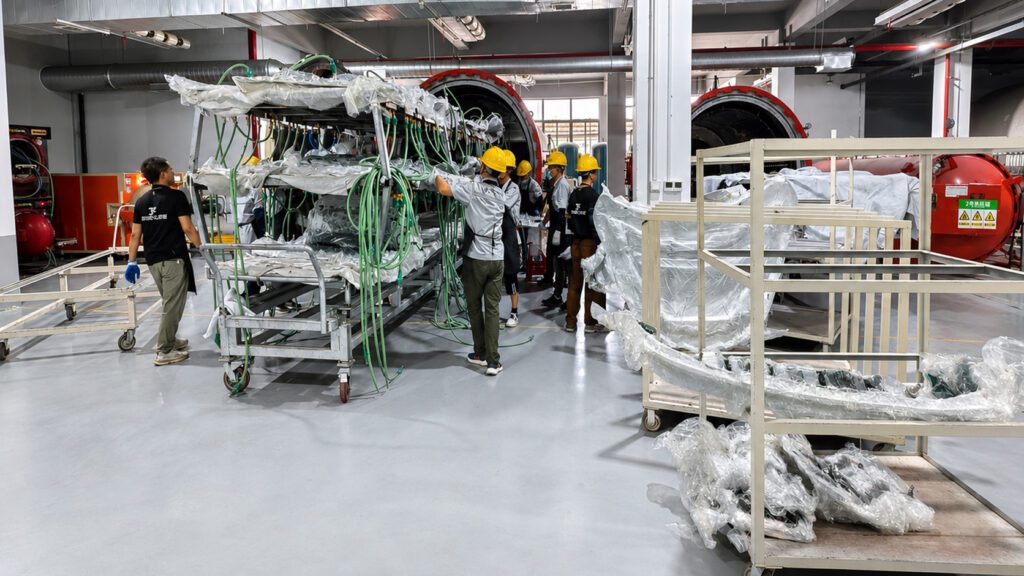
For 100+ piece orders, the most dangerous thing a supplier can give you is a confident date. A bulk carbon fiber production lead time is not a promise—it is the output of a capacity equation: how many molds exist for your part, what each mold yields per day, whether raw material is secured, how curing, surface finishing, and QC are sequenced, and where your order sits in the season’s queue. If a supplier cannot walk you through those variables, the date is decoration.
Three delivery records from our own order book show what happens when the capacity math is changed instead of the promise: a 100-piece order compressed from three months to one, peak-season delivery accuracy raised from 60% to 99%, and an urgent sample program delivered 10 days ahead of plan. Each came from a specific, verifiable mechanism—not a sales commitment.
Single-mold dependency is the failure mode we see most often. A US client’s previous supplier ran one mold set against a high-volume, low-SKU order book; once the mold needed maintenance, production stopped, and a 100-piece order stretched to roughly three months. Our response was structural: we added three new mold sets for their products, granted priority scheduling, and assigned a dedicated team so production continued even during mold servicing. The same 100-piece order shipped within one month. That is how to reduce carbon fiber production lead time—by changing the capacity math behind our carbon fiber production capacity, not the wording of the promise.
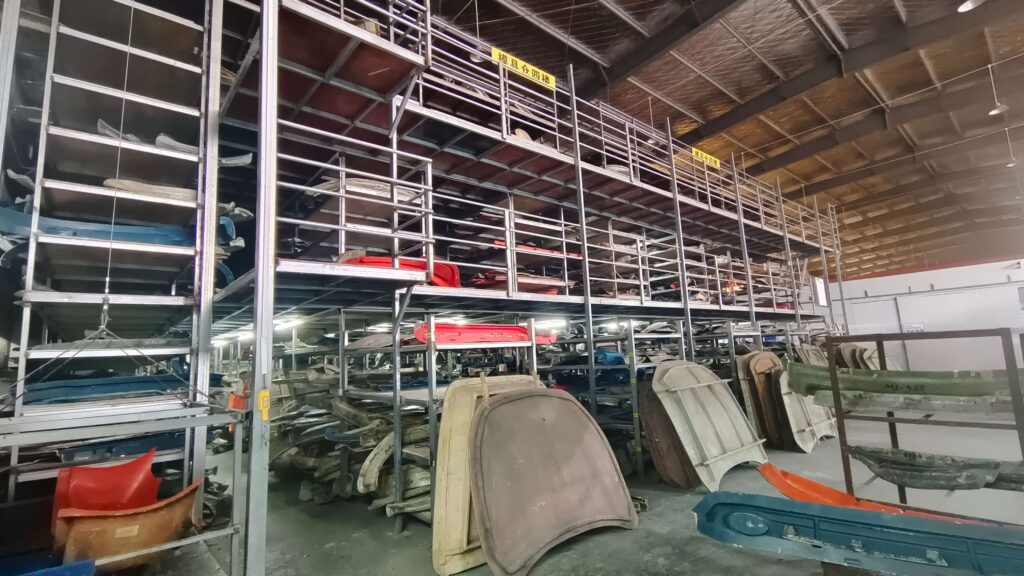
Peak season is the second stress test. A European distributor of Mercedes and BMW exterior parts faced 40–45 day lead times every March–May and September–November because their factory scheduled strictly order-by-order. We restructured the arrangement: annual orders locked three months ahead of peak season, 25% of capacity reserved exclusively for their urgent orders, large orders split into 3–4 staged shipments at 15-day intervals to match store restocking, and a dedicated contact issuing weekly production updates with 7-day advance logistics alerts. Delivery accuracy rose from 60% to 99%. These figures reflect specific project arrangements, not a universal standard—but the mechanisms behind them (capacity reservation, staged delivery, progress alerts) are exactly what you should be demanding in your own bulk carbon fiber production negotiations.
One more concern answered directly: staged shipments do not mean batch-to-batch drift. Consistency in weave alignment, gloss, and fitment comes from running every batch on the same tooling under the same documented process—which is also why mold status is the first thing to verify, not the last.
What to Send a Supplier for an Accurate MOQ and Lead Time Quote
Everything above converges into one practical habit: give complete inputs, demand complete outputs. To get a real custom carbon fiber parts lead time, send your vehicle model or drawings, part dimensions, target quantity, material and process requirements, surface finish, packaging requirements, and your required delivery date. In return, ask the supplier to disclose mold status, monthly capacity for your part, restock cycle if inventory runs out, and—for bulk orders—their staged-delivery and progress-alert plan.
Complete information is what makes acceleration possible. When a client came to us with a hard launch deadline, full specifications let us run mold development and material preparation in parallel, assign a priority production line, and lock key raw materials early. A 60-day plan was delivered in 50 days—10 days ahead of schedule—and the client placed follow-up orders. No supplier can compress a schedule for a project it only half understands.
And if your real constraint is the carbon fiber minimum order quantity itself, say so—the right answer may be starting from stocked products or dropshipping and growing into custom development, rather than forcing a new-tooling project before the market is proven.
Diagnose First, Then Quote
A trustworthy carbon fiber MOQ is the end of a diagnosis, not the start of a sales pitch. The proof is in delivery records, not adjectives: a 100-piece order shipped in one month after adding three mold sets, 99% peak-season delivery accuracy built on reserved capacity and staged shipments, and an urgent program finished 10 days early because mold development and material sourcing ran in parallel. Lead time, handled correctly, is engineering—not optimism.
At JCSPORTLINE, every inquiry begins the same way: confirm whether the product is in stock or already tooled, then build an executable MOQ and carbon fiber lead time plan around your quantity, customization level, and target delivery date—from first prototype through stable volume production, under one roof.
If you are weighing a 1–5 piece development project or planning a 100+ piece order against a hard deadline, send us your drawings, quantity, and timeline. You will get back a production path, not just a number.
Frequently Asked Questions
What is your minimum order quantity (MOQ)?
It depends on product type, process, tooling status, and customization scope. Many custom projects start around a standard MOQ of 20–30 pieces, while very small runs are reviewed separately with adjusted pricing or development costs.
Can you support 1–5 pieces or low-volume development projects?
Yes—reviewed case by case, especially for prototypes, validation builds, show cars, and early-stage product testing. Because engineering and setup resources are still required, unit cost is higher than mass production.
What is the normal production lead time for bulk orders?
It depends on quantity, process, part size, mold availability, finishing requirements, and current capacity. Standard production typically runs about 15–45 days; very large or complex orders may need a longer schedule.
Are all products on the website in stock?
Not always. Popular items may be stocked in our overseas or China warehouses, while others are made to order. If an item is out of stock, production time is confirmed based on the product and order quantity.
How do you reduce stock-out risk for dealers or distributors?
For long-term B2B partners, we can set up forecast planning, semi-finished inventory, staged delivery, overseas warehouse stocking, and priority production plans for high-demand products.