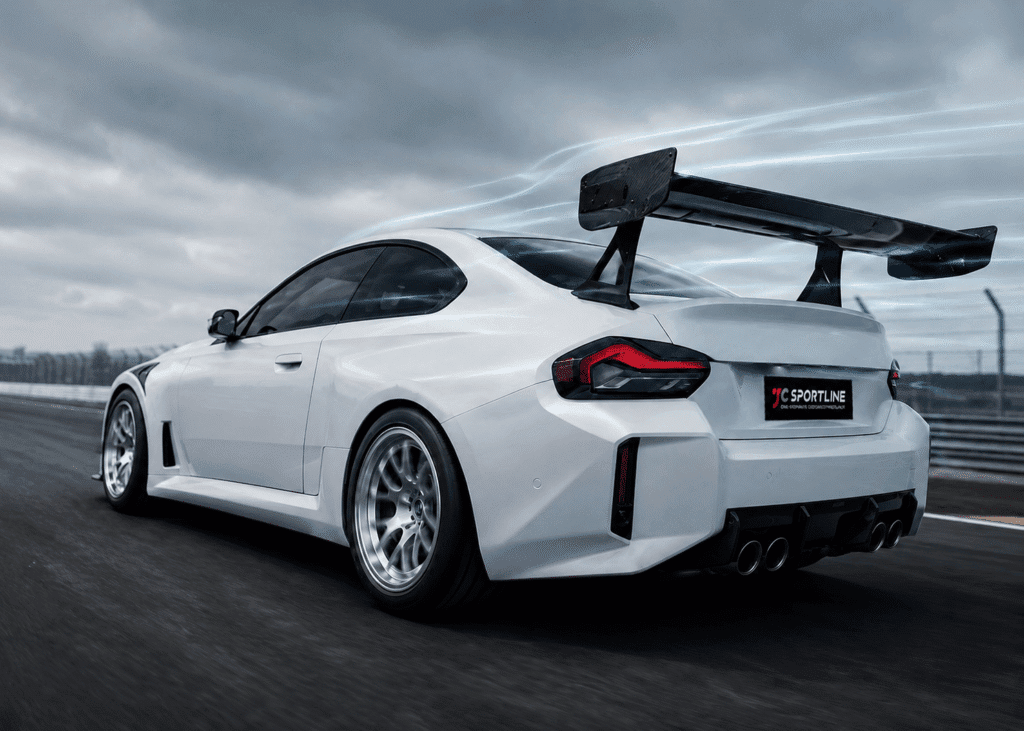
A rendering that looks fast and a sample that photographs well are not the same as a product that bolts on straight, survives a season of high-speed loading, and looks identical across 200 units. Most buyers who have been burned by a cheap supplier already know this. They received a wing that resembled the concept, then watched it fail in the real world — misaligned mounting holes, unstable brackets, weave and clearcoat drifting batch to batch. What a real project needs is not another quote. It is a partner who can judge whether a design can be built, how to build it consistently, and how to control the risk at volume. That judgment is the entire point of professional carbon fiber rear wing development.
Why a Custom Carbon Fiber Rear Wing Is an Engineering Project, Not Just a Part
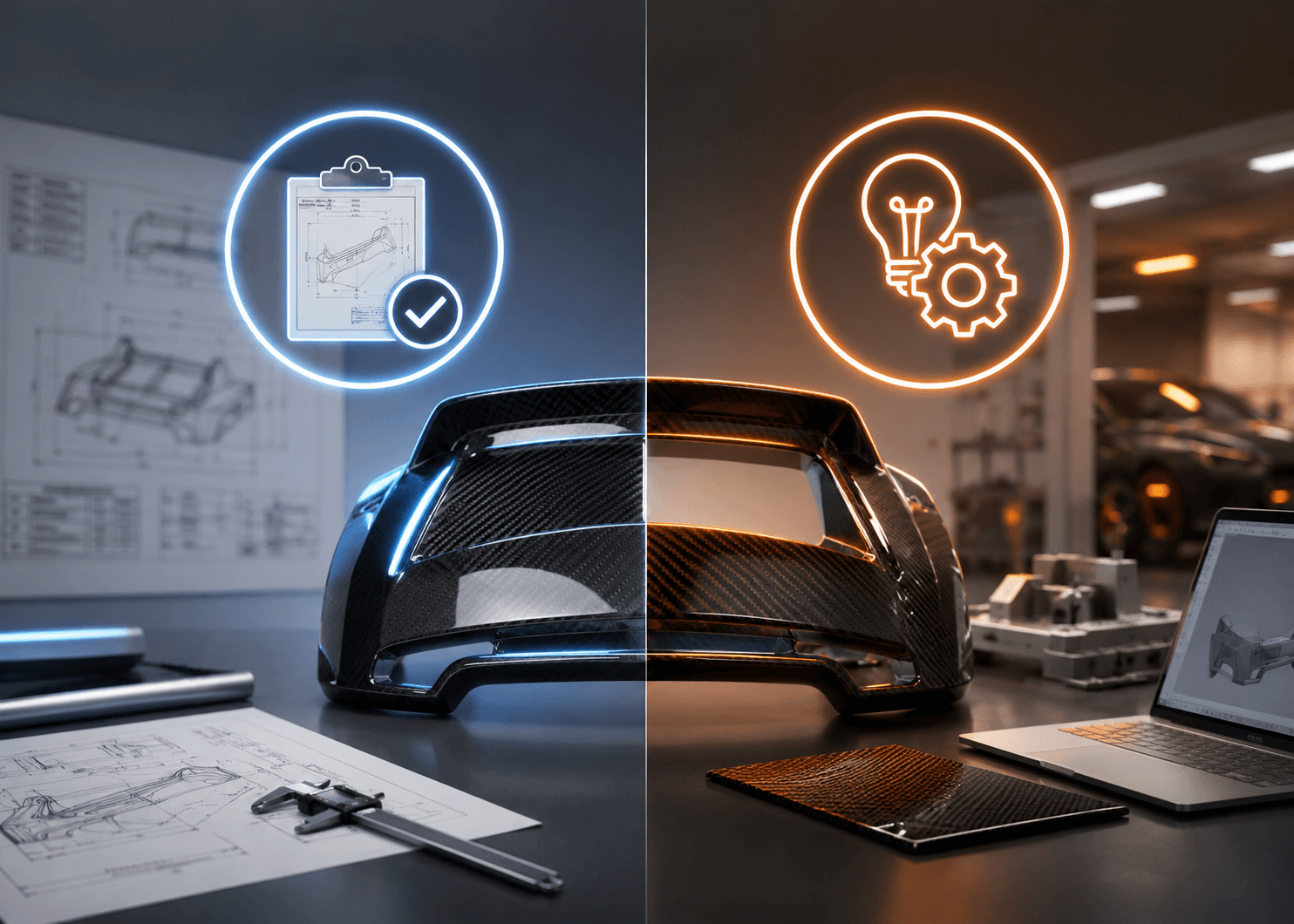
A Custom Carbon Fiber Rear Wing is not a cosmetic shell. It is where five disciplines have to agree with one another: aerodynamic logic, structural engineering, composite process, mold split design, and batch-to-batch consistency control. A low-price shop usually covers exactly one of these — copying the outer shape — and leaves the other four to chance. A carbon fiber racing rear wing that passed a single hand-built sample can still come apart in production for precisely that reason.
For a performance aerodynamics brand, a motorsport team, or an aftermarket shop building its own identity, the wing carries the brand at 200 km/h. A custom motorsport rear wing that flexes, whistles, or arrives with a 2 mm gap at the mounting face costs more in reputation than a slightly higher unit price ever will. Treating the wing as a project — not a part — is the position that protects you.
From Concept to Mass Production: The End-to-End Development Workflow
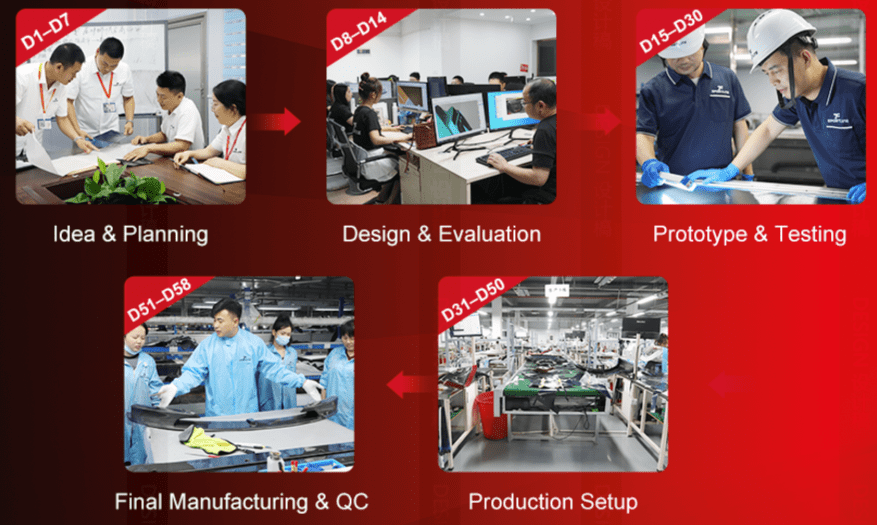
Whether carbon fiber rear wing development for racing applications succeeds comes down to sequencing. Skip a step and the cost resurfaces later as rework. A disciplined program runs the path below, which JCSPORTLINE compresses into a standardized 58-day workflow backed by a dedicated 1,400 m² R&D center and a 98% on-time delivery rate.
| Stage | What it locks down |
| Requirement & vehicle confirmation | Target platform, performance goal, budget, volume |
| 3D scanning / reverse engineering | Real mounting geometry, not assumed CAD |
| Appearance co-creation | The brand’s visual identity, frozen before tooling |
| CFD direction evaluation | Airflow and downforce intent (optional service) |
| Structural optimization | Layup, bracket logic, high-speed safety |
| Material & process selection | Dry vs wet, prepreg, autoclave, RTM |
| Sample trial fitting | Real fitment on the real car where available |
| Hole-position verification | The detail that exposes weak suppliers |
| Surface standard sign-off | Weave, gloss/matte, clearcoat reference |
| Batch production validation | Proving sample quality survives volume |
Most custom carbon fiber rear wing for motorsport projects never receive this map from a copy-and-cast vendor. Procurement leads and team principals can use it as a direct checklist to test any supplier’s depth — and it is the backbone of JCSPORTLINE’s complete carbon fiber rear wing development support.
CFD & Downforce: Validating Aerodynamics Before You Cut a Mold
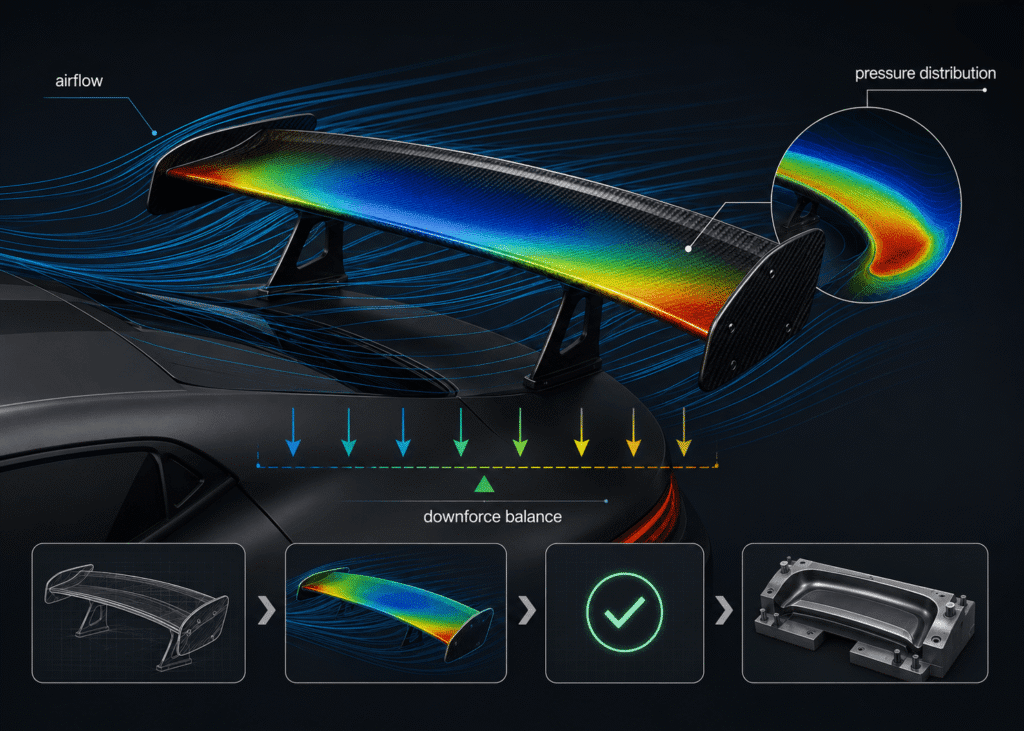
Cutting a mold before the aero intent is understood locks in an expensive mistake. Proper CFD rear wing design evaluates airflow behavior, pressure distribution, and downforce balance while the geometry is still editable. The aim of rear wing downforce optimization is not a larger number on a slide — it is making the wing do what the brand claims without upsetting the car’s balance at speed.
JCSPORTLINE provides CFD analysis for carbon fiber rear wing design as an optional engineering service, quoted separately by project scope, since simulation depth scales with complexity. We do not publish or invent downforce figures for a design we have not tested — for an aero engineer or a racing project, fabricated numbers are worse than none. CFD is a risk-reduction tool used before prototyping, so the design you sign off is the design that performs.
Structural Validation: Why High-Speed Reliability Is Non-Negotiable
A rear wing carries sustained aerodynamic load, and insufficient structure is a safety and brand-liability issue, not a cosmetic one. Serious structural validation for custom carbon fiber rear wing programs sits on finite element analysis (FEA), not on a fabricator’s feel for the part. JCSPORTLINE runs the standard structural load cases on composite programs — free and constrained modal frequency, axial tensile stiffness, bending stiffness, and bending strength to failure — so the layup and bracket design are proven before tooling, not discovered after a field failure.
The engineering principle is the point: a correctly designed composite part is not merely lighter than its metal equivalent — with the right fiber orientation and ply schedule it can also be stiffer and more dynamically stable. For a carbon fiber racing rear wing, that combination is exactly what high-speed reliability demands, and it is out of reach for a shop that only knows how to copy a shape. It is also what separates a credible carbon fiber rear wing manufacturer from a fabricator.
Material & Process Selection: Dry Carbon, Wet Carbon, Prepreg, Autoclave, RTM
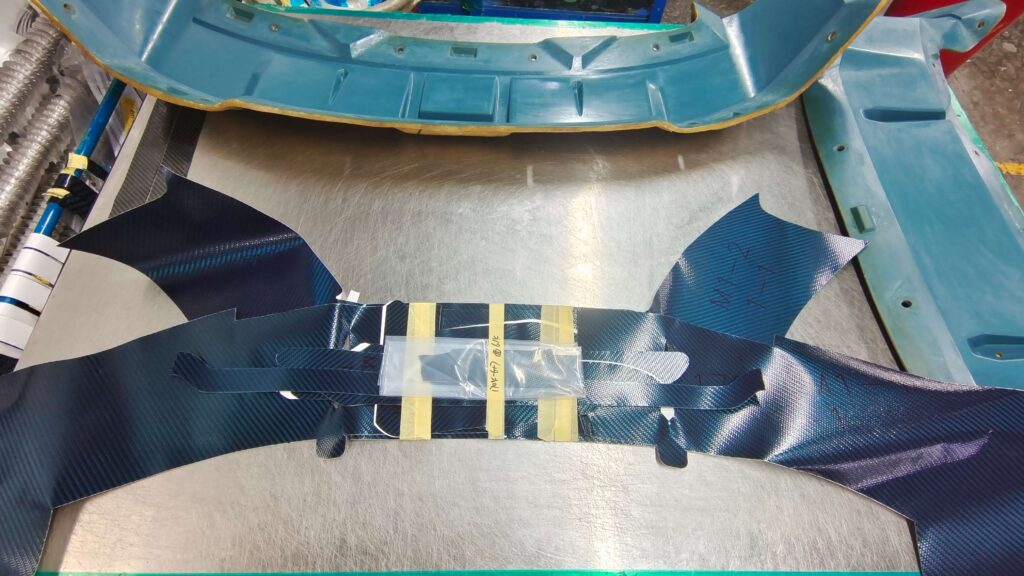
There is no single correct process, and any supplier who pushes everyone toward the same one is optimizing for their own factory, not your project. The right route for a custom carbon fiber rear wing for performance cars depends on performance target, appearance standard, volume, and budget.
| Process | Strength | Best fit |
| dry carbon fiber rear wing (prepreg + autoclave) | Best surface, lowest void content, highest strength-to-weight | Premium brands, motorsport, show-grade weave |
| wet carbon rear wing (vacuum-bagged) | Balanced cost and speed | Volume aftermarket, budget-aware launches |
| RTM / vacuum infusion | Repeatable at higher volume | Programs prioritizing batch consistency |
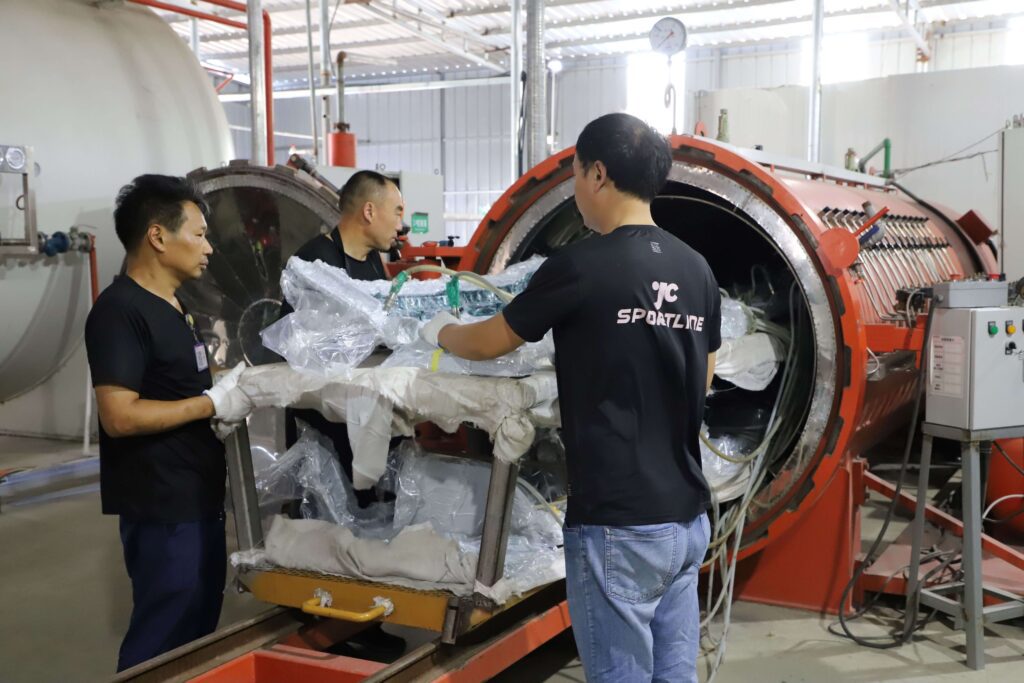
The honest answer to dry carbon vs wet carbon rear wing is a trade-off, not a winner. JCSPORTLINE supports prepreg, autoclave, RTM, and vacuum infusion in-house, so carbon fiber rear wing mold development is matched to the chosen process from day one rather than forced afterward. A brand chasing a flawless forged-weave look and a shop launching a price-competitive line get different — and both correct — answers, including a full autoclave dry carbon racing rear wing route for the top tier.
From Sample Approval to Consistent Mass Production — and Protecting Your Design
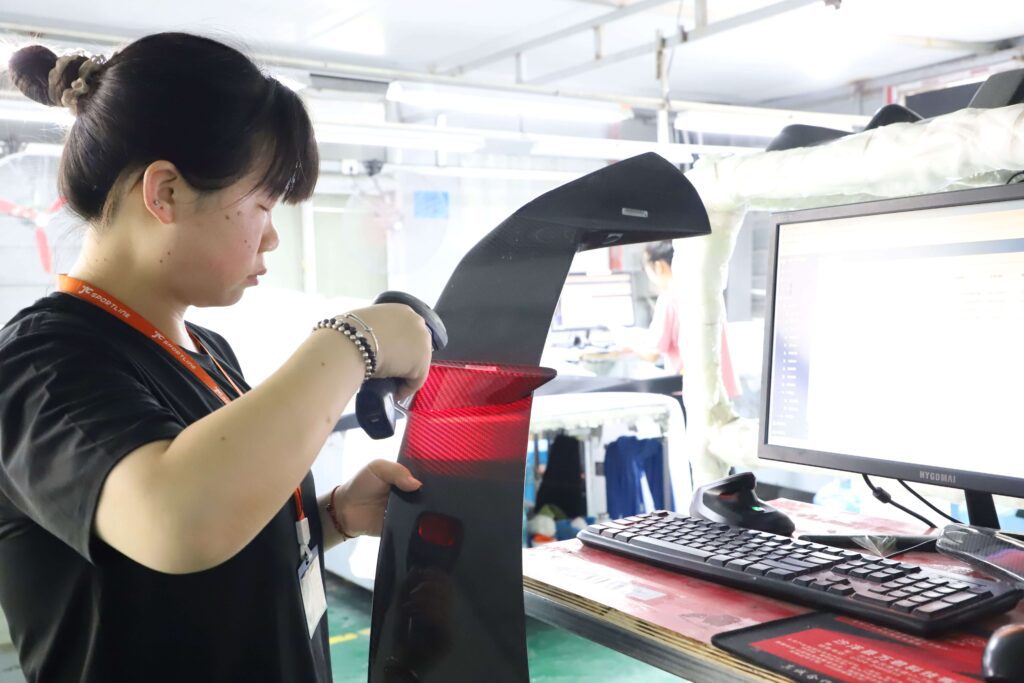
Sample approval is the start of the hard part, not the finish. Batch consistency in weave, gloss, and hole position comes from process SOPs, mold accuracy, and final QC — and from a partner that signs an NDA to keep an exclusive design exclusive. This is where an OEM carbon fiber rear wing program separates a real manufacturer from a copy shop.
- A U.S. aftermarket shop moving from a general tuning service into a high-end carbon brand partnered with us on dry-carbon kits and exclusive signature aero parts under NDA, with development on the 58-day cycle. In that program, fitment reached over 99%, returns fell from 12% to under 1%, kit-and-wing order volume grew 280% year over year, and high-end custom work rose from 15% to 65% of revenue — roughly doubling the business’s valuation.
- A motorsport-influencer client arrived with a DTM-style wide-body concept but no design team and no way to reach production. Through full-vehicle 3D scanning, a month of hand-built prototyping, and a vacuum wet-carbon route chosen to balance cost against the target finish, two finished sample sets were delivered to a major international trade show on schedule — turning an enthusiast’s concept into a branded, production-ready line.
- A consistency-and-structural-optimization program reworked a complex multi-piece carbon assembly without altering its appearance; the client was satisfied enough to expand from four parts to six and move into volume production.
- A UK championship racing project demanded race-grade fitment precision and weight control on a compressed timeline; iterating mounting positions with 3D-printed checks, the program delivered inside its window.
How to evaluate a supplier: judge a carbon fiber rear wing manufacturer on long-term consistency, real-car fitment, structural reliability, batch repeatability, and design protection — not on the lowest opening quote. That is what separates a one-time sample from a sellable product line, and it is the standard behind every JCSPORTLINE OEM carbon fiber rear wing program.
Conclusion
A higher upfront development cost is not a premium for prettier carbon — it is the price of removing downstream rework, complaints, returns, and brand damage. A Custom Carbon Fiber Rear Wing that survives the road, fits like an OE part, and ships identically every batch is an engineering outcome, not a casting outcome. The brands that win build the wing as a project: aero validated, structure proven, process chosen on purpose, production controlled. If you have a concept or a design that refuses to scale, that is exactly the gap carbon fiber rear wing development is built to close.
FAQ
How do you control fitment accuracy for custom automotive carbon fiber parts?
Through 3D scanning, reverse engineering, CAD data comparison, CNC mold accuracy, bracket and mounting-point verification, trial fitting where a vehicle is available, and final inspection before delivery.
Can JCSPORTLINE develop custom carbon fiber rear wings?
Yes. We support custom rear wing development for performance brands, motorsport projects, and aftermarket programs — design review, structure planning, mold development, dry or wet carbon production, mounting solutions, and surface finish customization.
Can you support CFD simulation for aerodynamic carbon fiber parts?
Yes. For rear wings, splitters, diffusers, and aero kits we provide CFD simulation and aerodynamic validation to evaluate airflow, pressure distribution, and downforce balance before prototyping. It is an optional engineering service, quoted separately by project scope.
Dry carbon or wet carbon — which is right for my rear wing project?
Dry carbon (prepreg + autoclave) gives the best surface and strength-to-weight for premium and motorsport use; wet carbon balances cost and speed for volume aftermarket lines. We recommend the route based on your appearance standard, volume, and budget.
How do you guarantee batch quality and protect my exclusive design?
Quality is controlled through material selection, process SOPs, mold accuracy, production inspection, surface standards, fitment checks, and final QC. Inspection standards are defined before production, and exclusive designs are protected under NDA.