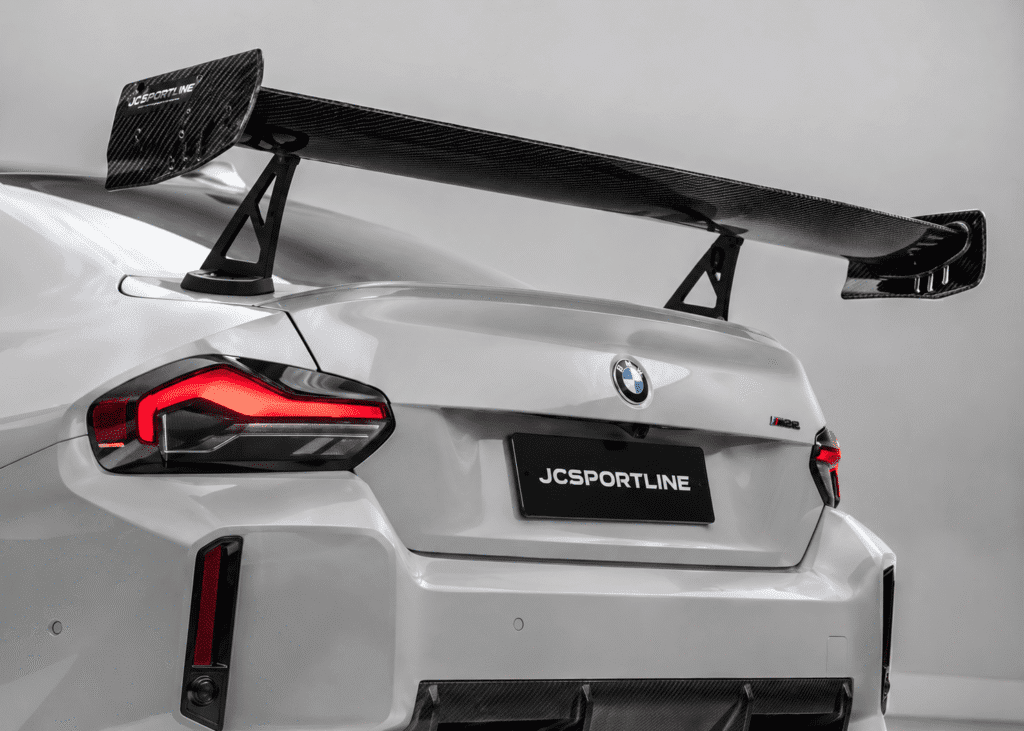
A carbon fiber rear wing is a better solution for B2B buyers sourcing lightweight aero parts because it can combine low weight, high stiffness-to-weight performance, premium motorsport appearance, aerodynamic design flexibility, and vehicle-specific fitment. For racing, performance vehicles, and premium modification projects, the rear wing is not only a styling accessory. It is a functional aerodynamic component that must support stability, downforce control, mounting strength, weather resistance, and repeatable production.
For procurement managers, product managers, R&D engineers, distributors, tuning brands, and motorsport teams, choosing a rear wing only by appearance is risky. A wing may look aggressive, but if it is too heavy, poorly reinforced, weakly mounted, or not validated for high-speed use, it may increase installation complaints and reduce buyer confidence.
A reliable carbon fiber racing rear wing should be evaluated by its weight, structure, aerodynamic logic, fitment accuracy, bracket design, surface finish, UV resistance, testing evidence, and supplier capability.
Why Traditional Rear Wings Fail in High-Performance Applications
Traditional metal, ordinary plastic, and low-end aftermarket rear wings can work for some basic appearance upgrades. However, high-performance applications create stricter requirements.
Excessive Weight
Metal rear wings can be strong, but they often add unnecessary weight. A heavy rear wing may increase the load on the vehicle body and mounting points. For performance vehicles, unnecessary mass can affect response, handling feel, and product positioning.
For B2B buyers selling to motorsport or premium tuning markets, weight is not just a technical detail. It is part of the product value.
Insufficient Stiffness at Speed
A rear wing experiences airflow pressure, vibration, and mounting loads. If the structure is not stiff enough, deformation may occur at high speed. This can reduce aerodynamic consistency and affect driving stability.
Ordinary plastic wings may be suitable for decorative use, but they may not be appropriate for high-speed or track-focused applications unless the material, structure, and mounting system are engineered for that purpose.
Poor Appearance and Surface Texture
Low-end products may have rough surfaces, uneven textures, visible seams, or inconsistent finishing. This reduces the premium feel of the vehicle and makes the product harder for distributors and tuning shops to position as a high-value upgrade.
Poor Fitment and Installation Difficulty
Rear wings with inaccurate brackets, unclear mounting points, or poor vehicle-specific adaptation create problems for installers.
Common issues include:
- uneven gaps;
- bracket mismatch;
- drilling errors;
- difficult alignment;
- damage to the original vehicle;
- longer installation time;
- higher after-sales pressure.
For B2B buyers, poor installation experience can increase returns, complaints, and dealer dissatisfaction.
Weak Weather Resistance
Rear wings are exposed to sunlight, rain, cold, heat, and road conditions. Without proper coating and curing control, long-term use may lead to aging, cracking, fading, coating failure, or surface degradation.
Not every metal or plastic rear wing is low quality. However, for premium racing and performance applications, buyers should compare weight, rigidity, fitment, weather resistance, and aerodynamic validation before choosing a material.
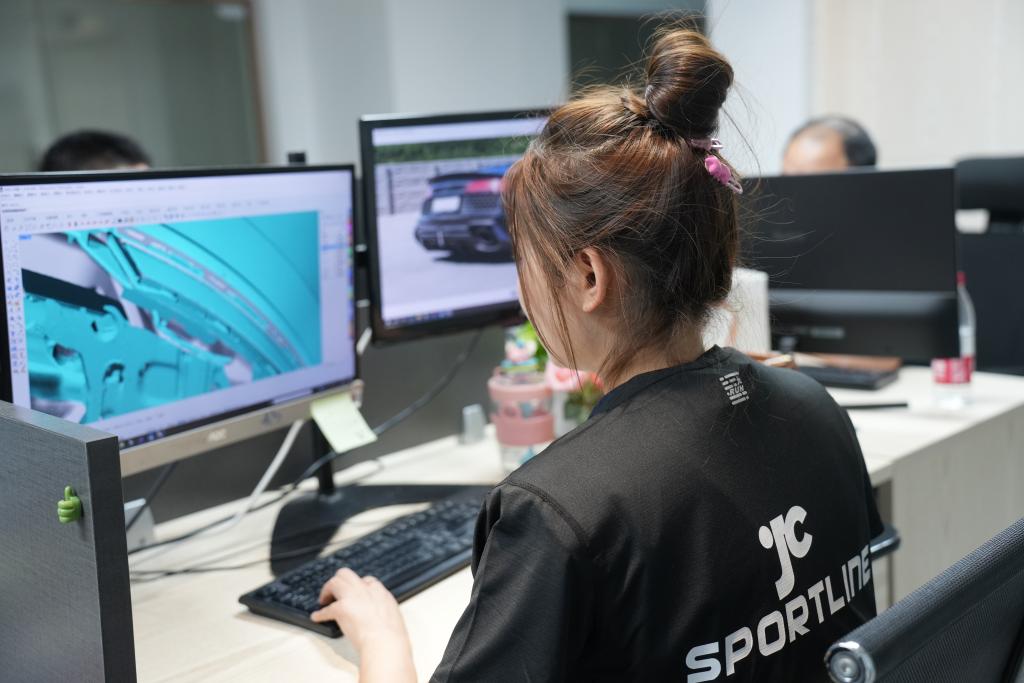
Why Carbon Fiber Racing Rear Wing Design Matters for B2B Buyers
Carbon fiber is suitable for performance rear wings because it provides strong stiffness-to-weight potential while supporting premium visible surfaces and complex aerodynamic shapes.
A carbon fiber wing can help brands build products for:
- racing applications;
- track-day vehicles;
- performance tuning packages;
- premium aftermarket upgrades;
- private-label aero kits;
- OEM and ODM performance projects.
More Than an Aggressive Shape
A rear wing should not be designed only to look aggressive. Its value depends on how the shape interacts with airflow and how it is mounted to the vehicle.
Important design factors include:
- wing profile;
- curvature;
- wing width;
- mounting height;
- installation position;
- side plate design;
- angle adjustment;
- airflow management;
- downforce target;
- drag control.
A poorly designed wing may create drag without meaningful stability benefits. A properly engineered wing uses shape, angle, and mounting position to support the vehicle’s performance goals.
Aerodynamic Results Depend on the Vehicle
A well-designed carbon fiber racing rear wing can help improve high-speed stability when the wing profile, mounting angle, and vehicle setup are properly matched.
However, aerodynamic results are not universal. Downforce, drag, and cornering behavior depend on vehicle body shape, wing geometry, installation angle, speed, test method, and real driving conditions.
For B2B buyers, this is why validated design matters. A rear wing with wind tunnel or track-testing support gives stronger evidence than a product developed only from visual styling.
Carbon Fiber Rear Wing vs Metal and Plastic Rear Wings
| Factor | Carbon Fiber Rear Wing | Metal Rear Wing | Ordinary Plastic Rear Wing |
| Weight | Usually lighter when properly designed | Often heavier | Usually light, but may lack stiffness |
| Stiffness-to-weight | Strong potential | Strong but weight penalty may be higher | Limited for performance use |
| High-speed deformation risk | Lower when structure and reinforcement are controlled | Depends on design and thickness | Higher risk if not reinforced |
| Aerodynamic design potential | High, suitable for complex shapes | Good but heavier | Good for styling, limited for demanding loads |
| Appearance | Premium motorsport look | Industrial or painted finish | Lower premium perception |
| Surface finish | Gloss, matte, visible weave options | Painted or anodized surface | Molded or painted surface |
| Weather resistance | Depends on resin, coating, and process | Can corrode depending on material | Can age, fade, or crack depending on plastic |
| UV resistance | Requires UV-resistant coating | Coating dependent | Material and coating dependent |
| Fitment accuracy | Strong with precision tooling | Strong with good machining | Varies by tooling quality |
| Customization | High for OEM/ODM projects | Good but may be limited by forming | Good for styling, weaker for structural tuning |
| Production cost | Higher than basic plastic | Medium to high | Lower for basic decorative products |
| Ideal applications | Racing, premium tuning, lightweight aero | Strong structural brackets or cost-balanced products | Decorative or lower-cost products |
Carbon fiber usually provides a stronger balance of lightweight structure, stiffness, premium appearance, and performance positioning. However, it also requires better tooling, process control, curing, finishing, and quality inspection than ordinary decorative parts.
Buyers can also compare existing carbon fiber spoiler & wing products to understand product range and application direction.
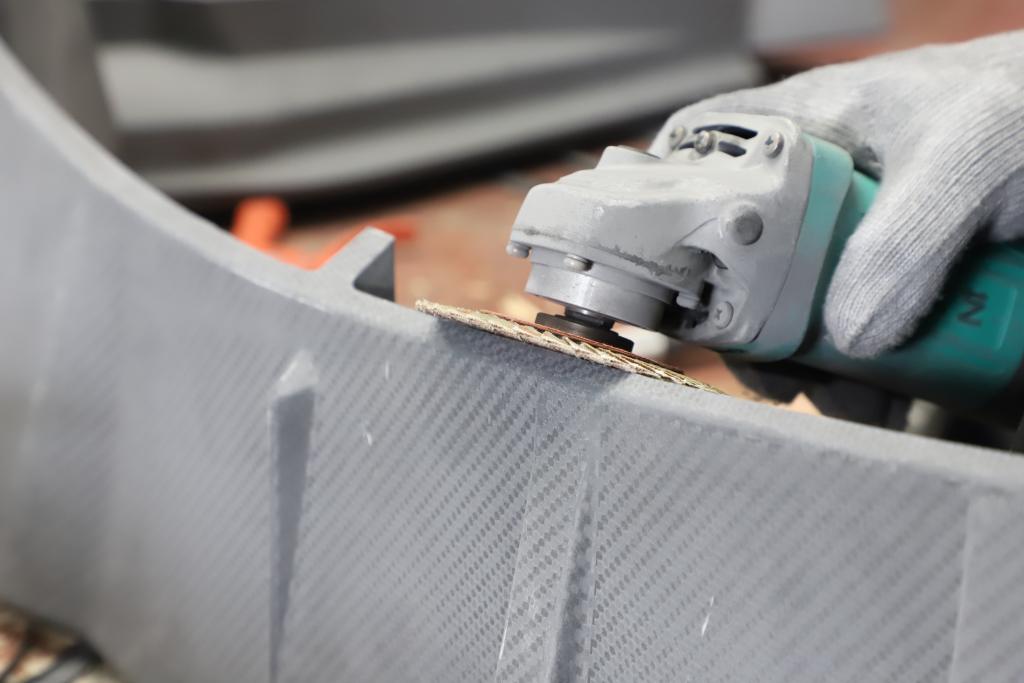
Key Manufacturing Factors: Weight, Strength, Fitment, and Surface Finish
Lightweight Structure
A well-engineered carbon fiber rear wing may achieve low product weight compared with many traditional metal solutions. Selected racing rear wing products may target around 5 kg net weight, depending on wing size, laminate structure, reinforcement, mounting hardware, and process route.
B2B buyers should not only ask for the weight number. They should also ask how that weight is achieved.
If weight is reduced by removing necessary reinforcement, the product may lose stiffness or mounting strength. The goal is to balance lightness with structural reliability.
Strength and Reinforcement
A carbon fiber rear wing typically uses carbon fiber fabric and epoxy resin to create a lightweight but stiff structure.
Key reinforcement factors include:
- fiber direction;
- layup sequence;
- resin system;
- internal reinforcement ribs;
- mounting-area reinforcement;
- bracket connection strength;
- load transfer from the wing to the vehicle.
A rear wing is not only a shell. The mounting points and bracket areas must carry aerodynamic and vibration loads. If these areas are weak, the product may fail even if the visible carbon fiber surface looks excellent.
Carbon fiber rear wings should not be described as unbreakable. Their performance depends on design, material, curing, reinforcement, installation, and usage conditions.
Fitment and Installation
Fitment matters directly to distributors and tuning shops. A product with poor fitment creates more labor, more complaints, and more after-sales pressure.
A reliable carbon fiber wing spoiler should consider:
- vehicle-specific bracket design;
- accurate hole positions;
- positioning hardware;
- mounting-point strength;
- installation instructions;
- fasteners;
- video guidance;
- online installation support where needed.
Selected products may be developed for platforms such as BMW M2, M3, and M4. For other models, custom mold development can be reviewed based on vehicle year, body dimensions, installation data, and project volume.
Surface Finish
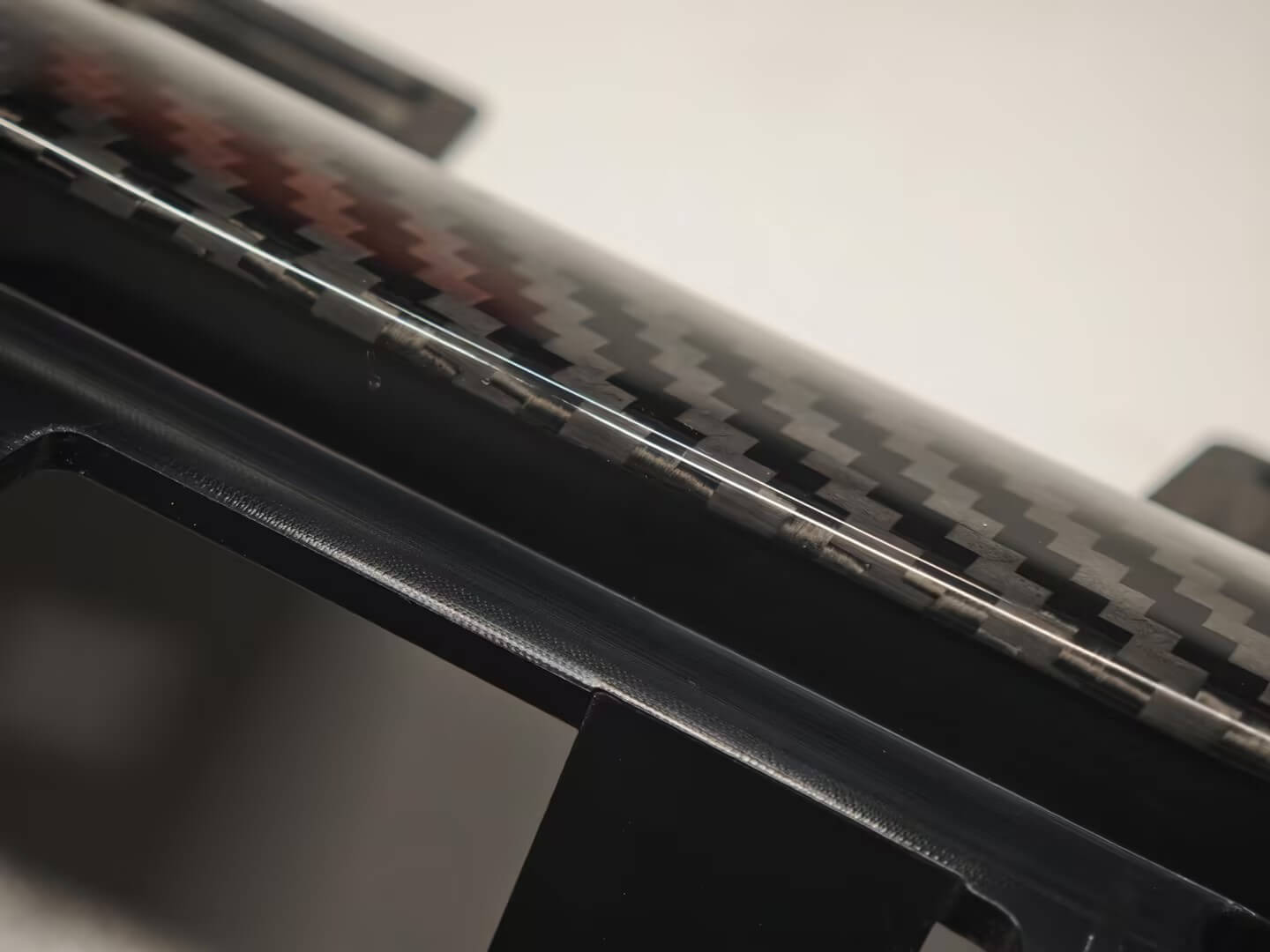
Visible carbon fiber quality is important in premium modification markets.
Buyers should review:
- smooth carbon fiber texture;
- natural weave appearance;
- gloss or matte options;
- clear-coat quality;
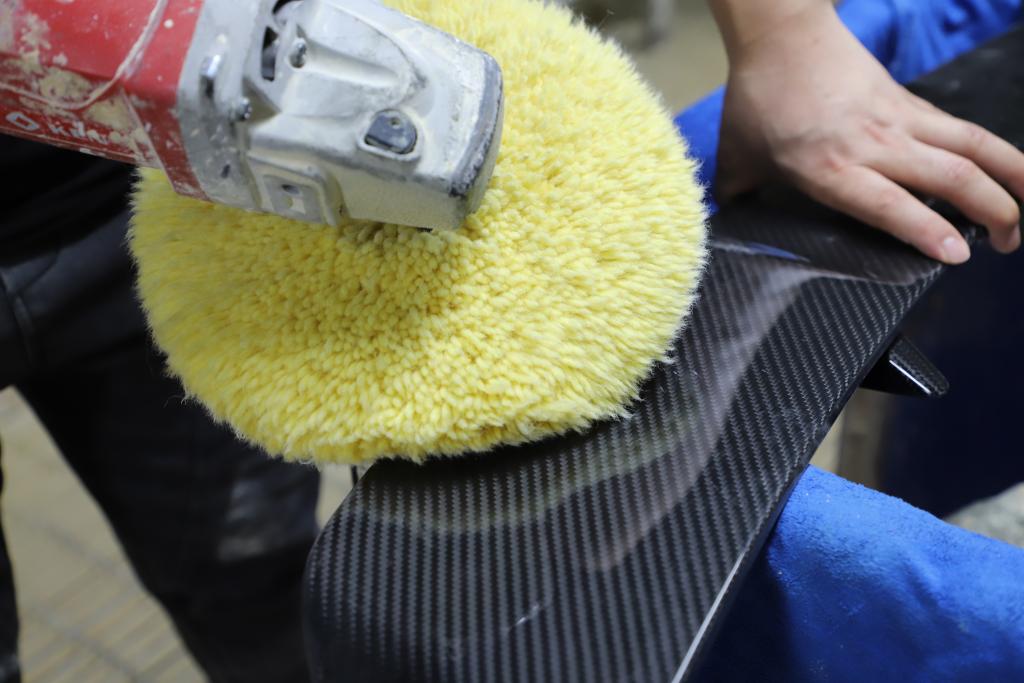
- handcrafted sanding and polishing;
- surface flatness;
- visual consistency;
- batch surface control.
Selected project standards may target surface flatness control around ≤0.1 mm depending on the product and inspection method. This should be treated as a project-specific quality reference, not a universal value for every part.
Manufacturing Process for Carbon Fiber Racing Rear Wings
The manufacturing process affects weight, stiffness, appearance, and repeatability. A typical process route for a custom carbon fiber rear wing may include the following stages.
Material and Fabric Preparation
The project begins with carbon fiber fabric and epoxy resin selection. Material choice should match the target weight, structure, appearance, production volume, and budget.
Precision fabric cutting helps improve consistency across batches. High-precision intelligent cutting machines can reduce variation in ply shape and improve layup repeatability.
Layup and Reinforcement
Controlled layup defines fiber direction, overlap, local thickness, and reinforcement. Internal ribs or reinforcement structures may be added to increase stiffness and support aerodynamic loads.
Mounting areas usually require special attention because they connect the wing to brackets and transfer load into the vehicle.
Vacuum Forming and Curing
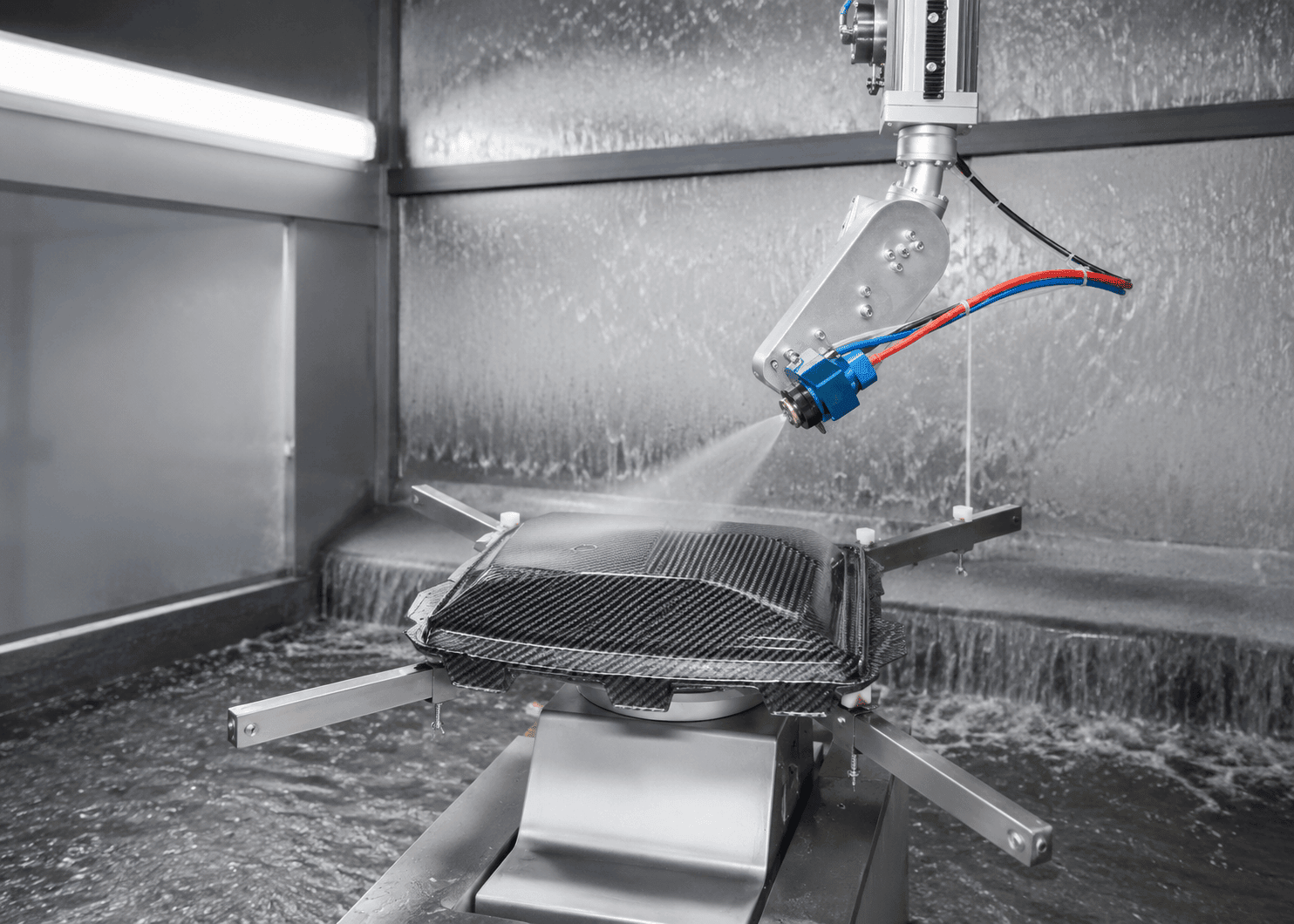
Vacuum forming and high-temperature curing help consolidate the laminate and improve structural stability. Selected products may use 120°C high-temperature curing, depending on material system and process route.
For suitable projects, large autoclave or vacuum-forming equipment can support standardized process parameters and more repeatable production.
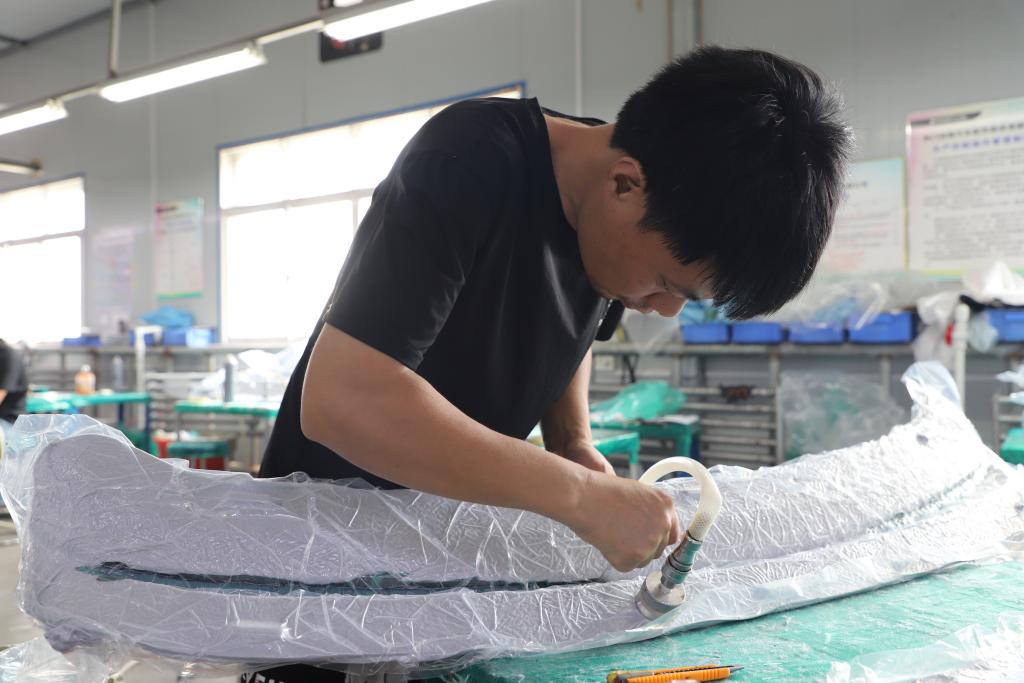
Trimming, Drilling, Sanding, and Polishing
After curing and demolding, the part is trimmed, drilled, sanded, coated, polished, and inspected.
Handcrafted sanding and polishing remain important because the rear wing is a visible exterior aero part. The finish must meet both performance and visual expectations.
Tooling and Equipment Capability
Reliable production depends on tooling accuracy and equipment control.
Relevant capabilities may include:
- high-precision CNC machining centers;
- mold accuracy references up to ±0.02 mm for suitable projects;
- intelligent fabric cutting;
- large forming or curing equipment;
- standardized parameters;
- dimensional inspection tools.
These values should be understood as capability-related or project-specific references, not automatic guarantees for every product.
How Testing Proves Aerodynamic Stability and Long-Term Durability
Testing is important because a rear wing may be used at high speed, in outdoor environments, and under repeated vibration and airflow loads.
Aerodynamic Testing
Wind tunnel testing can help optimize:
- wing profile;
- angle;
- airflow behavior;
- downforce;
- drag;
- side plate design;
- vehicle integration.
Track or racing validation may also help verify practical performance under real conditions.
Some project-specific testing may show downforce improvement or drag reduction, but actual results depend on design, vehicle platform, speed, installation angle, and testing method. Buyers should avoid assuming that one data point applies to every vehicle.
Fitment and Dimensional Inspection
Dimensional and fitment inspection helps confirm that the product can be installed correctly and repeatably.
Inspection may cover:
- wing width;
- edge lines;
- bracket position;
- hole locations;
- side plate alignment;
- mounting interface;
- installation clearance.
This is especially important for B2B buyers who sell to many installers or dealers.
Weather and Durability Testing
A carbon fiber rear wing spoiler must perform in real outdoor conditions.
Selected products may be tested through:
- -40°C to 80°C temperature cycling;
- 72-hour rain testing;
- 1000-hour UV exposure testing;
- coating and surface inspection;
- impact resistance review;
- final QC.
UV-resistant coating can help reduce fading, yellowing, and surface aging risk. Actual long-term performance still depends on resin, coating system, installation, use environment, maintenance, and storage conditions.
A two-year warranty may be offered for selected products or projects according to agreed product terms, but warranty conditions should always be confirmed before purchase.
Customization Options for Carbon Fiber Rear Wing Projects
OEM and ODM buyers often need more than a standard product. A custom carbon fiber rear wing may be developed around vehicle platform, market positioning, aerodynamic goals, and brand identity.
Customization options may include:
- vehicle model adaptation;
- wing width;
- curvature;
- angle adjustment;
- mounting height;
- bracket design;
- side plate shape;
- carbon fiber weave;
- gloss or matte finish;
- branding;
- private-label packaging;
- hardware kits;
- instruction materials.
However, customization must balance styling, aerodynamic function, structure, fitment, tooling feasibility, cost, and production volume.
For example, a more aggressive shape may look attractive, but it must still be manufacturable, stable, and installable. A wider wing may create a stronger visual impact, but it may require more reinforcement and stronger brackets.
Buyers developing new aero products can review professional carbon fiber design services to support engineering, styling, and mold planning.
How to Choose a Reliable Carbon Fiber Racing Rear Wing Manufacturer
A reliable carbon fiber racing rear wing manufacturer should provide more than a product picture and a quotation.
B2B buyers should evaluate whether the supplier can support:
- aerodynamic design;
- 3D design and engineering review;
- mold development;
- high-precision CNC machining;
- fabric cutting and layup control;
- vacuum forming or autoclave processing;
- high-temperature curing;
- reinforcement design;
- fitment validation;
- surface finishing;
- weather testing;
- quality inspection;
- traceability;
- production scheduling;
- after-sales support.
JC SPORTLINE’s Capability Focus
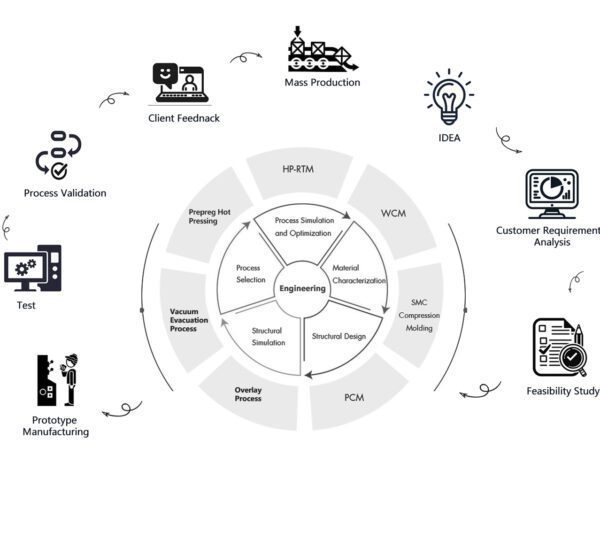
JC SPORTLINE supports carbon fiber aero part development for performance and racing applications. Its capability includes carbon fiber material application, structural design, tooling, forming, surface finishing, fitment inspection, testing, and B2B delivery support.
Relevant capability areas include:
- more than ten years of carbon fiber modification-parts experience;
- aerodynamic design support for selected projects;
- wind tunnel or track validation for suitable applications;
- vehicle-specific brackets and installation support;
- high-precision CNC tooling;
- intelligent fabric cutting;
- standardized vacuum-forming and curing processes;
- UV-resistant surface coating;
- dimensional inspection and weather testing;
- product traceability;
- AI-supported production scheduling.
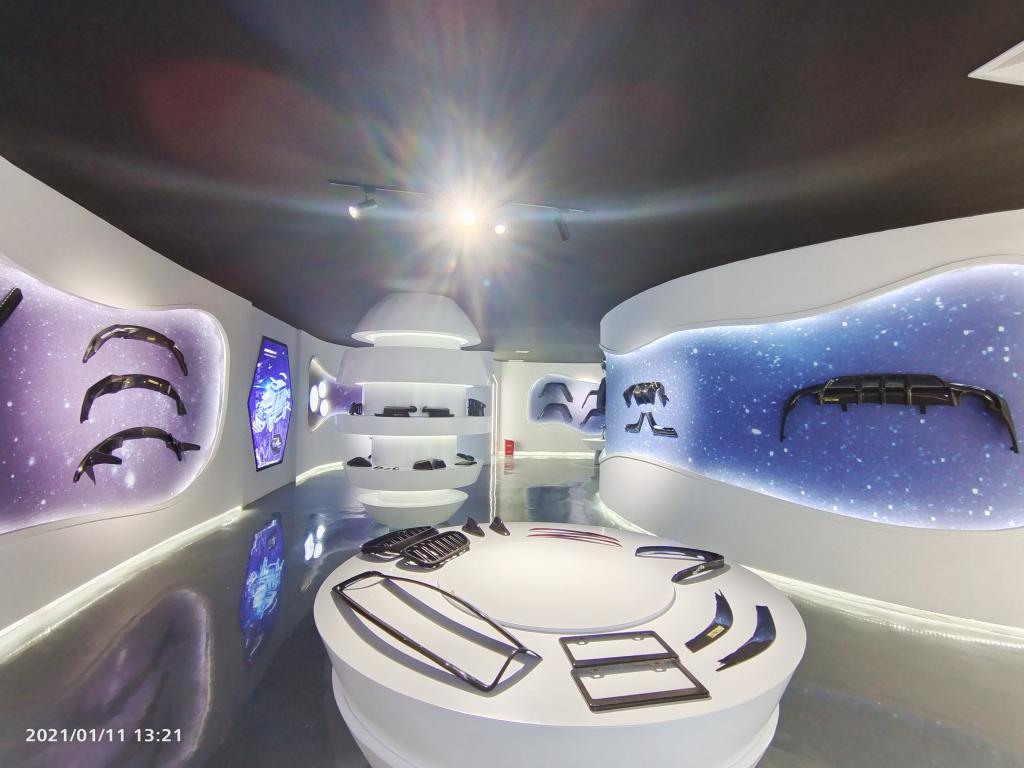
For facility and process background, buyers can review JC SPORTLINE’s carbon facilities and the autoclave dry carbon fiber racing rear wing project page.
Conclusion: Choose Rear Wings by Engineering Value, Not Appearance Alone
A carbon fiber racing rear wing is most valuable when it combines lightweight design, aerodynamic logic, structural reinforcement, accurate fitment, premium surface finish, and verified durability.
For B2B buyers, the best rear wing is not simply the most aggressive-looking product. It is the product that can be installed efficiently, perform reliably, support the brand’s market positioning, and be produced consistently across batches.
If your company is developing or sourcing carbon fiber aero parts for racing, performance vehicles, or premium modification projects, contact an experienced carbon fiber racing rear wing manufacturer for aerodynamic design support, tooling review, testing, fitment validation, surface options, and scalable B2B production.
FAQ
What is a carbon fiber rear wing?
A carbon fiber rear wing is an aerodynamic exterior part made from carbon fiber composite materials. It is designed to reduce weight while supporting stiffness, performance styling, and, when properly engineered, aerodynamic function.
Is a carbon fiber racing rear wing only for appearance?
No. A racing rear wing should not be treated only as decoration. For performance projects, it may support high-speed stability, downforce control, and motorsport styling. However, actual aerodynamic results depend on design, vehicle platform, installation angle, and testing.
Which vehicle models can a carbon fiber rear wing fit?
Selected products may support BMW M2, M3, and M4 platforms. For other models, custom development can be reviewed based on vehicle year, body dimensions, mounting structure, target quantity, and project data.
Does installation require professional support?
Professional tuning shops or experienced installers are recommended. Depending on the project, products may include vehicle-specific brackets, fasteners, positioning hardware, installation instructions, video guidance, and online support.
How durable is a carbon fiber rear wing in extreme weather?
Selected products may undergo -40°C to 80°C temperature cycling, 72-hour rain testing, and 1000-hour UV exposure testing. UV-resistant coating can help reduce aging and fading risk, but long-term performance depends on material, resin, coating, installation, use environment, and maintenance.
How should B2B buyers choose a carbon fiber rear wing supplier?
B2B buyers should evaluate aerodynamic design capability, mold accuracy, carbon fiber process control, reinforcement design, fitment validation, surface finishing, weather testing, installation support, batch quality, traceability, and delivery planning.